
Quick Answer
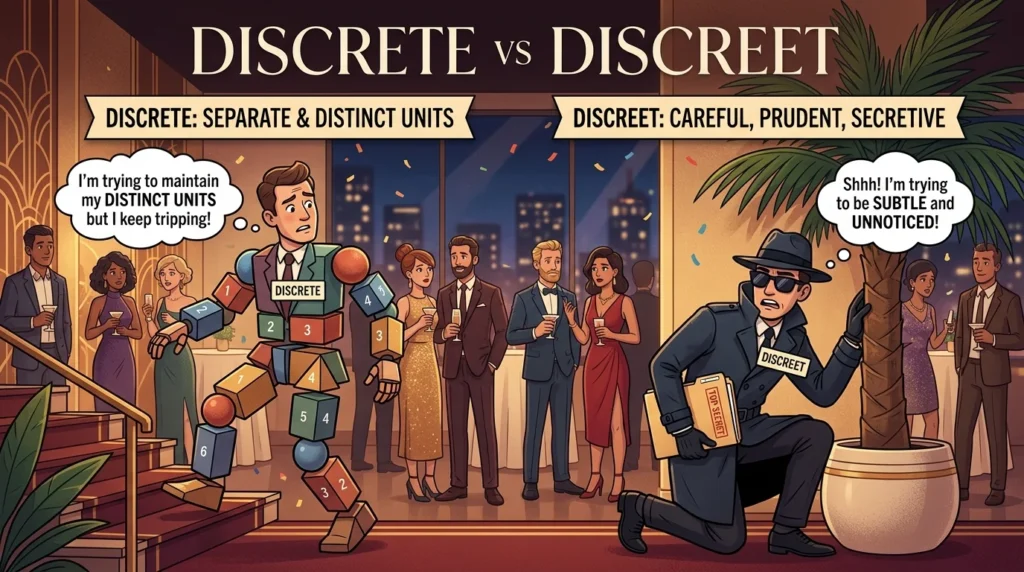
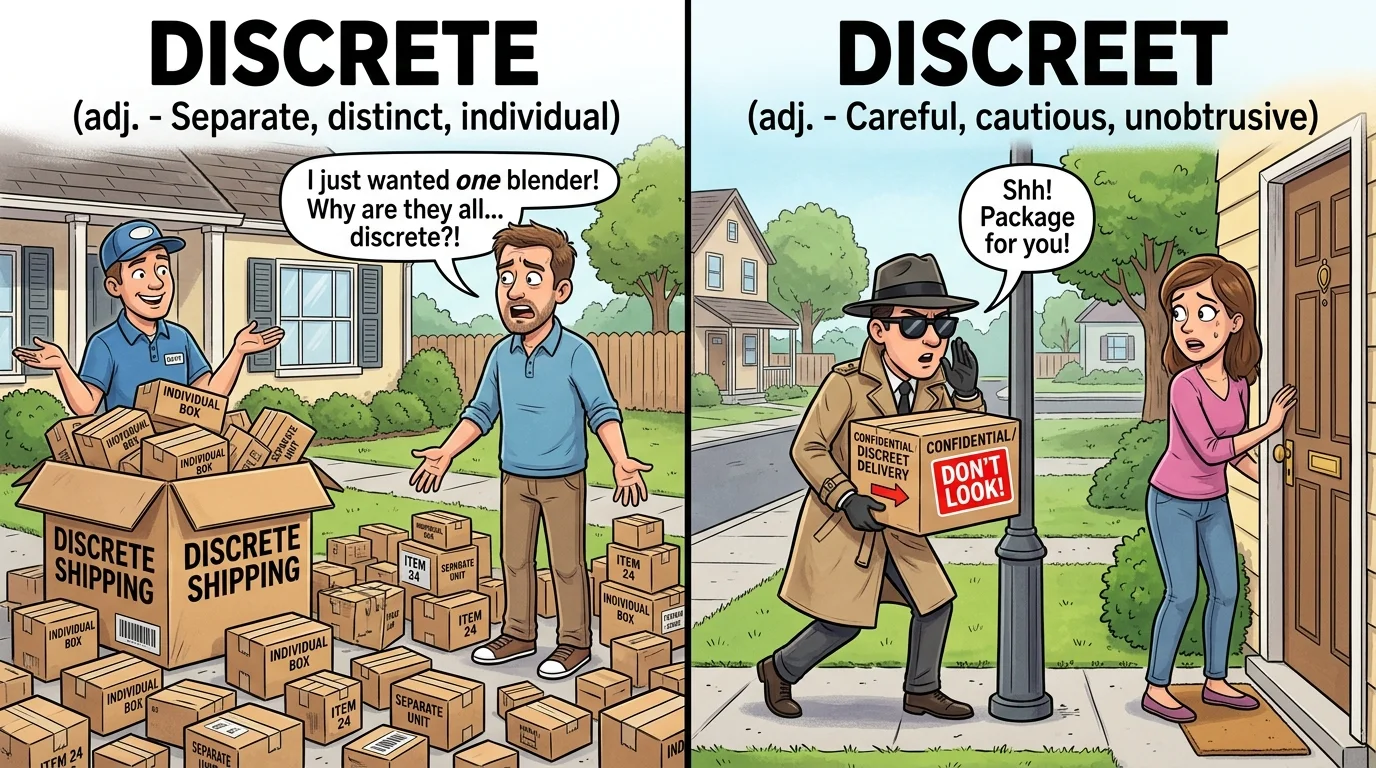
Discrete means separate, distinct, or individually identifiable.
Discreet means careful, tactful, and cautious in speech or behavior, especially to avoid causing embarrassment or attracting attention.
Simply put, discrete describes things that are separate, while discreet describes people or actions that are careful and tactful.
What Does “Discrete” Mean?
Discrete refers to things that are separate, distinct, or individually separate from one another. The word is commonly used in mathematics, science, business, and everyday English.
Usage Rules
Use discrete when referring to:
- Separate parts or categories
- Individual units or elements
- Distinct groups or systems
- Items that are not connected or continuous
Examples
- The report divides the project into three discrete phases.
- The company operates through several discrete business units.
- In mathematics, discrete data consists of separate values.
Key Insight: If something can be separated into individual parts, discrete is usually the correct word.
What Does “Discreet” Mean?
Discreet describes someone or something that is careful, tactful, and avoids drawing unnecessary attention.
Usage Rules
Use discreet when referring to:
- Being careful with sensitive information
- Acting tactfully in social situations
- Remaining unobtrusive or private
- Showing good judgment and caution
Examples
- She was discreet about discussing the family’s financial situation.
- The hotel offers discreet services for high-profile guests.
- He made a discreet inquiry about the job opening.
Key Insight: If the sentence involves caution, privacy, or tact, use discreet.
Discrete vs Discreet: Key Differences
Bullet Differences
- Meaning: Discrete means separate; discreet means careful and tactful.
- Function: Discrete describes things or categories; discreet describes behavior or actions.
- Context: Discrete is common in science, mathematics, and business; discreet is common in social and professional situations.
- Usage: Discrete emphasizes separation; discreet emphasizes caution and privacy.
- Common Mistake: Writers often confuse the words because they differ by only one letter.
| Feature | Discrete | Discreet |
|---|---|---|
| Meaning | Separate or distinct | Careful and tactful |
| Function | Describes things or categories | Describes behavior or actions |
| Context | Mathematics, science, business | Social and professional communication |
| Focus | Separation | Privacy and caution |
| Example | The process has three discrete stages. | She remained discreet about the matter. |
Real-World Usage Scenarios
Scenario 1
Incorrect: “The company consists of several discreet divisions.”
Correct: “The company consists of several discrete divisions.”
🎯 Lesson: Divisions are separate units, so use discrete.
Scenario 2
Incorrect: “Please be discrete about my personal information.”
Correct: “Please be discreet about my personal information.”
🎯 Lesson: Protecting private information requires tact and caution, so use discreet.
Scenario 3
Incorrect: “The survey grouped responses into discreet categories.”
Correct: “The survey grouped responses into discrete categories.”
🎯 Lesson: Categories are separate groups, making discrete the correct choice.
Scenario 4
Incorrect: “The reporter remained discrete while investigating the story.”
Correct: “The reporter remained discreet while investigating the story.”
🎯 Lesson: The reporter’s behavior is careful and unobtrusive, so use discreet.
Common Mistakes
Mistake 1: Using “Discreet” to Mean Separate
Why it happens: The words look and sound nearly identical.
Correction: If you mean distinct or separate, use discrete.
Mistake 2: Using “Discrete” to Mean Tactful
Why it happens: Many people cannot remember which spelling refers to careful behavior.
Correction: If someone is acting cautiously or privately, use discreet.
Mistake 3: Ignoring Context
Why it happens: Writers focus on spelling rather than meaning.
Correction: Determine whether the sentence discusses separation or caution.
Memory Tricks to Remember the Difference
Trick 1
Discrete = Separate
The word contains the letters “et”, which you can remember as “each thing” being separate.
Trick 2
Discreet = Keep a Secret
The word discreet contains double e’s in the middle.
Think:
The two e’s represent two eyes keeping a secret.
Trick 3
Ask yourself:
Am I talking about separate things or careful behavior?
- Separate things → Discrete
- Careful behavior → Discreet
Trick 4
Remember this simple rule:
Discrete things are divided. Discreet people are careful.
Expert Insight
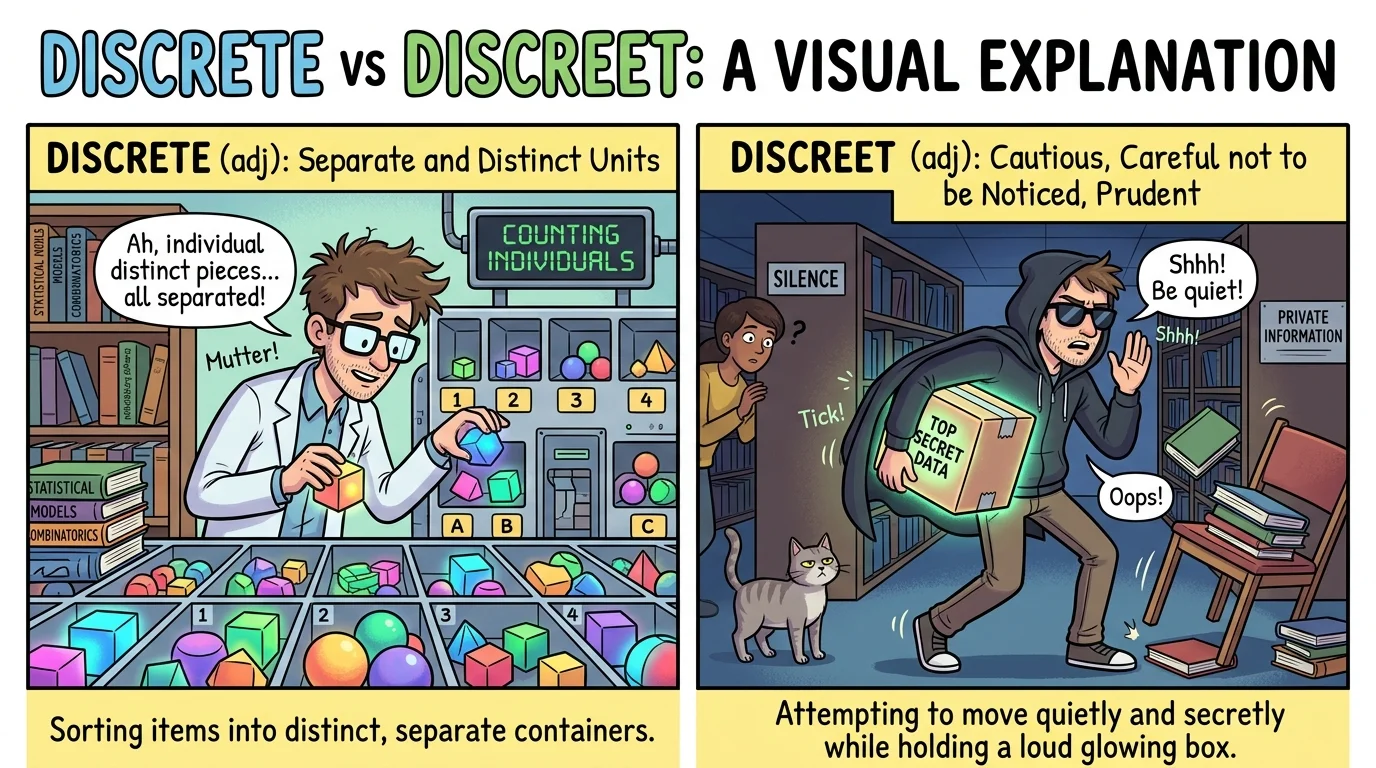
The words discrete and discreet both originate from the Latin verb meaning “to separate.” Over time, however, they developed different meanings in English.
Discrete retained the idea of separation and distinction. This is why it is frequently used in mathematics, science, and technical writing.
Discreet, on the other hand, evolved to describe careful judgment and tactful behavior. A discreet person knows how to separate private information from public discussion and acts with caution.
Because the words share similar origins and pronunciations, even experienced writers occasionally confuse them. Paying attention to context is the best way to choose the correct spelling.