
Quick Answer
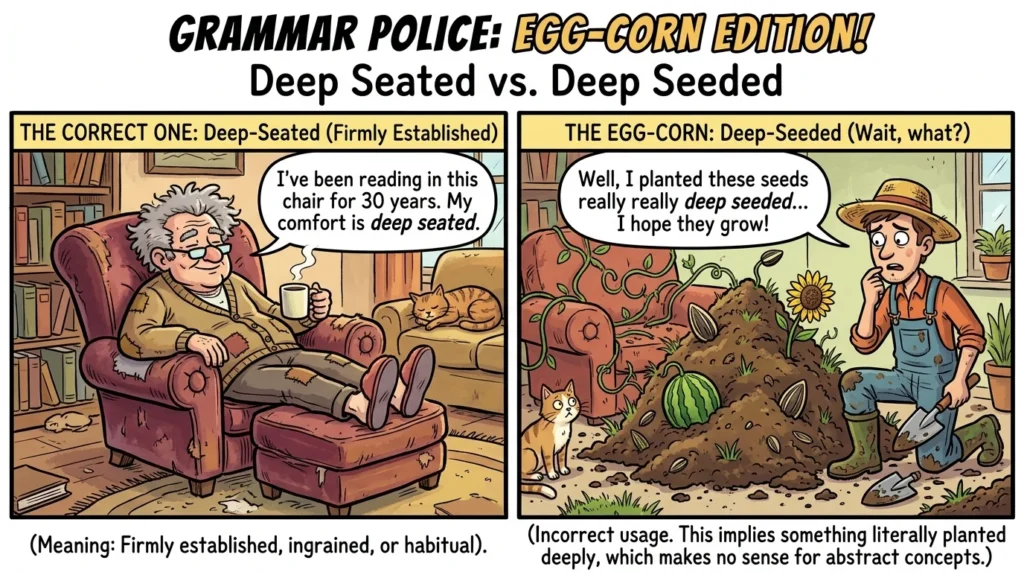
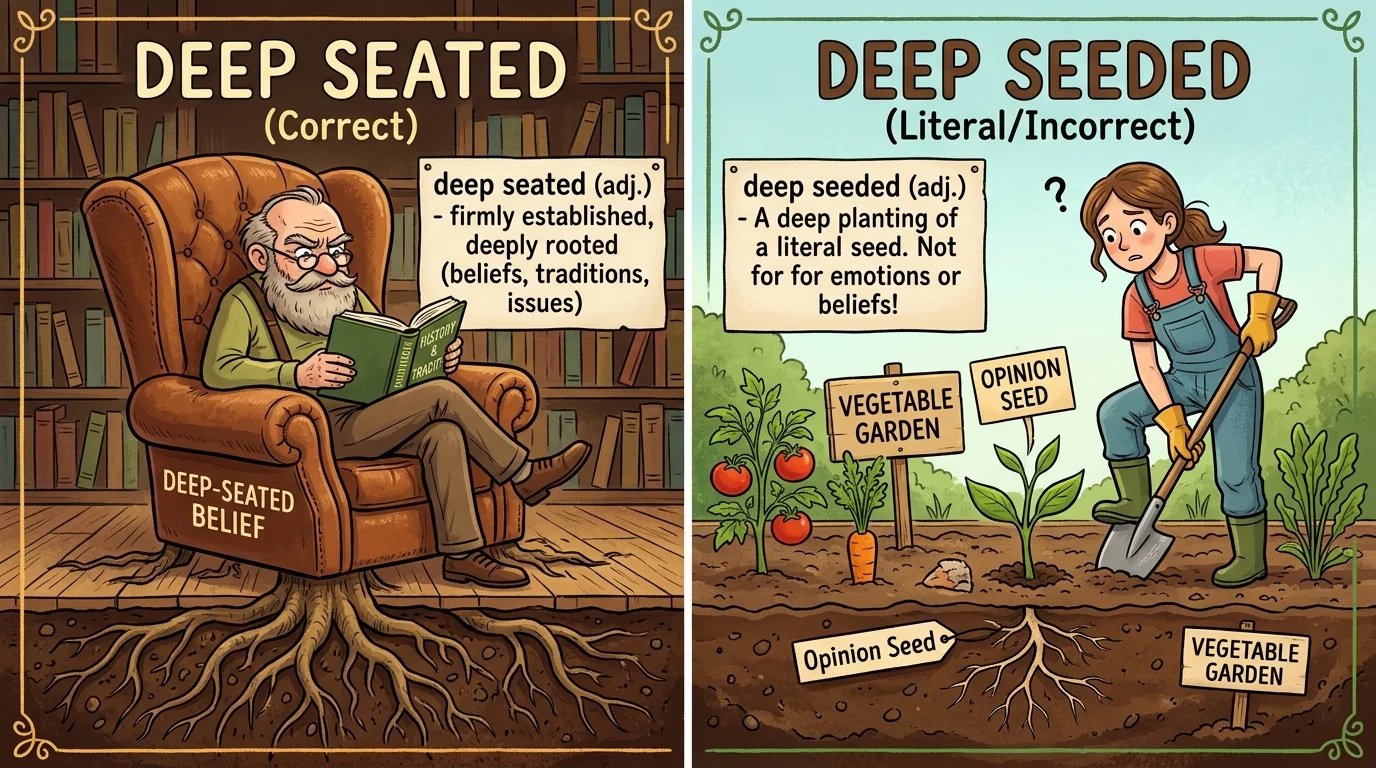
Deep-seated is the correct expression. It means something is firmly established, strongly rooted, or difficult to change, such as beliefs, fears, habits, or emotions.
Deep-seeded is usually a misspelling or mishearing of deep-seated and is generally not considered standard English.
Simply put, deep-seated is correct, while deep-seeded is usually incorrect.
What Does “Deep-Seated” Mean?
Deep-seated means something is firmly established or embedded in a person’s mind, emotions, habits, or society. The phrase suggests that an idea, feeling, or problem has become deeply ingrained over time.
Usage Rules
Use deep-seated when referring to:
- Strong beliefs or opinions
- Long-standing fears or anxieties
- Entrenched habits or behaviors
- Deep emotional issues
- Persistent social or cultural problems
Examples
- She has a deep-seated fear of public speaking.
- The community faces deep-seated economic challenges.
- His deep-seated belief in honesty shaped his decisions.
Key Insight: The phrase often describes things that are difficult to change because they have existed for a long time.
What Does “Deep-Seeded” Mean?
Strictly speaking, deep-seeded is not the standard expression in modern English. Most of the time, people use it when they actually mean deep-seated.
Why People Use “Deep-Seeded”
- The phrase sounds similar to deep-seated.
- People associate ideas and emotions with something that grows from a seed.
- They learned the expression through speech rather than reading.
Examples of Incorrect Usage
Incorrect:
- She has a deep-seeded fear of failure.
- The country struggles with deep-seeded social issues.
Correct:
- She has a deep-seated fear of failure.
- The country struggles with deep-seated social issues.
Key Insight: In professional, academic, and formal writing, choose deep-seated.
Deep-Seeded vs Deep-Seated: Key Differences
Bullet Differences
- Meaning: Deep-seated means firmly established; deep-seeded is generally a mistaken variation.
- Usage: Deep-seated is accepted in standard English; deep-seeded is usually considered incorrect.
- Origin: Deep-seated comes from the idea of something being firmly “seated” or settled deeply.
- Context: Deep-seated appears in formal and informal writing; deep-seeded should generally be avoided.
- Common Mistake: People assume the phrase refers to seeds growing deeply.
| Feature | Deep-Seated | Deep-Seeded |
|---|---|---|
| Meaning | Firmly established or ingrained | Usually a mistaken variation |
| Usage | Correct expression | Generally incorrect |
| Origin | From something deeply settled or seated | Misinterpretation involving seeds |
| Context | Formal and informal writing | Best avoided |
| Example | Deep-seated fear of failure | Usually considered incorrect |
Real-World Usage Scenarios
Scenario 1
Incorrect: “He has a deep-seeded distrust of politicians.”
Correct: “He has a deep-seated distrust of politicians.”
🎯 Lesson: Long-standing beliefs and feelings are deep-seated, not deep-seeded.
Scenario 2
Incorrect: “The company has deep-seeded management problems.”
Correct: “The company has deep-seated management problems.”
🎯 Lesson: Persistent problems are described as deep-seated.
Scenario 3
Incorrect: “Her deep-seeded fear prevents her from flying.”
Correct: “Her deep-seated fear prevents her from flying.”
🎯 Lesson: Emotional fears and anxieties are typically deep-seated.
Scenario 4
Incorrect: “The nation faces deep-seeded inequality.”
Correct: “The nation faces deep-seated inequality.”
🎯 Lesson: Social and cultural issues are commonly described as deep-seated.
Common Mistakes
Mistake 1: Writing “Deep-Seeded”
Why it happens: The phrase sounds logical because ideas and emotions can seem like seeds that grow.
Correction: The standard expression is deep-seated.
Mistake 2: Assuming Both Forms Are Equally Correct
Why it happens: The incorrect form appears occasionally in speech and informal writing.
Correction: In professional and edited writing, use deep-seated.
Mistake 3: Avoiding the Phrase Altogether
Why it happens: Writers become uncertain about which version is correct.
Correction: Simply remember that deep-seated is the accepted expression.
Memory Tricks to Remember the Difference
Trick 1
Think of deep-seated as something that has been sitting in place for a long time.
Seated = Settled.
Trick 2
Ask yourself:
Has this belief or problem become firmly established?
If the answer is yes, use deep-seated.
Trick 3
Remember this simple rule:
Problems become deep-seated because they are deeply settled, not because they were planted like seeds.
Expert Insight
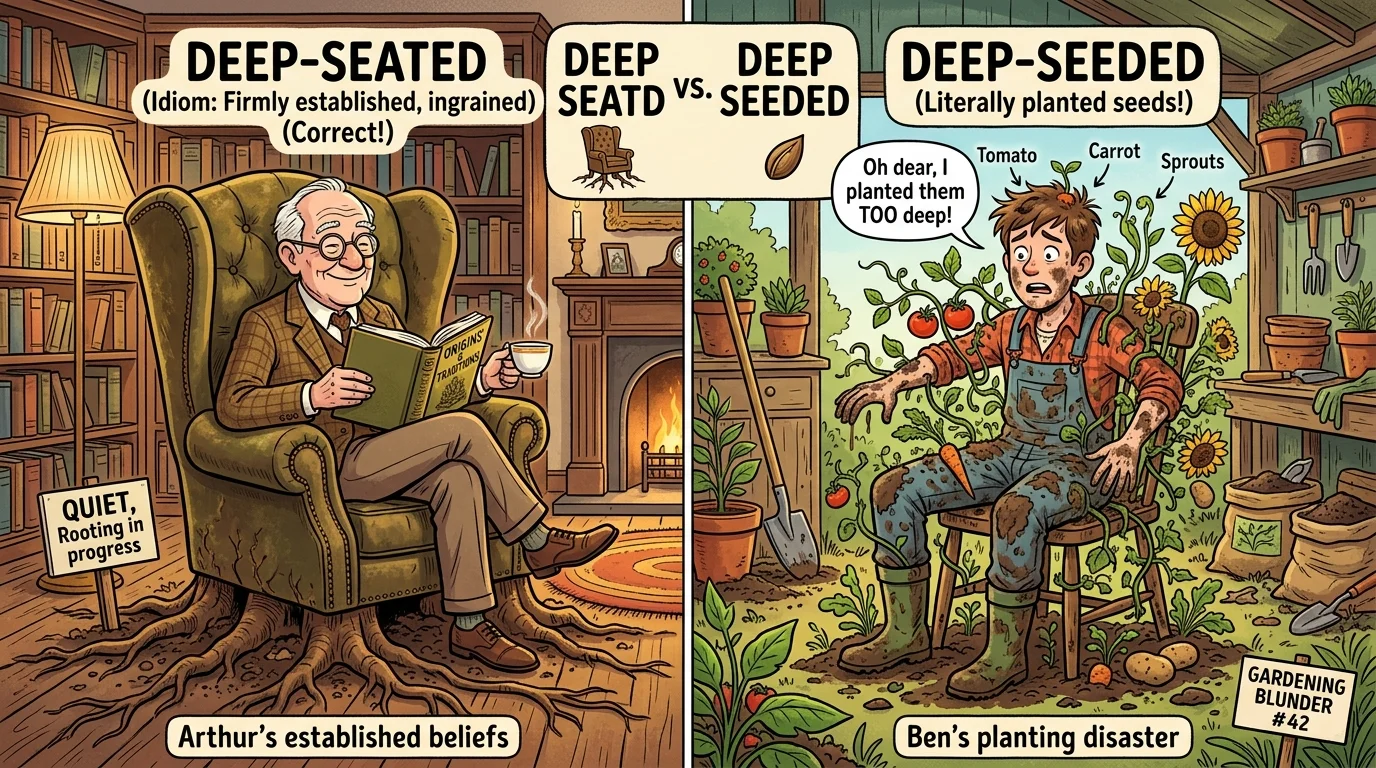
The phrase deep-seated dates back several centuries and originally referred to something firmly fixed or settled in a deep position. Over time, English speakers began using it metaphorically to describe beliefs, emotions, and conditions that are firmly ingrained.
The popularity of deep-seeded demonstrates a linguistic phenomenon known as an eggcorn, where people replace an unfamiliar expression with a similar-sounding phrase that seems more logical. Since emotions and ideas often appear to “grow” like seeds, many speakers naturally adopt the incorrect version.
However, dictionaries, style guides, editors, and professional writers overwhelmingly prefer deep-seated as the standard expression.