
Quick Answer
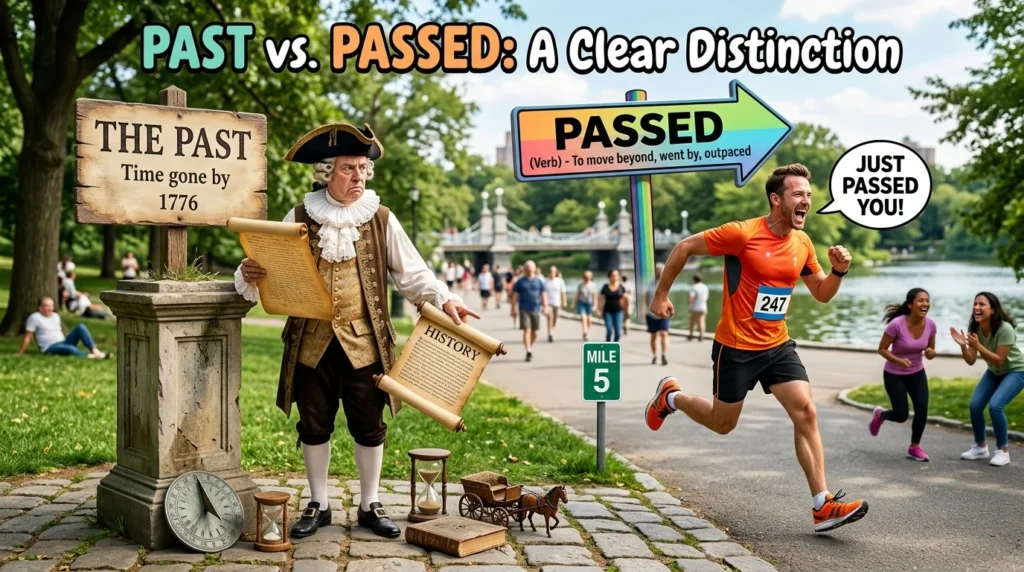
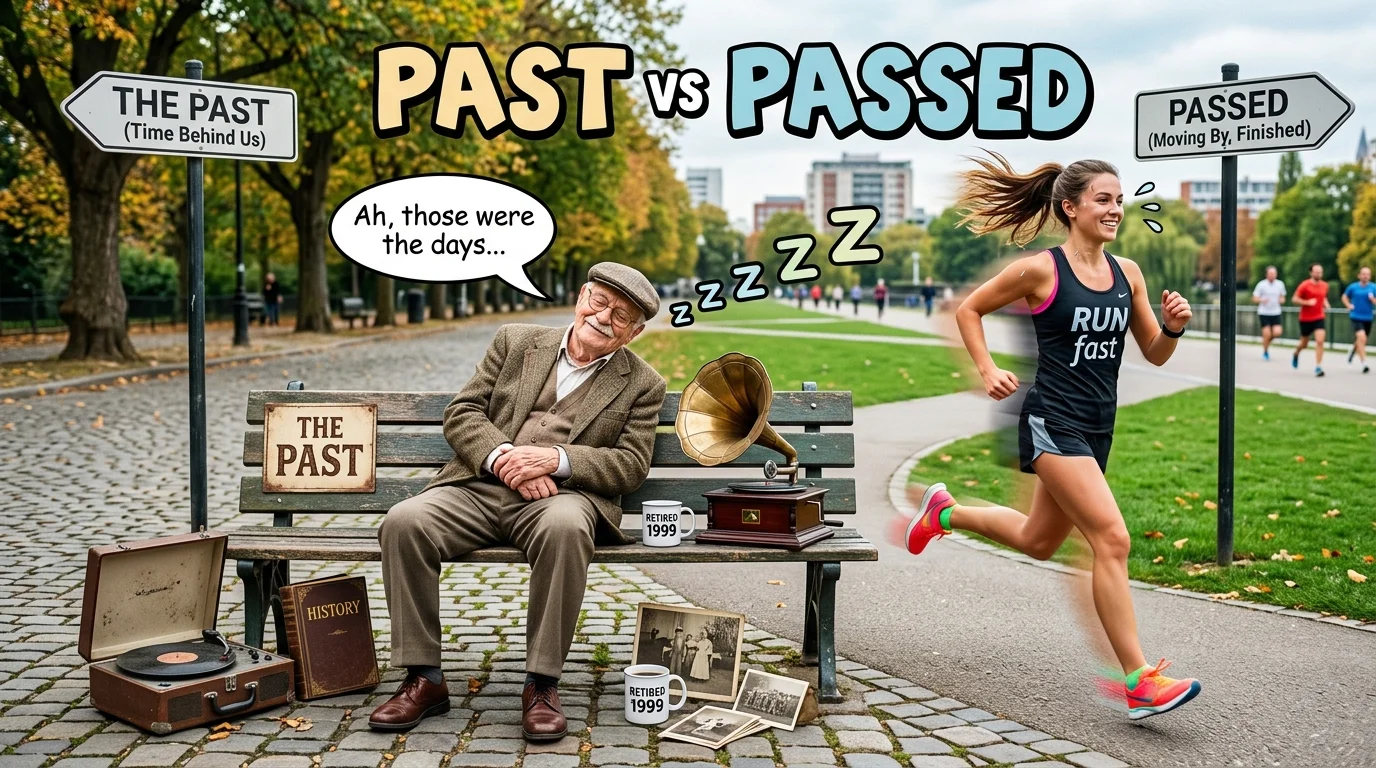
Past is usually a noun, adjective, preposition, or adverb related to a previous time or a position beyond something.
Passed is always a verb. It is the past tense and past participle of pass, meaning to move beyond, go by, hand over, or succeed.
Simply put, past refers to time or position, while passed describes an action.
What Does “Past” Mean?
Past generally refers to something that has already happened or a position beyond a particular point. Unlike passed, it is not typically used as a verb.
Usage Rules
Use past when:
- Referring to an earlier time
- Describing a position beyond something
- Talking about previous experiences or events
- Indicating movement beyond a place
Examples
- We cannot change the past.
- It is half past eight.
- She walked past the library.
- During the past year, sales increased significantly.
Key Insight: If you are talking about time, history, or a position beyond something, you probably need past.
What Does “Passed” Mean?
Passed is the past tense of the verb pass. It describes an action that has already happened.
Usage Rules
Use passed when:
- Something moved by or beyond another thing
- Someone succeeded in a test or examination
- An object was handed to someone
- Time elapsed
- A law or proposal was approved
Examples
- She passed me on the highway.
- He passed the driving test.
- The teacher passed the papers to the students.
- Several hours passed before we heard the news.
Key Insight: Since passed is a verb, it always expresses an action.
Past vs Passed: Key Differences
Bullet Differences
- Meaning: Past refers to time or position; passed describes an action.
- Function: Past can function as several parts of speech; passed is always a verb.
- Usage: Past discusses previous events or locations; passed shows something happened or moved.
- Grammar: Past is usually descriptive; passed is action-oriented.
- Common Mistake: People often write “I passed your house” as “I past your house.”
| Feature | Past | Passed |
|---|---|---|
| Meaning | Previous time or beyond a point | Moved, succeeded, or went by |
| Part of Speech | Noun, adjective, preposition, adverb | Verb |
| Function | Describes time or position | Expresses action |
| Example | She walked past the store. | She passed the store. |
| Related To | Time and location | Actions and events |
Real-World Usage Scenarios
Scenario 1
Incorrect: “I past your house yesterday.”
Correct: “I passed your house yesterday.”
🎯 Lesson: Since driving by your house is an action, use passed.
Scenario 2
Incorrect: “Forget about the passed.”
Correct: “Forget about the past.”
🎯 Lesson: When referring to previous events or history, use past.
Scenario 3
Incorrect: “Two hours past before dinner.”
Correct: “Two hours passed before dinner.”
🎯 Lesson: Since time elapsed, use the action verb passed.
Scenario 4
Incorrect: “She walked passed the bank.”
Correct: “She walked past the bank.”
🎯 Lesson: The expression walked past uses past as a preposition.
Scenario 5
Incorrect: “He finally past the exam.”
Correct: “He finally passed the exam.”
🎯 Lesson: Passing an exam is an action, so use passed.
Common Mistakes
Mistake 1: Writing “Walked Passed”
Why it happens: People hear the words the same way and assume they are interchangeable.
Correction: The correct phrase is walked past.
Mistake 2: Writing “The Passed”
Why it happens: Writers confuse the verb with the noun.
Correction: When referring to history or earlier times, use the past.
Mistake 3: Using “Past” as a Verb
Why it happens: The identical pronunciation creates confusion.
Correction: Remember that passed is the verb form.
Memory Tricks to Remember the Difference
Trick 1
Passed = Action
The word contains -ed, a common ending for past-tense verbs.
Think:
Passed = Something happened.
Trick 2
Past = Time or Position
Think:
The past happened before now.
Trick 3
Ask yourself this question:
Is there an action?
- Yes → Use passed
- No → Use past
Trick 4
Remember this simple rule:
You passed a test, but the test is now in the past.
Expert Insight
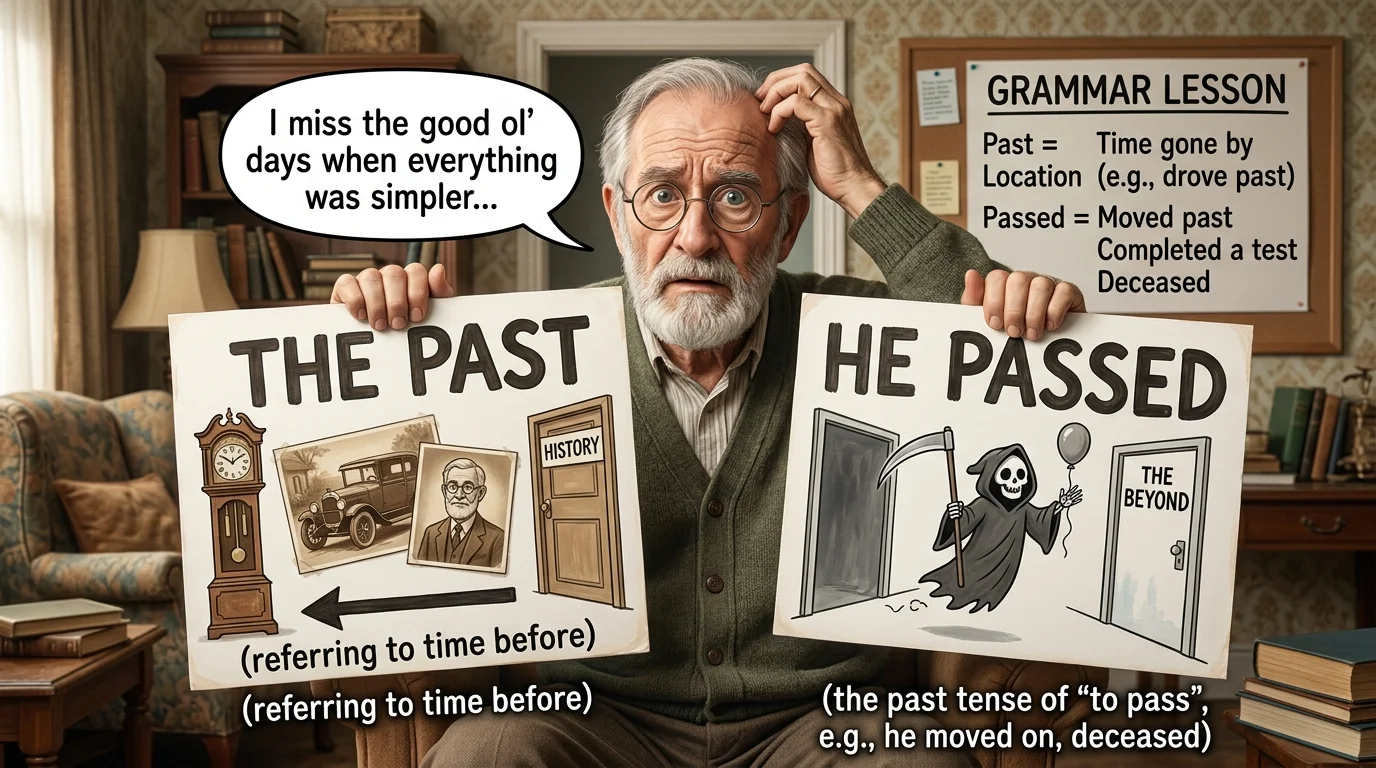
The confusion between past and passed occurs because they are perfect homophones, meaning they have identical pronunciations but different meanings and grammatical functions.
The word past comes from historical forms referring to what has gone by, while passed developed as the past tense of the verb pass. Modern English preserves both words because they perform different grammatical roles.
Professional writers often use a simple test: if the sentence needs a verb that describes an action, they choose passed. If the sentence refers to time, direction, or position, they use past.