

Quick Answer
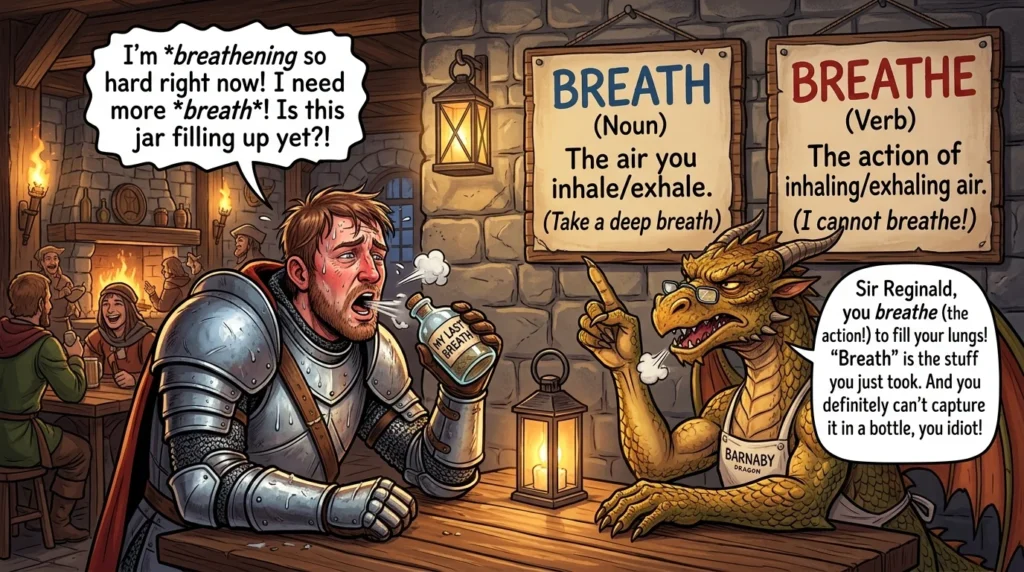
Breath is a noun that refers to the air you inhale and exhale or a single act of breathing.
Breathe is a verb that means to inhale and exhale air.
Simply put, you take a breath, but you breathe.
What Does “Breath” Mean?
Breath refers to the air that goes into and out of your lungs or one complete act of inhaling and exhaling. Since it is a noun, it names a thing or an action.
Usage Rules
Use breath when referring to:
- The air coming from your lungs
- A single inhalation or exhalation
- A moment of rest or recovery
Examples
- She took a deep breath before speaking.
- After running, he was short of breath.
- The cold air took my breath away.
Key Insight: Since breath is a noun, it usually follows words like a, the, deep, short, or fresh.
What Does “Breathe” Mean?
Breathe means to inhale and exhale air. It is a verb, so it describes an action.
Usage Rules
Use breathe when:
- Talking about the act of inhaling and exhaling
- Giving instructions to relax
- Describing someone’s ability to get air
Examples
- Remember to breathe slowly during meditation.
- It became difficult to breathe because of the smoke.
- She stopped to breathe after climbing the stairs.
Key Insight: Since breathe is a verb, it often appears after words like can, could, should, must, and to.
Breath vs Breathe: Key Differences
Bullet Differences
- Meaning: Breath is the air you take in and release; breathe is the act of inhaling and exhaling.
- Function: Breath is a noun; breathe is a verb.
- Usage: You take a breath, but you breathe.
- Pronunciation: Breath ends with a soft “th” sound, while breathe ends with a “th” sound similar to the word “this.”
- Common Mistake: People often use one word when they need the other.
| Feature | Breath | Breathe |
|---|---|---|
| Meaning | Air inhaled and exhaled | To inhale and exhale |
| Part of Speech | Noun | Verb |
| Function | Names a thing | Describes an action |
| Example | Take a deep breath. | Please breathe slowly. |
| Pronunciation | Ends with a soft “th” sound | Ends with a voiced “th” sound |
Real-World Usage Scenarios
Scenario 1
Incorrect: “Take a deep breathe.”
Correct: “Take a deep breath.”
🎯 Lesson: After the article a, you usually need a noun, so use breath.
Scenario 2
Incorrect: “I can’t breath.”
Correct: “I can’t breathe.”
🎯 Lesson: After modal verbs like can, use the verb breathe.
Scenario 3
Incorrect: “She took a breathe before answering.”
Correct: “She took a breath before answering.”
🎯 Lesson: The phrase take a breath always uses the noun.
Scenario 4
Incorrect: “Remember to breath slowly.”
Correct: “Remember to breathe slowly.”
🎯 Lesson: After to, use the verb breathe.
Scenario 5
Incorrect: “After running, I needed to catch my breathe.”
Correct: “After running, I needed to catch my breath.”
🎯 Lesson: The expression catch your breath always uses the noun.
Common Mistakes
Mistake 1: Writing “Take a Deep Breathe”
Why it happens: People assume both words are interchangeable.
Correction: Since you are naming something, use breath.
Mistake 2: Writing “I Can’t Breath”
Why it happens: The words look almost identical.
Correction: Since you are describing an action, use breathe.
Mistake 3: Ignoring Part of Speech
Why it happens: Writers focus on pronunciation rather than grammar.
Correction: Ask yourself whether you need a noun or a verb.
Memory Tricks to Remember the Difference
Trick 1
Breath = Noun
Think of the phrase:
Take a breath.
You can take a thing, not an action.
Trick 2
Breathe = Verb
The extra E at the end can remind you of the word exhale, which is also an action.
Trick 3
Remember this simple rule:
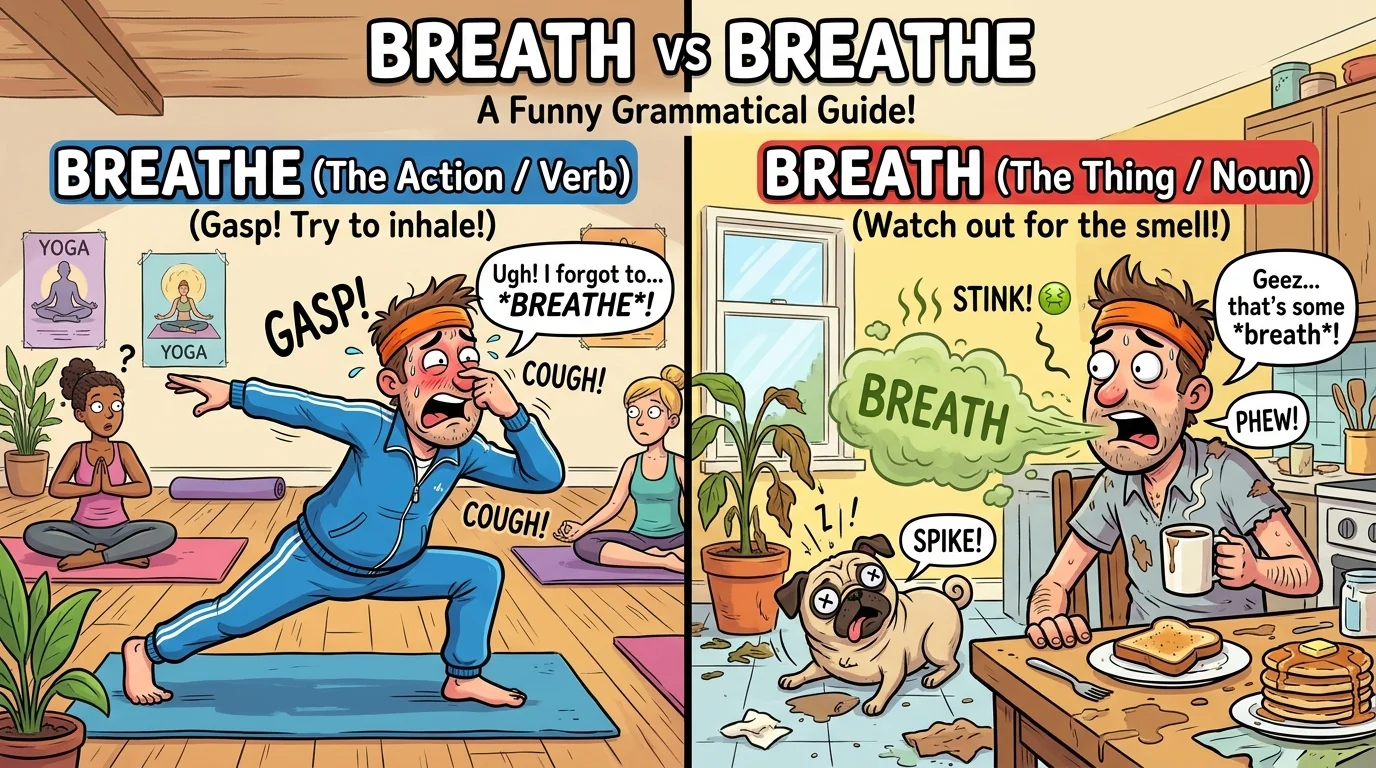
Breath is the thing. Breathe is the action.
Expert Insight
The words breath and breathe come from the same historical root in English. Over time, the language developed two forms to serve different grammatical purposes.
English commonly creates noun and verb pairs that are closely related in spelling and meaning. However, even a single letter can completely change the grammatical role of a word.
Professional writers and editors often identify the correct word by looking at the sentence structure first. If the sentence needs an object or thing, they use breath. If it needs an action, they choose breathe.