
Quick Answer
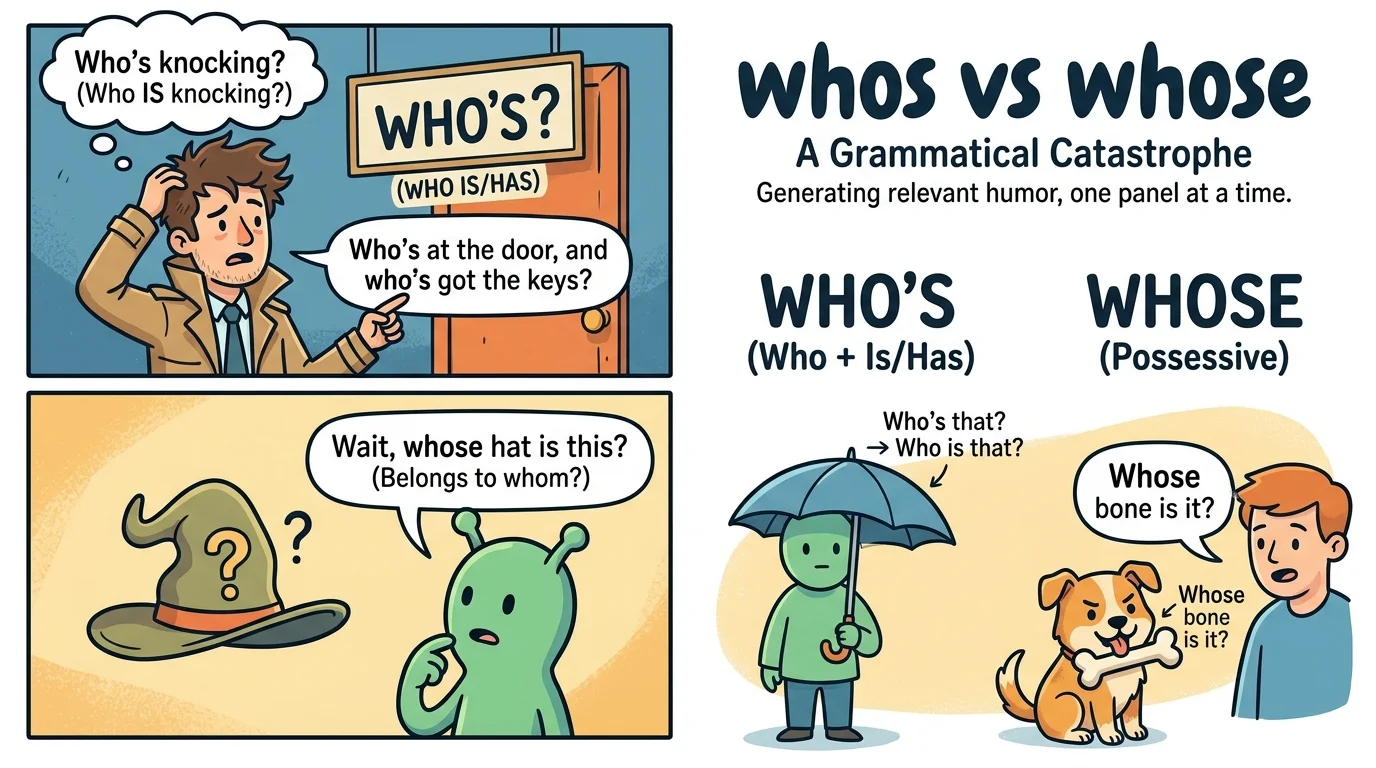
Whose is the correct word when showing ownership or possession.
Whos is generally considered incorrect and is usually a misspelling of either whose or who’s.
Examples:
- Correct: Whose jacket is this?
- Incorrect: Whos jacket is this?
If you’re asking who owns something, use whose.
What Does “Whose” Mean?
Whose is a possessive pronoun and determiner used to ask or indicate ownership.
It means:
- Belonging to whom
- Owned by whom
Usage Rules
Use whose when referring to possession or ownership.
Examples
- Whose phone is ringing?
- Do you know whose car is parked outside?
- She found the person whose wallet was missing.
Key Insight
If you can replace the word with “belonging to whom”, then whose is correct.
Example:
- Whose book is this?
- Belonging to whom is this book?
The sentence still makes sense, confirming that whose is the correct choice.
What Does “Whos” Mean?
Whos is generally not recognized as a standard English word.
Most of the time, people accidentally write whos when they mean:
- Whose (possessive)
- Who’s (contraction of “who is” or “who has”)
Examples of Incorrect Usage
- Whos coming to the party?
- Whos backpack is on the floor?
Correct Versions
- Who’s coming to the party?
- Whose backpack is on the floor?
Key Insight
Whenever you see whos without an apostrophe, it is almost always a spelling error.
Whos vs Whose: Key Differences
Quick Comparison
- Whose = shows ownership
- Whos = usually a misspelling
Comparison Table
| Feature | Whos | Whose |
|---|---|---|
| Meaning | Usually incorrect | Indicates ownership |
| Grammar Function | Not standard English | Possessive pronoun/determiner |
| Usage | Misspelling | Correct English usage |
| Example | Whos keys are these? ❌ | Whose keys are these? ✔ |
| Accepted in Formal Writing | No | Yes |
Real-World Usage Scenarios
Scenario 1
Person A: Whose laptop is on the desk?
Person B: It’s Sarah’s.
🎯 Lesson: Use whose when asking who owns something.
Scenario 2
Incorrect:
Whos dog is barking outside?
Correct:
Whose dog is barking outside?
🎯 Lesson: Ownership requires whose.
Scenario 3
Incorrect:
Whos coming with us tonight?
Correct:
Who’s coming with us tonight?
🎯 Lesson: When meaning who is, use who’s, not whos.
Scenario 4
Teacher: Whose notebook did I find?
Student: It’s mine.
🎯 Lesson: Whose helps identify ownership.
Scenario 5
Incorrect Email:
Whos responsible for this report?
Correct Email:
Who’s responsible for this report?
🎯 Lesson: Use who’s when the phrase means who is.
Common Mistakes
Mistake 1: Using “Whos” Instead of “Whose”
❌ Whos jacket is this?
✔ Whose jacket is this?
Why it happens:
People often forget that possessive forms do not always use apostrophes.
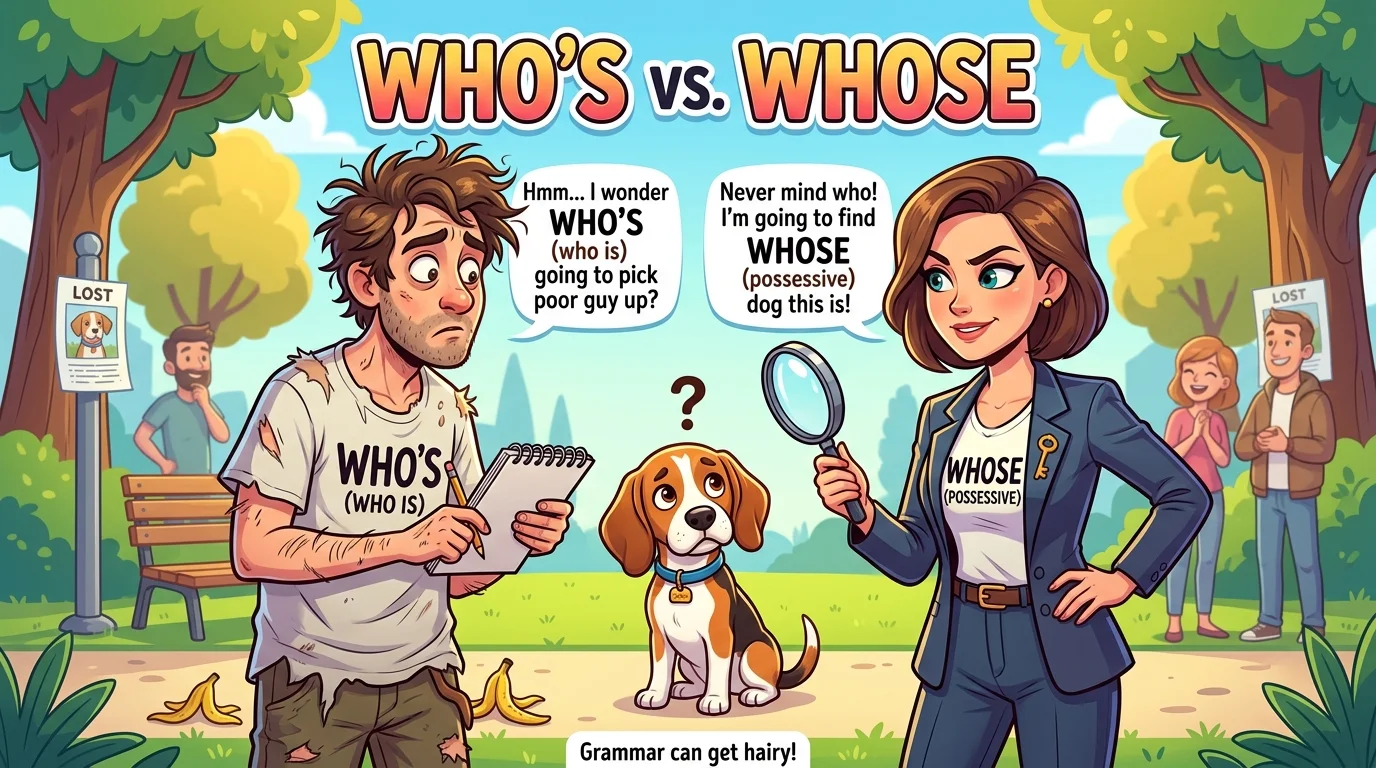
Mistake 2: Confusing “Whose” and “Who’s”
❌ Whose coming to dinner?
✔ Who’s coming to dinner?
Why it happens:
Both words sound identical when spoken.
Mistake 3: Removing the Apostrophe
❌ Whos going first?
✔ Who’s going first?
Why it happens:
Writers type quickly and omit punctuation.
Memory Tricks
Trick 1: Ownership Test
If the sentence asks who owns something, use whose.
Example:
- Whose shoes are these?
Ownership = whose
Trick 2: Expand the Sentence
Replace the word with who is.
If the sentence still works, use who’s.
Example:
- Who’s coming?
- Who is coming?
Correct.
Trick 3: Think of Other Possessive Words
- His
- Her
- Their
- Whose
Notice that none require an apostrophe.
Expert Insight
One reason many people struggle with whose is that English possessive pronouns often do not use apostrophes.
For example:
- His
- Hers
- Theirs
- Yours
- Whose
In contrast, contractions use apostrophes:
- Who’s = who is
- It’s = it is
- They’re = they are
Because whose sounds exactly like who’s, writers frequently confuse the two.
From a grammatical perspective, whose functions as a possessive determiner or pronoun, while who’s functions as a contraction. The form whos is generally considered a spelling error in standard English.