
Quick Answer
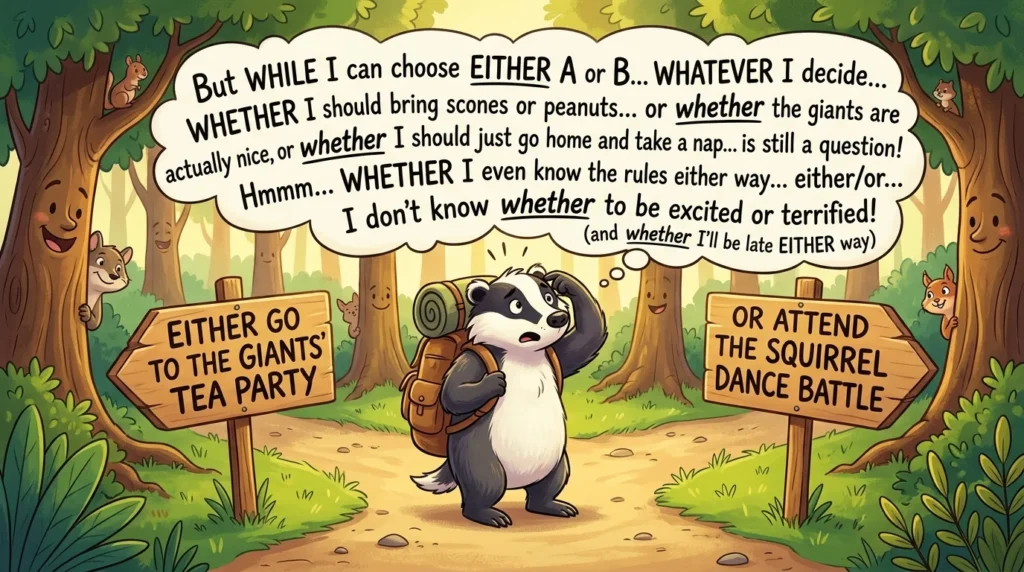
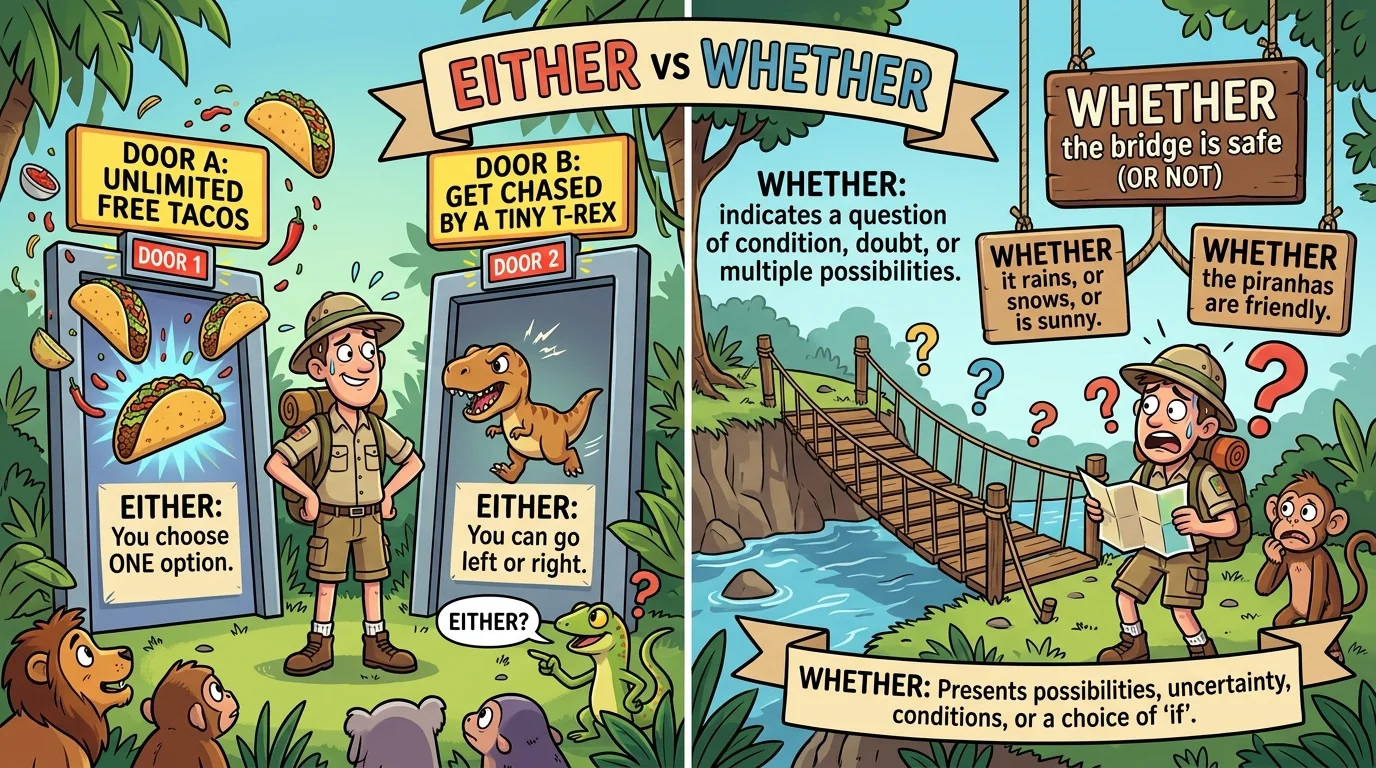
Either means one or the other of two choices and can function as a determiner, pronoun, conjunction, or adverb.
Whether means if and is used to express uncertainty or introduce alternatives.
Simply put, either presents choices, while whether introduces doubt or uncertainty about those choices.
What Does “Either” Mean?
Either refers to one of two people, things, options, or possibilities. It emphasizes alternatives and often appears with the word or.
Usage Rules
Use either when:
- Referring to one of two choices
- Presenting alternatives
- Saying that both options are acceptable
- Creating an either-or construction
Examples
- You can choose either the blue shirt or the black one.
- Either answer is acceptable.
- We can meet on either Monday or Tuesday.
Key Insight: If the sentence involves selecting one of two alternatives, either is usually the correct word.
What Does “Whether” Mean?
Whether introduces uncertainty, doubt, or a question about which possibility is true. It often means if.
Usage Rules
Use whether when:
- Expressing uncertainty
- Introducing indirect questions
- Showing doubt between possibilities
- Using the phrase whether or not
Examples
- I don’t know whether she will attend the meeting.
- They are deciding whether to move abroad.
- Please tell me whether you can come.
Key Insight: If you can replace the word with if, you probably need whether.
Either vs Whether: Key Differences
Bullet Differences
- Meaning: Either means one of two choices; whether expresses uncertainty or doubt.
- Function: Either presents alternatives; whether introduces questions or possibilities.
- Usage: Either commonly appears with or; whether often appears with or not.
- Context: Either emphasizes options; whether emphasizes uncertainty.
- Common Mistake: Writers often use either when they should use whether.
| Feature | Either | Whether |
|---|---|---|
| Meaning | One of two choices | If; uncertainty between possibilities |
| Function | Presents alternatives | Introduces doubt or questions |
| Common Pairing | Either…or | Whether…or not |
| Focus | Choice | Uncertainty |
| Example | You can take either route. | I don’t know whether to go. |
Real-World Usage Scenarios
Scenario 1
Incorrect: “I don’t know either I should stay.”
Correct: “I don’t know whether I should stay.”
🎯 Lesson: Uncertainty requires whether, not either.
Scenario 2
Incorrect: “You may choose whether tea or coffee.”
Correct: “You may choose either tea or coffee.”
🎯 Lesson: Choosing between alternatives requires either.
Scenario 3
Incorrect: “She is wondering either to accept the offer.”
Correct: “She is wondering whether to accept the offer.”
🎯 Lesson: Wondering indicates uncertainty, so use whether.
Scenario 4
Incorrect: “Either you agree or not.”
Correct: “Whether you agree or not.”
🎯 Lesson: The phrase whether or not expresses uncertainty.
Scenario 5
Incorrect: “I can take whether road.”
Correct: “I can take either road.”
🎯 Lesson: Selecting one of two options requires either.
Common Mistakes
Mistake 1: Using “Either” to Express Uncertainty
Why it happens: Both words often appear in sentences involving alternatives.
Correction: If you mean if or are expressing doubt, use whether.
Mistake 2: Using “Whether” for Choices
Why it happens: Writers associate uncertainty with making choices.
Correction: If the sentence involves choosing between options, use either.
Mistake 3: Confusing Common Expressions
Why it happens: The phrases either…or and whether…or not sound similar.
Correction: Learn the fixed expressions separately.
Memory Tricks to Remember the Difference
Trick 1
Either = Choice
Think:
Either…or = Choose one option.
Trick 2
Whether = If
If you can replace the word with if, use whether.
Example:
- I don’t know whether he is coming.
- I don’t know if he is coming.
Both sentences work.
Trick 3
Ask yourself:
Am I choosing or questioning?
- Choosing → Either
- Questioning or uncertain → Whether
Trick 4
Remember this simple rule:
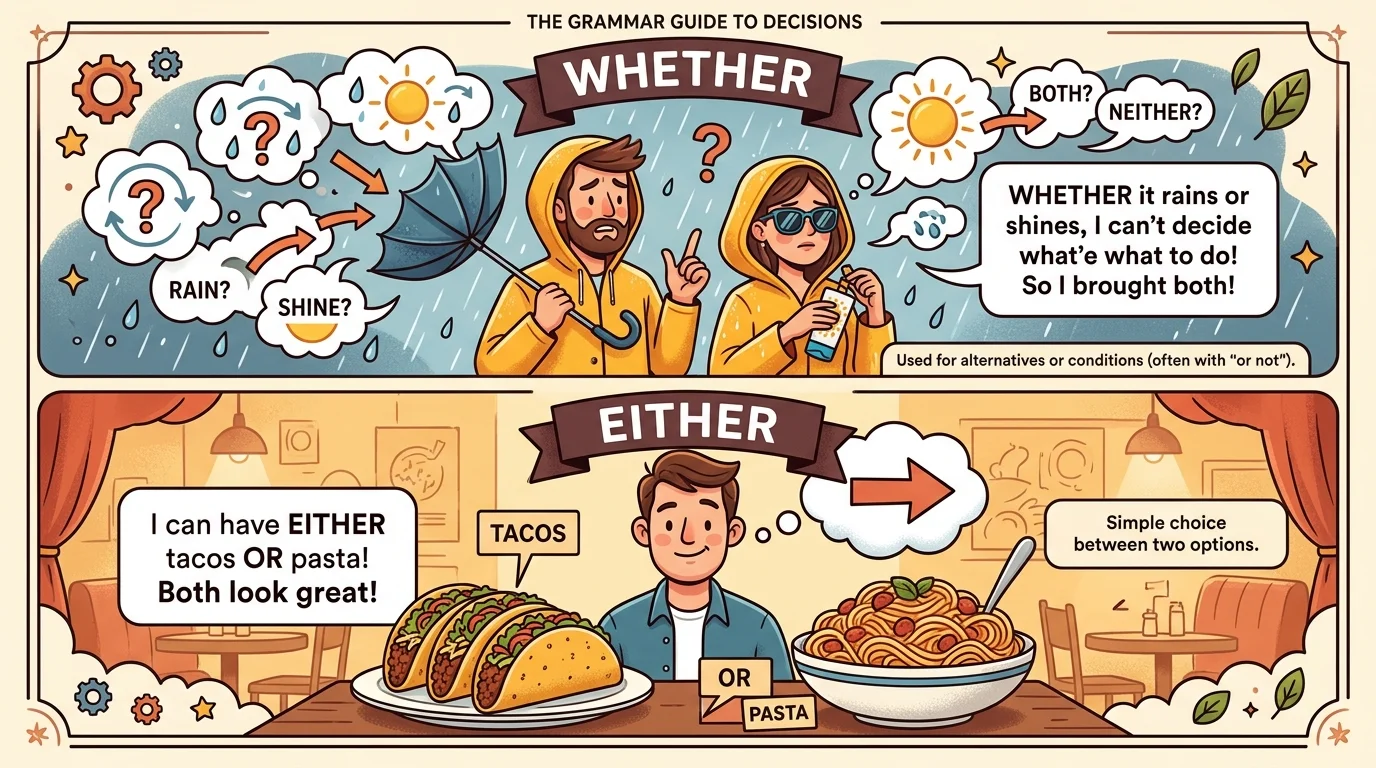
Either gives options. Whether asks if.
Expert Insight
The confusion between either and whether arises because both words frequently appear in sentences involving alternatives. However, their grammatical functions are entirely different.
Either focuses on selection and choice. It directs attention to available alternatives and often forms the expression either…or.
Whether, on the other hand, introduces uncertainty and indirect questions. It frequently appears in constructions such as whether…or not and can often be replaced by if.
Professional writers typically use a simple test. If the sentence could be rephrased as an indirect question beginning with if, they choose whether. If the sentence involves selecting one of two alternatives, they use either.