
Quick Answer
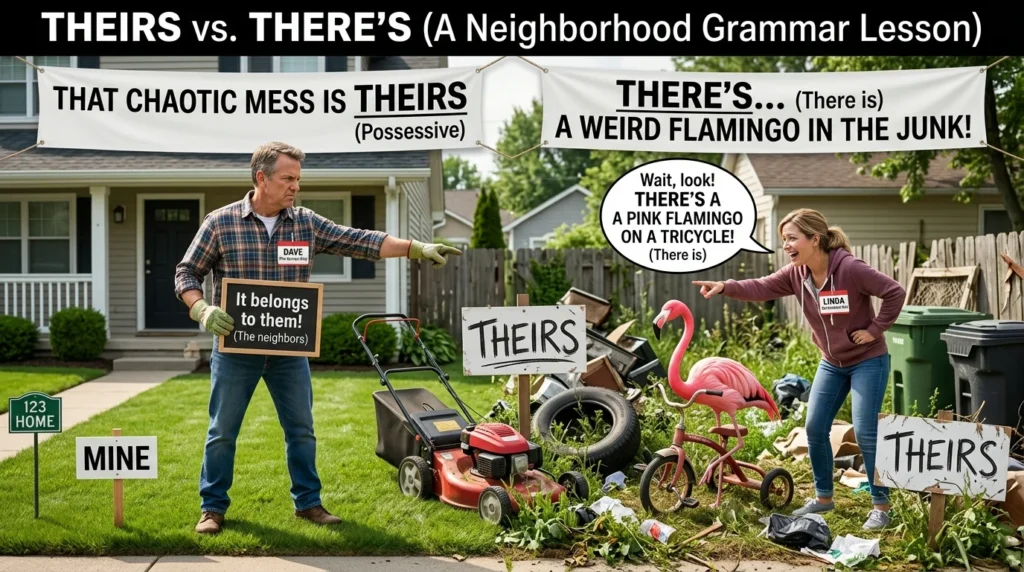
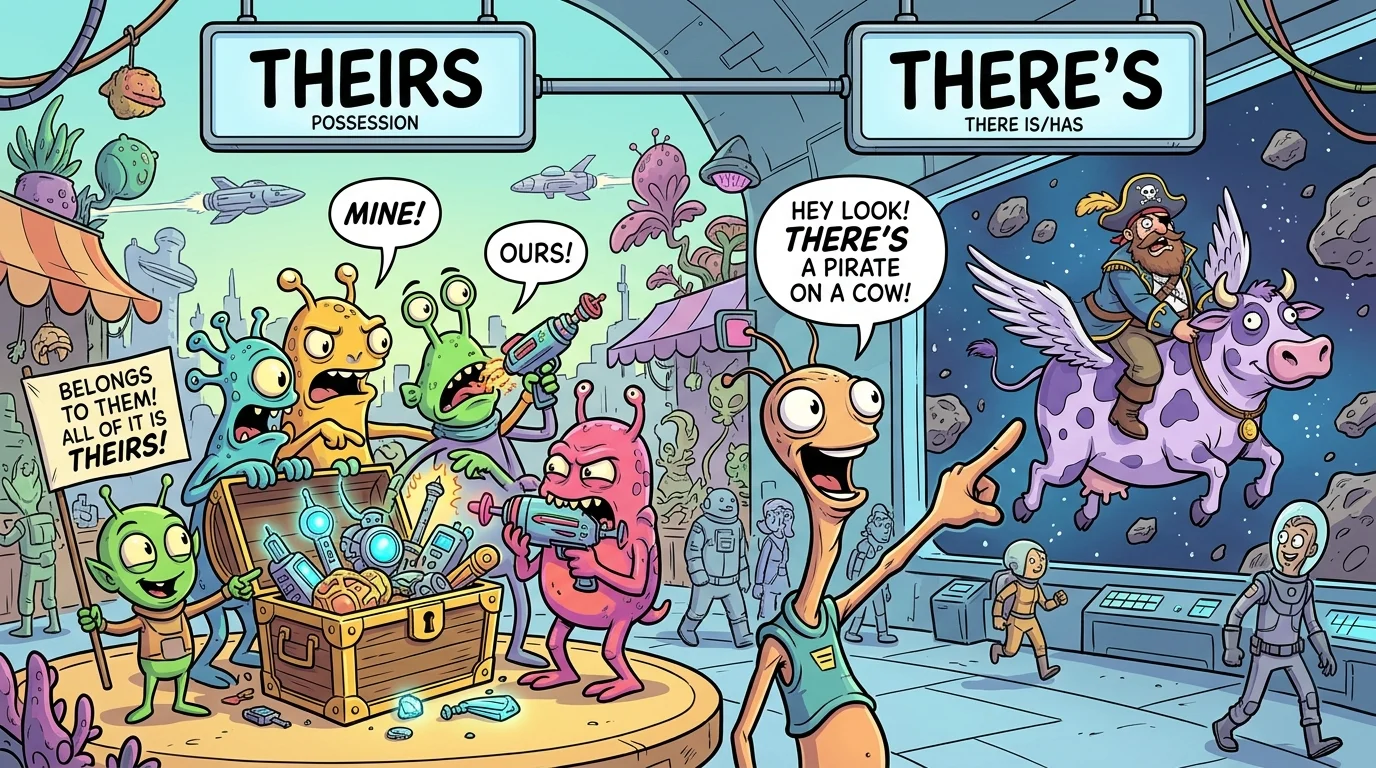
Theirs is a possessive pronoun that means something belongs to them.
There’s is a contraction that means there is or there has.
Simply put, theirs shows possession, while there’s introduces the existence of something or shortens “there is” or “there has.”
What Does “Theirs” Mean?
Theirs is a possessive pronoun that indicates ownership. It replaces a noun to avoid repetition.
Usage Rules
Use theirs when:
- Showing that something belongs to a group of people
- Replacing phrases like their car or their house
- Indicating ownership without repeating the noun
Examples
- That red car is theirs.
- The decision was theirs to make.
- The house on the corner is theirs.
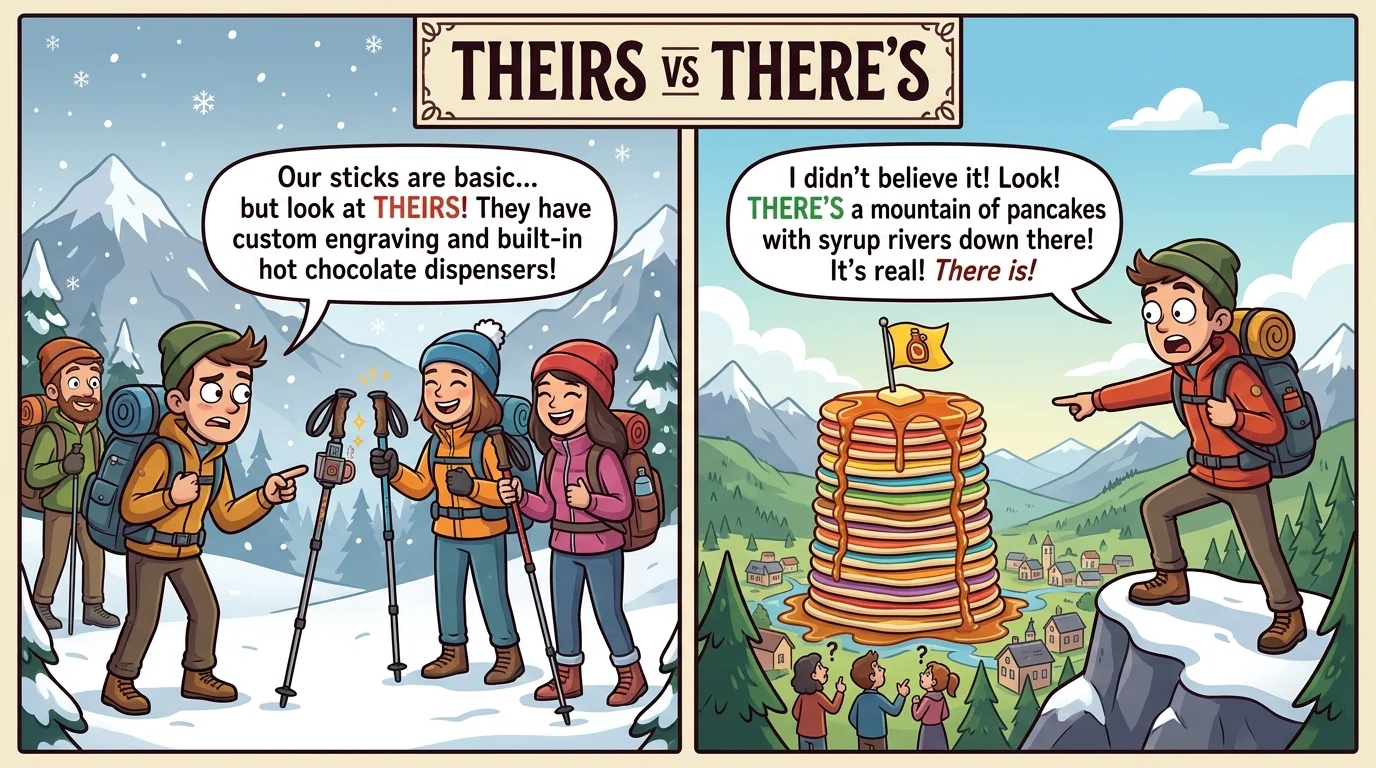
Key Insight: If you can replace the word with belongs to them, use theirs.
What Does “There’s” Mean?
There’s is a contraction of there is or there has. It usually introduces the existence of something.
Usage Rules
Use there’s when:
- Saying that something exists
- Introducing a person, place, or thing
- Replacing there is
- Replacing there has
Examples
- There’s a restaurant near my office.
- There’s no reason to worry.
- There’s been a change in the schedule.
Key Insight: If you can expand the word into there is or there has, use there’s.
Theirs vs There’s: Key Differences
Bullet Differences
- Meaning: Theirs shows ownership; there’s means there is or there has.
- Part of Speech: Theirs is a possessive pronoun; there’s is a contraction.
- Function: Theirs replaces a noun phrase; there’s introduces existence.
- Usage: Theirs refers to possession; there’s refers to the presence of something.
- Common Mistake: Writers sometimes use there’s when they mean ownership.
| Feature | Theirs | There’s |
|---|---|---|
| Meaning | Belonging to them | There is or there has |
| Part of Speech | Possessive pronoun | Contraction |
| Function | Shows ownership | Introduces existence |
| Example | The blue backpacks are theirs. | There’s a backpack on the desk. |
| Related To | Possession | Existence or occurrence |
Real-World Usage Scenarios
Scenario 1
Incorrect: “That house is there’s.”
Correct: “That house is theirs.”
🎯 Lesson: Ownership requires theirs, not there’s.
Scenario 2
Incorrect: “Theirs a problem with the computer.”
Correct: “There’s a problem with the computer.”
🎯 Lesson: The sentence means there is, so use there’s.
Scenario 3
Incorrect: “The decision is there’s.”
Correct: “The decision is theirs.”
🎯 Lesson: The decision belongs to them, so use theirs.
Scenario 4
Incorrect: “Theirs been an update.”
Correct: “There’s been an update.”
🎯 Lesson: The phrase means there has been, so use there’s.
Scenario 5
Incorrect: “The blue bicycles over there are there’s.”
Correct: “The blue bicycles over there are theirs.”
🎯 Lesson: Since the bicycles belong to someone, use theirs.
Common Mistakes
Mistake 1: Writing “There’s” for Possession
Why it happens: Both words sound identical.
Correction: If something belongs to people, use theirs.
Mistake 2: Writing “Theirs” Instead of “There’s”
Why it happens: Writers forget that there’s is a contraction.
Correction: If you can say there is or there has, use there’s.
Mistake 3: Forgetting to Expand the Contraction
Why it happens: People write based on pronunciation.
Correction: Expand there’s into there is. If the sentence still works, the spelling is correct.
Memory Tricks to Remember the Difference
Trick 1
Theirs = Their + Ownership
Think:
Theirs = Belongs to them.
Example:
- The books are theirs.
- The books belong to them.
Trick 2
There’s = There Is
Expand the contraction:
- There’s a cat outside.
- There is a cat outside.
Both sentences work.
Trick 3
Ask yourself:
Am I talking about ownership or existence?
- Ownership → Theirs
- Existence → There’s
Trick 4
Remember this simple rule:
Theirs owns. There’s exists.
Expert Insight
The confusion between theirs and there’s exists because they are perfect homophones, meaning they have identical pronunciations but different meanings and grammatical functions.
Theirs belongs to the family of possessive pronouns, alongside words like mine, yours, and ours. It never uses an apostrophe because possessive pronouns in English generally do not require one.
There’s, however, is a contraction. The apostrophe replaces missing letters in there is or there has. Because contractions and possessive pronouns follow different grammatical rules, the two words are never interchangeable.
Professional editors often use a simple test. If they can replace the word with belongs to them, they choose theirs. If they can replace it with there is or there has, they use there’s.