
Quick Answer
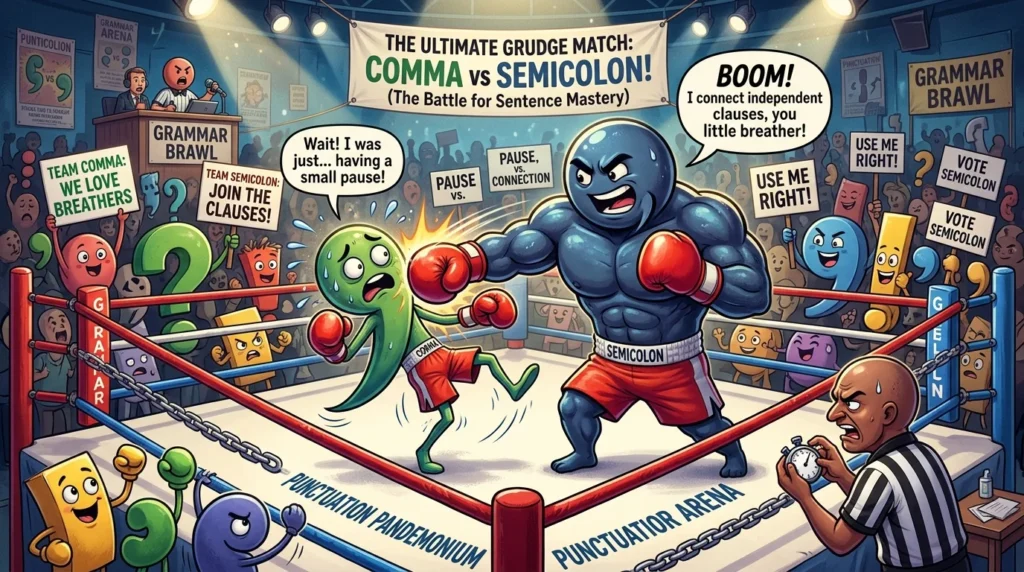
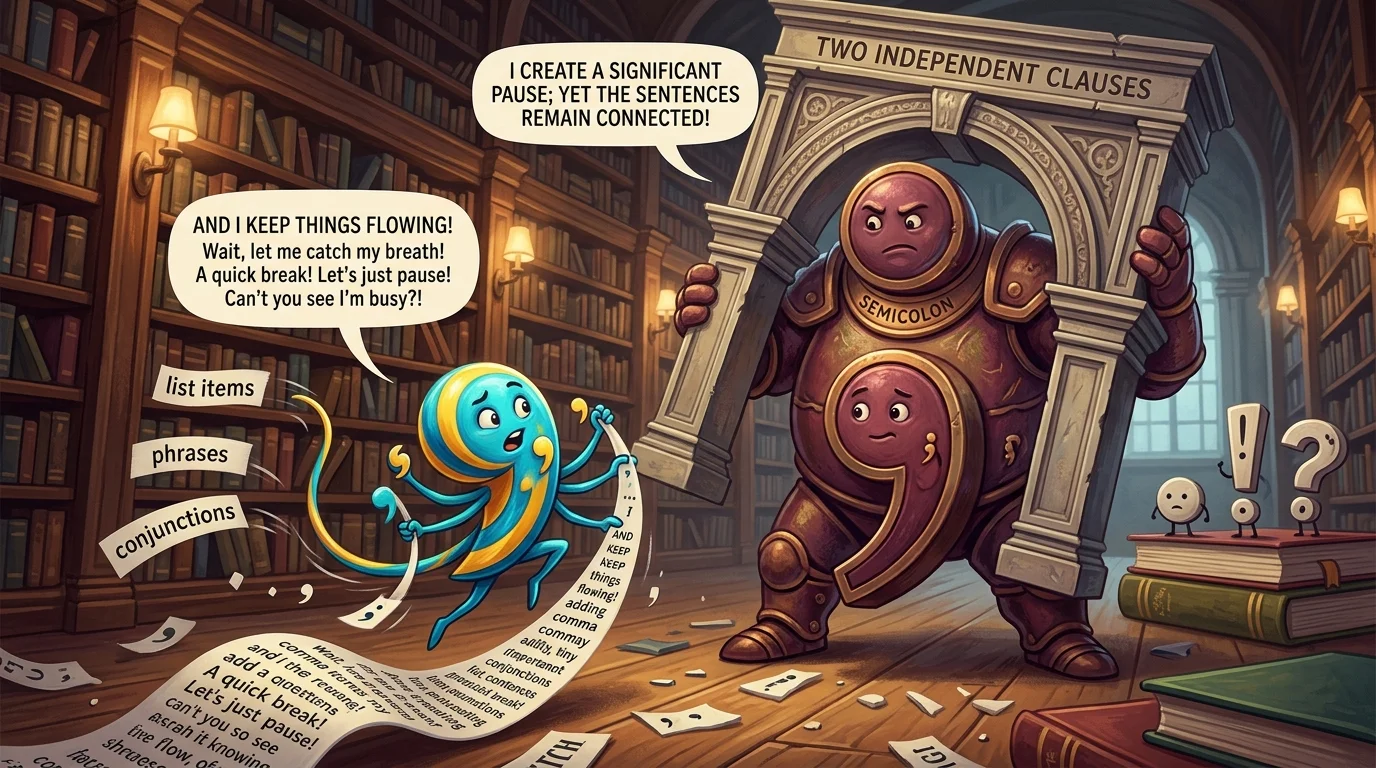
A comma (,) creates a short pause and separates words, phrases, or clauses within a sentence.
A semicolon (;) creates a stronger break and connects two closely related complete sentences without using a conjunction.
Simple rule: Use a comma for separation within a sentence and a semicolon to connect related complete thoughts.
What Is a Comma?
Definition
A comma (,) is a punctuation mark used to separate words, phrases, clauses, and items in a sentence.
Usage Rules
Use a comma when:
- Separating items in a list
- Separating introductory words or phrases
- Joining independent clauses with conjunctions like and, but, or so
- Adding extra information
- Separating dates, places, and direct addresses
Real Examples
- I bought apples, oranges, and bananas.
- After dinner, we watched a movie.
- She studied hard, so she passed the exam.
- My brother, who lives in London, is visiting us.
- Sarah, can you help me?
Key Insights
Commas commonly appear in:
- Everyday writing
- Academic essays
- Emails and business communication
- News articles
- Books and creative writing
Key idea: A comma organizes information and creates clarity within a sentence.
What Is a Semicolon?
Definition
A semicolon (;) is a punctuation mark used to connect closely related independent clauses or separate complicated items in a list.
Usage Rules
Use a semicolon when:
- Joining two related complete sentences without a conjunction
- Connecting ideas that are strongly related
- Separating items in a list when the items already contain commas
- Linking sentences with transitional expressions such as however, therefore, and for example
Real Examples
- The weather was terrible; we decided to stay indoors.
- She loves reading; her sister prefers watching movies.
- I visited Paris, France; Rome, Italy; and Madrid, Spain.
- He prepared carefully; therefore, he felt confident during the interview.
Key Insights
Semicolons commonly appear in:
- Formal writing
- Academic papers
- Professional reports
- Literature and journalism
- Complex lists
Key idea: A semicolon links complete thoughts that are closely connected.
Comma vs Semicolon: Key Differences
Comparison Table
| Feature | Comma (,) | Semicolon (;) |
|---|---|---|
| Purpose | Separates parts of a sentence | Connects closely related complete sentences |
| Pause Length | Short pause | Longer pause than a comma |
| Independent Clauses | Requires a conjunction in most cases | Can connect clauses without a conjunction |
| Lists | Separates simple items | Separates complex items containing commas |
| Formality | Common in all writing | More common in formal writing |
| Example | I was tired, so I slept. | I was tired; I went to bed early. |
Quick Differences
- Comma = separation within a sentence.
- Semicolon = connection between related complete thoughts.
- Comma creates a short pause.
- Semicolon creates a stronger pause.
- Semicolon can replace a period when ideas are closely related.
Real-World Usage Scenarios
Example 1
Incorrect:
“I was hungry, I ordered pizza.”
Correct:
“I was hungry; I ordered pizza.”
🎯 Lesson: Two complete sentences cannot usually be joined by only a comma.
Example 2
Correct:
“I was hungry, so I ordered pizza.”
🎯 Lesson: A comma works when a conjunction like so connects the clauses.
Example 3
Incorrect:
“I invited John, Canada, Sarah, Australia, and James, England.”
Correct:
“I invited John, Canada; Sarah, Australia; and James, England.”
🎯 Lesson: Use semicolons to separate complex list items containing commas.
Example 4
Correct:
“Before the meeting, I reviewed my notes.”
🎯 Lesson: Introductory phrases often require commas.
Example 5
Correct:
“The project was difficult; however, we completed it successfully.”
🎯 Lesson: Semicolons often appear before transitional words like however.
Common Mistakes People Make
Mistake 1: Creating a Comma Splice
Incorrect:
“The movie ended, everyone left.”
Correct:
“The movie ended; everyone left.”
Or:
“The movie ended, and everyone left.”
Why It Happens
Writers mistakenly believe a comma alone can connect two complete sentences.
Mistake 2: Using Semicolons Like Commas
Incorrect:
“I bought apples; oranges; and bananas.”
Correct:
“I bought apples, oranges, and bananas.”
Why It Happens
People assume semicolons are simply stronger commas.
Mistake 3: Using Too Many Semicolons
Incorrect:
“I woke up; brushed my teeth; and ate breakfast.”
Correct:
“I woke up, brushed my teeth, and ate breakfast.”
Why It Happens
Writers overuse semicolons because they seem more formal.
Memory Tricks to Remember the Difference
Trick 1
Comma = Small Pause
Think:
Comma creates a quick breath in your sentence.
Trick 2
Semicolon = Semi-Period
Think:
A semicolon is stronger than a comma but weaker than a period.
Trick 3
Remember this phrase:
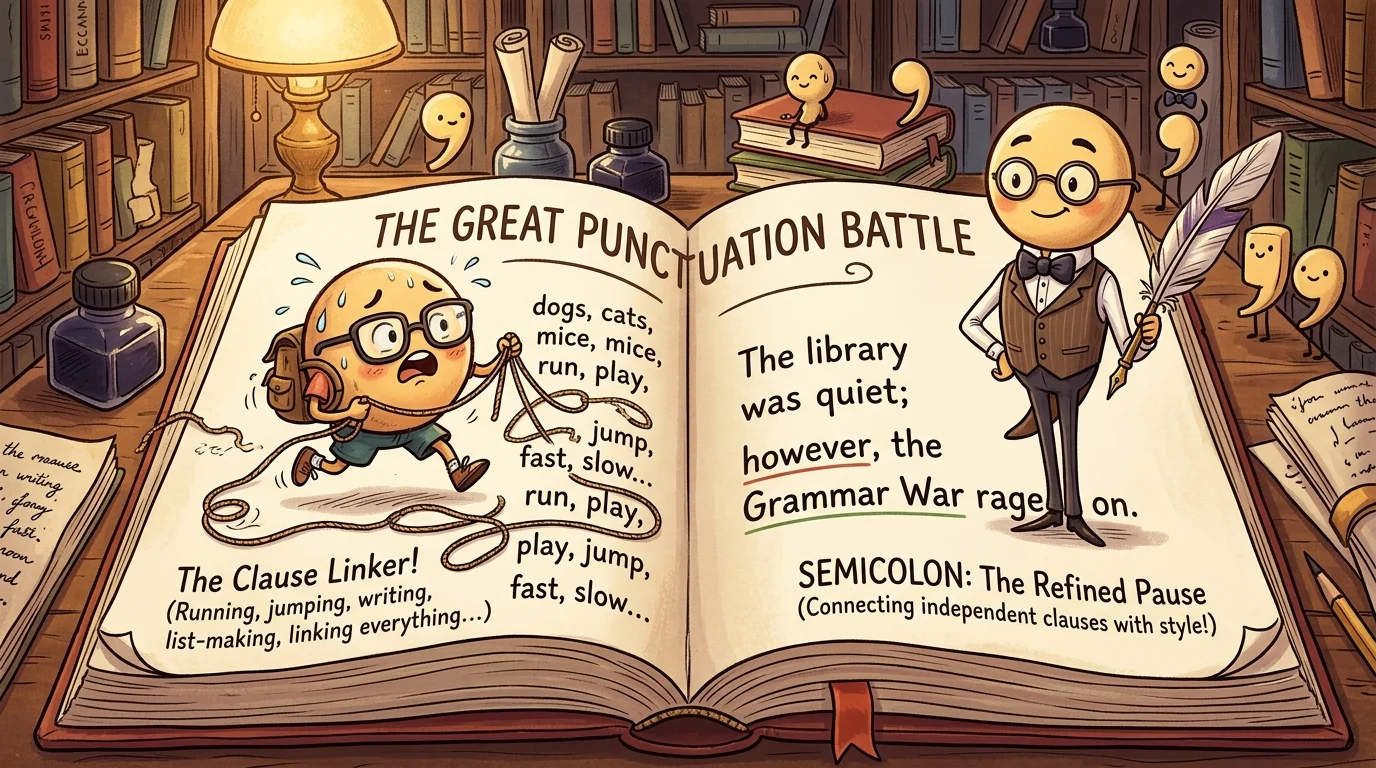
Commas separate. Semicolons connect.
Expert Insight: Why Commas and Semicolons Are Commonly Confused
Both punctuation marks create pauses, which makes them seem similar. However, their grammatical functions are very different.
A comma organizes elements inside a sentence and often works alongside conjunctions. A semicolon, on the other hand, can independently connect two complete ideas that share a close relationship.
Professional writers often use semicolons sparingly because they add sophistication and flow without breaking ideas into separate sentences. Understanding sentence structure is the key to mastering both punctuation marks.