
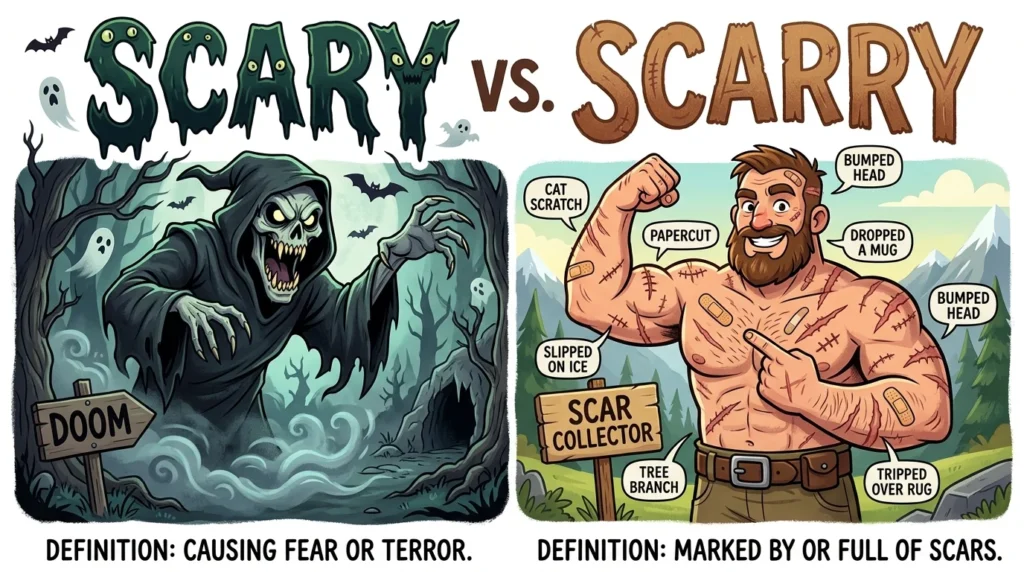
Quick Answer: Scary vs Scarry
Scary is the correct English word. It means something that causes fear, anxiety, or uneasiness.
Scarry is not a standard English word and is usually a spelling mistake.
Example:
✔ That horror movie was scary.
✘ That horror movie was scarry.
What Does Scary Mean?
Definition
Scary is an adjective used to describe something that makes people feel frightened, nervous, or afraid.
Usage
The word is commonly used when talking about:
- Horror movies
- Dangerous situations
- Spooky stories
- Threatening experiences
- Frightening animals or events
Examples
- The haunted house looked scary.
- That thunderstorm was scary.
- Watching the horror film alone was scary.
- It was a scary experience driving through the fog.
Key Insight
Scary is the only correct spelling recognized in modern English dictionaries and style guides.
What Does Scarry Mean?
Definition
Scarry is generally not recognized as a standard English word.
In most situations, it is simply a misspelling of scary.
Usage
You may see scarry in:
- Typing errors
- Social media posts
- Informal online comments
- Spelling mistakes by learners
Examples
Incorrect:
- That movie was scarry.
- The situation felt scarry.
Correct:
- That movie was scary.
- The situation felt scary.
Key Insight
If you mean frightening or fear-inducing, always use scary.
Scary vs Scarry: Key Differences
Quick Comparison
- Scary = Correct spelling
- Scarry = Incorrect spelling
- Scary = Accepted in dictionaries
- Scarry = Usually considered an error
- Scary = Used in formal and informal writing
- Scarry = Should generally be avoided
Comparison Table
| Feature | Scarry | Scary |
|---|---|---|
| Valid English Word | No | Yes |
| Meaning | Usually a misspelling | Causing fear or fright |
| Dictionary Recognition | No | Yes |
| Formal Writing | Incorrect | Correct |
| Everyday Usage | Incorrect | Correct |
| Example | The movie was scarry. | The movie was scary. |
Why Is It “Scary” and Not “Scarry”?
The adjective scary comes from the noun scare.
When forming the adjective, English drops the final e and adds -y:
- scare + y → scary
The spelling does not require doubling the letter r.
Similar examples include:
- haze → hazy
- taste → tasty
- shine → shiny
Because of this spelling pattern, scary became the standard form.
Real-World Usage Scenarios
Scenario 1: Watching a Horror Movie
Incorrect:
“That movie was scarry.”
Correct:
“That movie was scary.”
🎯 Lesson: Use scary when something causes fear.
Scenario 2: Haunted House
“The haunted house looked scary at night.”
🎯 Lesson: Scary describes frightening places and experiences.
Scenario 3: Dangerous Situation
“It was scary driving during the storm.”
🎯 Lesson: Scary can describe situations that create anxiety or fear.
Scenario 4: Children’s Story
“The monster in the story seemed scary.”
🎯 Lesson: Scary is often used in books, stories, and entertainment.
Scenario 5: Everyday Conversation
“That was the scariest moment of my life.”
🎯 Lesson: Related forms include scarier and scariest, not scarryer or scarryest.
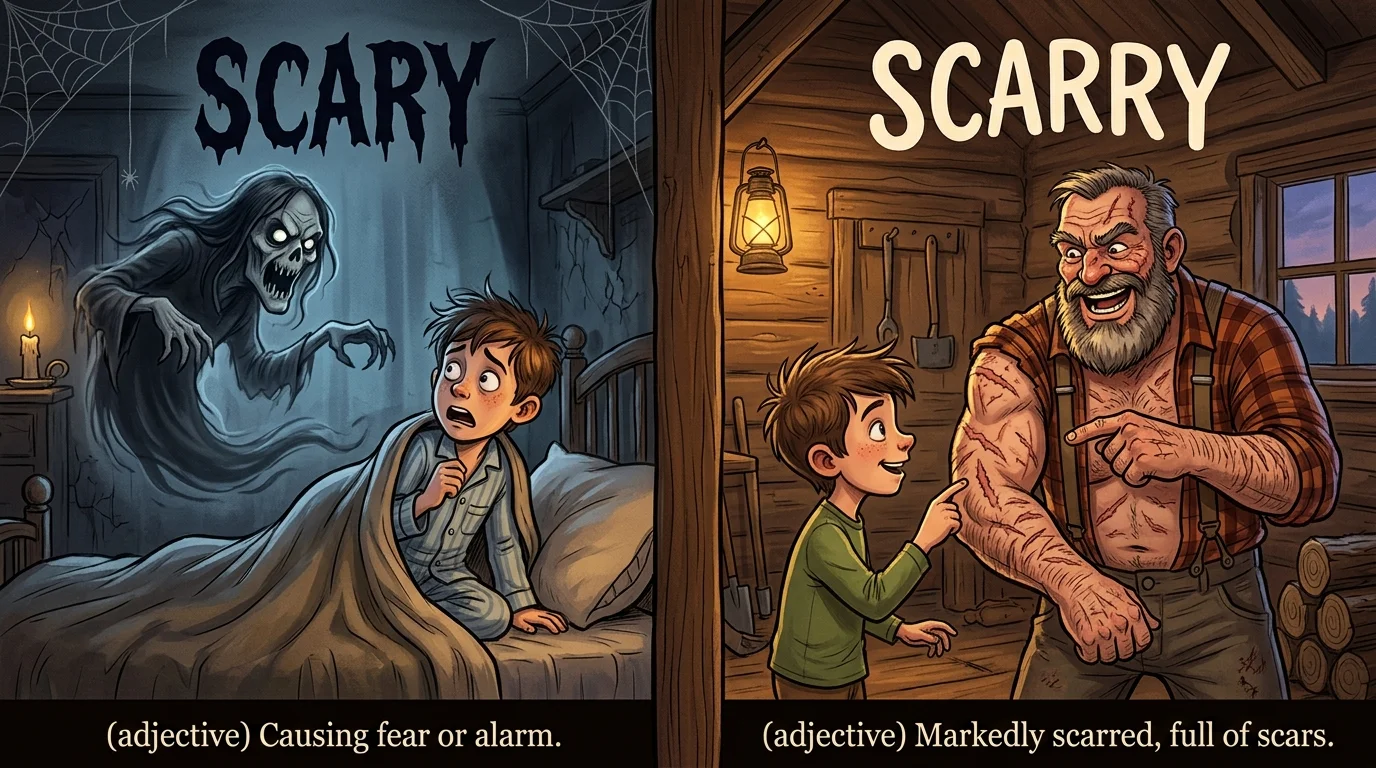
Common Mistakes
Mistake 1: Adding an Extra R
Many people mistakenly write scarry instead of scary.
Correction: Remember that scary contains only one r.
Mistake 2: Spelling Based on Pronunciation
Some writers assume the sound requires a double r.
Correction: The correct spelling remains scary regardless of pronunciation.
Mistake 3: Using Scarry in Formal Writing
Because the mistake is common online, some people accidentally carry it into professional writing.
Correction: Always use scary in essays, emails, reports, and publications.
Why This Happens
The confusion often occurs because English contains many words with doubled consonants, leading writers to assume scary follows the same pattern.
Easy Memory Tricks
Trick 1: Think of the Root Word
Scary comes from scare.
- scare → scary
There is only one r in scare, so scary keeps a single r.
Trick 2: Remember “Scare + Y”
Visualize:
Scare + Y = Scary
Not:
Scare + Ry = Scarry
Trick 3: Check Related Forms
Correct:
- scary
- scarier
- scariest
Incorrect:
- scarry
- scarryer
- scarryest
Expert Insight: The Linguistic Reason
The adjective scary evolved from the verb and noun scare. English word formation rules typically drop the silent final e before adding the suffix -y.
Because the root word already contains the correct consonant structure, there is no grammatical reason to double the r. As a result, dictionaries, style guides, educators, and publishers universally recognize scary as the standard spelling.