
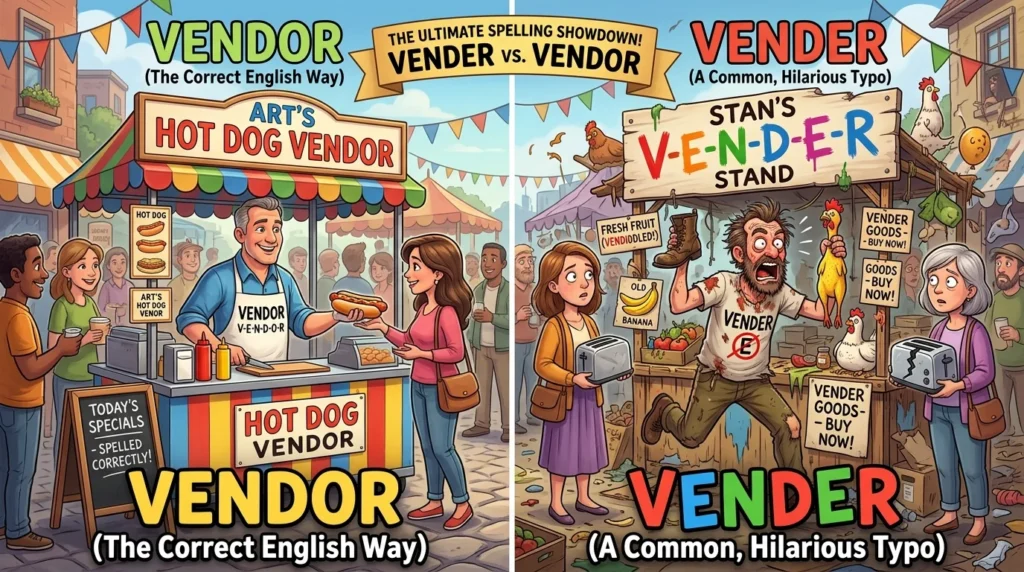

Quick Answer: Vender vs Vendor
Vendor is the standard and most widely accepted noun that refers to a person or company that sells goods or services.
Vender is a less common spelling that can refer to someone who sells something, but it is rarely used in modern English. In most situations, vendor is the correct choice.
Example:
✔ The software vendor released a new update.
✘ The software vender released a new update. (Generally considered incorrect in modern usage.)
What Does Vendor Mean?
Definition
A vendor is a person, business, or organization that sells products or services to customers or other businesses.
Usage
The term is commonly used in:
- Business contracts
- Technology industries
- Real estate transactions
- Retail sales
- Supply chain management
- Government procurement
Examples
- Our company selected a new software vendor.
- The vendor supplied all the office equipment.
- Street vendors sell food and merchandise to pedestrians.
- The vendor offered a discount for bulk purchases.
Key Insight
Vendor is the standard modern English term recognized globally in business and commerce.
What Does Vender Mean?
Definition
Vender is an alternative form derived from the verb vend, which means “to sell.”
Historically, a vender was someone who sold goods.
Usage
Today, the word is uncommon and largely replaced by vendor in modern English.
You may occasionally encounter it in:
- Older texts
- Historical documents
- Certain legal references
- Specialized dictionaries
Examples
- The vender displayed his goods at the market. (Rare usage)
- The historical document referred to the land vender. (Uncommon)
Key Insight
In modern writing, vendor is almost always preferred over vender.
Vender vs Vendor: Key Differences
Quick Comparison
- Vendor = Standard modern noun
- Vender = Rare alternative spelling
- Vendor = Preferred in business and professional writing
- Vender = Mostly historical or uncommon
- Vendor = Widely recognized globally
- Vender = Rarely seen today
Comparison Table
| Feature | Vender | Vendor |
|---|---|---|
| Meaning | Person who sells | Person or company that sells |
| Modern Usage | Rare | Extremely common |
| Business Usage | Uncommon | Standard term |
| Professional Writing | Usually avoided | Preferred |
| Dictionaries | Recognized but less common | Primary entry |
| Example | The vender sold fruit. | The vendor supplied software. |
Real-World Usage Scenarios
Scenario 1: Software Company
Incorrect:
“The vender provides cloud hosting services.”
Correct:
“The vendor provides cloud hosting services.”
🎯 Lesson: In technology and business contexts, use vendor.
Scenario 2: Street Market
“The street vendor sells fresh fruit every morning.”
🎯 Lesson: Vendor is the standard word for sellers in everyday English.
Scenario 3: Procurement Contract
“The vendor must deliver all products by June 30.”
🎯 Lesson: Legal and commercial documents almost always use vendor.
Scenario 4: Historical Writing
“The land vender transferred ownership in 1820.”
🎯 Lesson: Vender may appear in historical texts but is uncommon today.
Scenario 5: Business Email
Correct:
“Please contact the vendor regarding warranty support.”
Incorrect:
“Please contact the vender regarding warranty support.”
🎯 Lesson: Professional communication should use vendor.
Common Mistakes
Mistake 1: Assuming Both Are Equally Common
Many people believe vender and vendor are interchangeable.
Correction: While both have existed historically, vendor is overwhelmingly preferred in modern English.
Mistake 2: Using Vender in Business Writing
Business documents should generally avoid vender.
Correction: Use vendor for contracts, proposals, procurement, and professional communication.
Mistake #3: Confusing Vend with Vendor
Because the verb is vend, some writers assume the noun should be vender.
Correction: The accepted noun form in modern English is vendor.
Why This Happens
English contains many words whose noun forms do not perfectly match their verb roots. Over time, vendor became the dominant standard usage.

Easy Memory Tricks
Trick 1: Think Business = Vendor
Most business systems, software platforms, and contracts use vendor.
If you’re talking about commerce, choose vendor.
Trick 2: Vendor Is Everywhere
You’ll see:
- Vendor management
- Vendor contracts
- Vendor payments
- Vendor registration
- Vendor portal
You rarely see “vender” in modern business terminology.
Trick 3: Default to Vendor
If you’re unsure, vendor is almost always the correct choice.
Expert Insight: Why Vendor Became Standard
The word vendor originates from legal and commercial English and became the dominant noun form used in trade and business.
Although vender developed from the verb vend, professional English gradually standardized around vendor, especially in commercial law, procurement, technology, and international business.
Today, major style guides, dictionaries, corporations, and government agencies overwhelmingly use vendor.
As a result, using vendor improves clarity and aligns with modern English conventions.