
Quick Answer: Wore vs. Worn
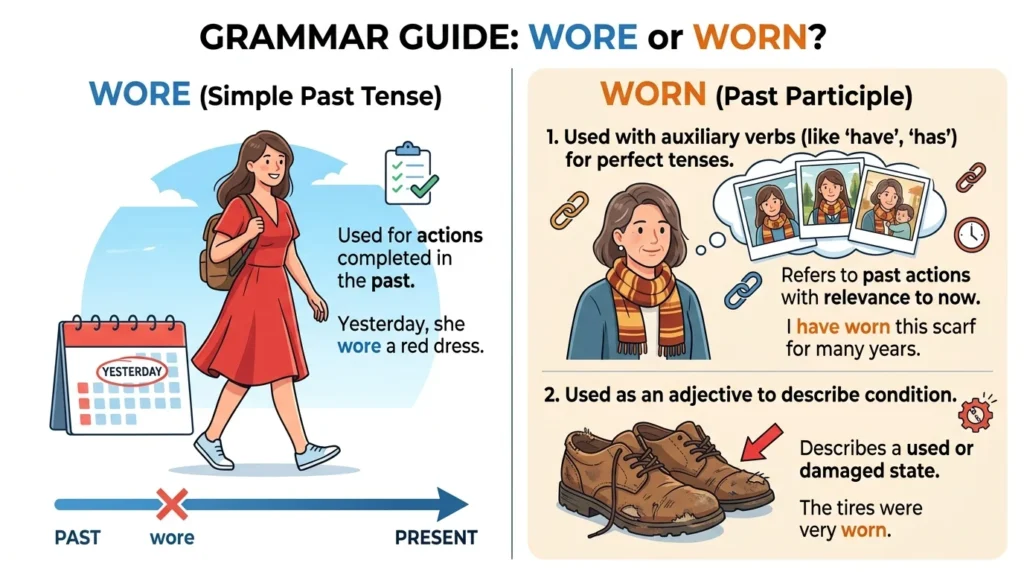
Wore is the simple past tense of wear.
I wore a blue shirt yesterday.
Worn is the past participle of wear and is normally used with a helping verb.
I have worn this shirt before.
The easiest rule:
- Wore = past action
- Worn = have/has/had + past participle
Think:
Yesterday → wore
Have/has/had → worn
What Does “Wore” Mean?
Wore is the simple past tense of the irregular verb wear.
The basic forms are:
| Verb Form | Word |
|---|---|
| Base form | wear |
| Simple past | wore |
| Past participle | worn |
We use wore when an action happened in the past and we’re simply describing that past event.
Examples of “Wore”
- I wore my new shoes yesterday.
- She wore a red dress to the wedding.
- He wore glasses when he was younger.
In each example, wore describes something that happened in the past.
Key Insight
If you’re talking about what someone put on or had on at a particular past time, wore is usually the correct choice.
She wore a black coat last winter.
What Does “Worn” Mean?
Worn is the past participle of wear.
Unlike wore, it generally cannot stand alone as the main past-tense verb.
It is commonly used with helping verbs such as:
- have
- has
- had
- is
- was
- been
Examples of “Worn”
I have worn these shoes before.
She has worn that dress several times.
He had worn the jacket before the trip.
Here, worn forms part of a perfect tense.
Worn in Passive or Adjectival Uses
Worn can also describe something that has become damaged or used through repeated use.
The carpet looks worn.
His shoes were worn from years of use.
In these examples, worn is describing a condition rather than simply stating a past action.
Key Insight
If you see have, has, or had, you will generally need worn, not wore.
Wore vs. Worn: The Main Difference
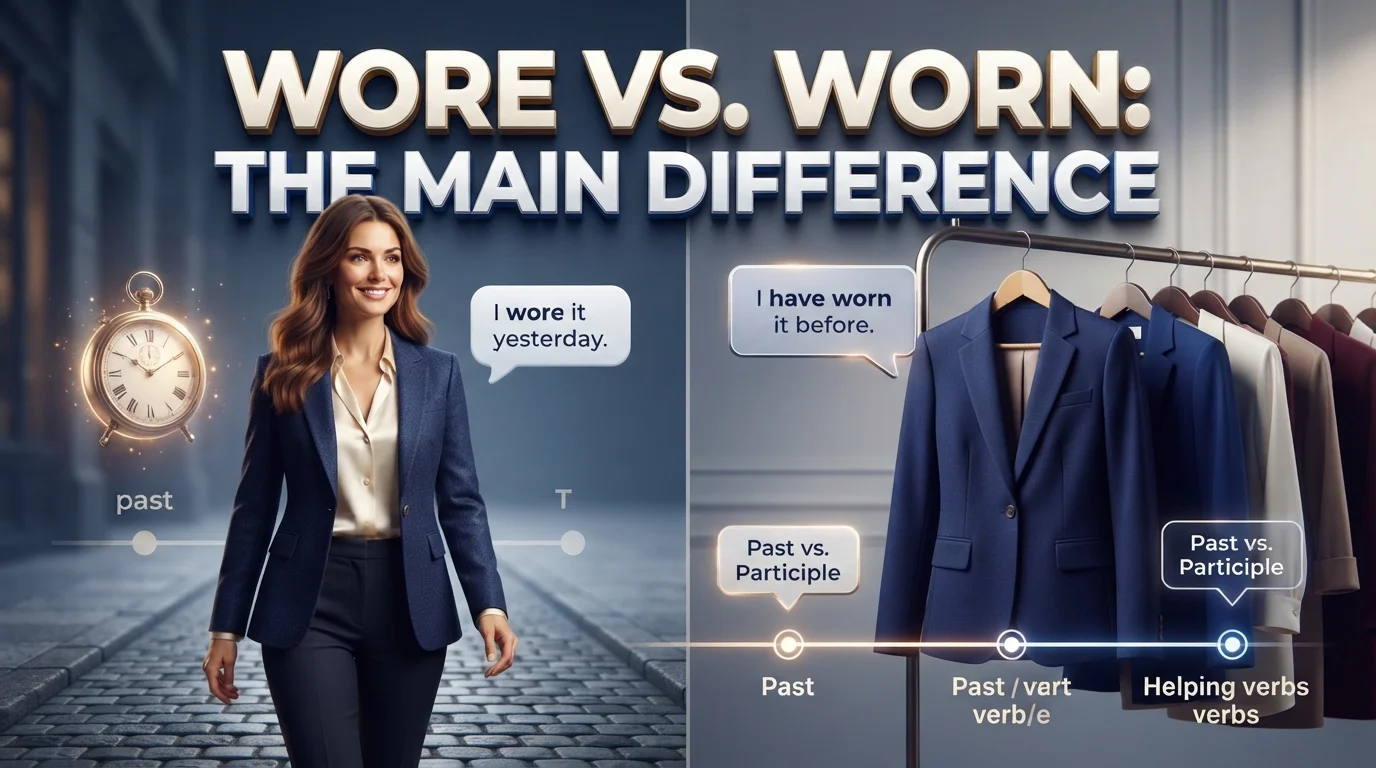
The simplest distinction is grammatical.
Wore
- Simple past tense
- Used for a completed past action
- Does not normally require a helping verb
- Example: She wore a blue dress.
Worn
- Past participle
- Used with helping verbs in perfect constructions
- Can also describe a worn-out or used condition
- Example: She has worn the dress before.
Comparison Table
| Feature | Wore | Worn |
| Verb form | Simple past | Past participle |
| Base verb | Wear | Wear |
| Typical use | Completed past action | Perfect tenses / passive / adjective |
| Common helper | Usually none | Have, has, had, be |
| Example | I wore a jacket yesterday. | I have worn this jacket before. |
| Memory clue | Yesterday → wore | Have/has/had → worn |
Real-World Usage Scenarios
Scenario 1: A Specific Past Time
I wore my favorite shirt yesterday.
🎯 Lesson: The action happened at a specific time in the past, so use wore.
Scenario 2: Life Experience
I have worn traditional clothing many times.
🎯 Lesson: The sentence uses have, so the past participle worn is required.
❌ I have wore traditional clothing many times.
✅ I have worn traditional clothing many times.
Scenario 3: Before Another Past Event
She had worn the dress before the ceremony began.
🎯 Lesson: Had + past participle requires worn.
❌ She had wore the dress.
✅ She had worn the dress.
Scenario 4: Describing a Past Event
He wore a suit to the interview.
🎯 Lesson: There is no helping verb, and the action is simply in the past. Use wore.
Scenario 5: Describing Condition
The old jacket looked worn.
🎯 Lesson: Here, worn describes something that has become shabby or damaged through use.
Common Mistakes With Wore and Worn
Mistake 1: “Have wore”
❌ I have wore these shoes before.
✅ I have worn these shoes before.
Why it happens:
Learners remember that wore is a past form of wear but forget that have requires the past participle.
Mistake 2: “Had wore”
❌ She had wore the dress already.
✅ She had worn the dress already.
Why it happens:
After had, English requires the past participle, not the simple past.
Mistake 3: Using “worn” by itself for a simple past action
❌ I worn a blue shirt yesterday.
✅ I wore a blue shirt yesterday.
Why it happens:
Worn is not the simple past form. The simple past is wore.
Mistake 4: Confusing “worn” with “wearing”
These are different forms:
- I wore a coat. → simple past
- I am wearing a coat. → present continuous
- I have worn a coat. → present perfect
Understanding the tense makes the correct form much easier to identify.
Wore vs. Worn: A Simple Grammar Formula
Use “wore”:
Subject + wore + object
She wore a hat.
They wore uniforms.
I wore my new shoes.
Use “worn”:
Subject + have/has/had + worn + object
She has worn a hat.
They had worn uniforms.
I have worn these shoes before.
This simple pattern can eliminate most wore/worn mistakes.
Wore, Worn, and Wear: The Complete Verb Pattern
Because wear is an irregular verb, its forms don’t follow the normal -ed pattern.
Present
I wear glasses.
Simple Past
I wore glasses yesterday.
Past Participle
I have worn glasses for years.
Present Participle
I am wearing glasses.
Complete Pattern
wear → wore → worn → wearing
This is worth memorizing because the same pattern applies regardless of whether you’re talking about clothing, accessories, or something else you wear.
Wore vs. Worn in Different Tenses
Simple Past
She wore a beautiful dress.
Use wore.
Present Perfect
She has worn that dress before.
Use worn.
Past Perfect
She had worn the dress before the party.
Use worn.
Future Perfect
By next month, she will have worn the uniform for a year.
Use worn.
Passive Construction
The costume was worn by the actor.
Use worn.
Memory Tricks: Wore vs. Worn
🕒 Trick 1: Yesterday = Wore
If you’re talking about a straightforward past event, think:
Yesterday, I wore it.
Wore = simple past.
🔑 Trick 2: Have/Has/Had = Worn
When you see:
- have
- has
- had
think:
Have worn.
Has worn.
Had worn.
Never:
❌ Have wore
❌ Has wore
❌ Had wore
⭐ Trick 3: The “Have” Test
Put have before the word.
If the sentence is:
I have ___ this before.
The correct answer is:
I have worn this before.
This quick test works in many situations.
Expert Insight: Why “Wore” and “Worn” Work Differently
The distinction between wore and worn comes from the fact that wear is an irregular English verb.
The simple past form is wore, while the past participle is worn.
The difference isn’t about meaning alone; it is primarily about grammatical function.
The simple past can stand independently:
She wore a coat.
The past participle normally needs another verb in perfect constructions:
She has worn a coat.
This distinction is similar to other irregular verbs:
- go → went → gone
- see → saw → seen
- write → wrote → written
- break → broke → broken
- wear → wore → worn
Learning irregular verbs as a three-part pattern can make English grammar much easier.
Quick Test: Wore or Worn?
Choose the correct word.
- I ________ that jacket yesterday.
- She has ________ the dress before.
- They ________ uniforms to school last year.
- He had ________ the shoes several times.
- The old carpet looked ________.
Answers
- wore
- worn
- wore
- worn
- worn
The Pattern
Wore = simple past
Worn = past participle or describing a used condition