
Generalist or Specialist Salary
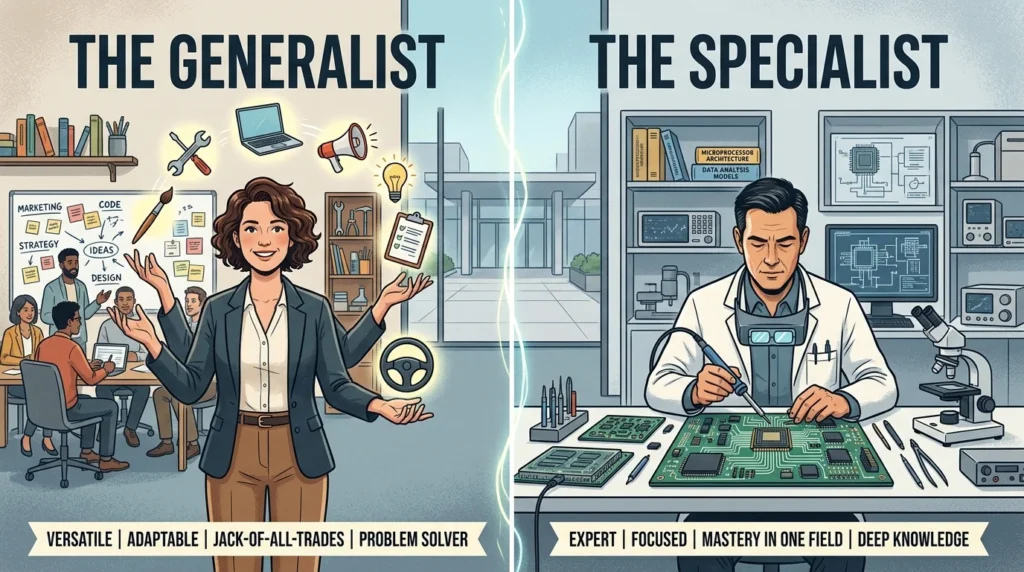
The salary difference between a generalist and a specialist depends heavily on the industry, job level, experience, location, and demand for particular skills. A specialist typically develops deep expertise in one area, while a generalist works across a broader range of responsibilities.
For example, in a technology company, a generalist might handle several areas of digital marketing, while a specialist may focus specifically on technical SEO, paid advertising, or data analytics.
A specialist can sometimes command higher pay when their expertise is scarce or highly sought after. However, a generalist may qualify for a wider range of roles because of their broader skill set. Salary therefore cannot be determined simply by whether someone is a generalist or specialist.
When comparing compensation, it is more useful to consider the specific job title, industry, seniority, required skills, geographic market, and years of experience.
Generalist vs Specialist in Environmental Science
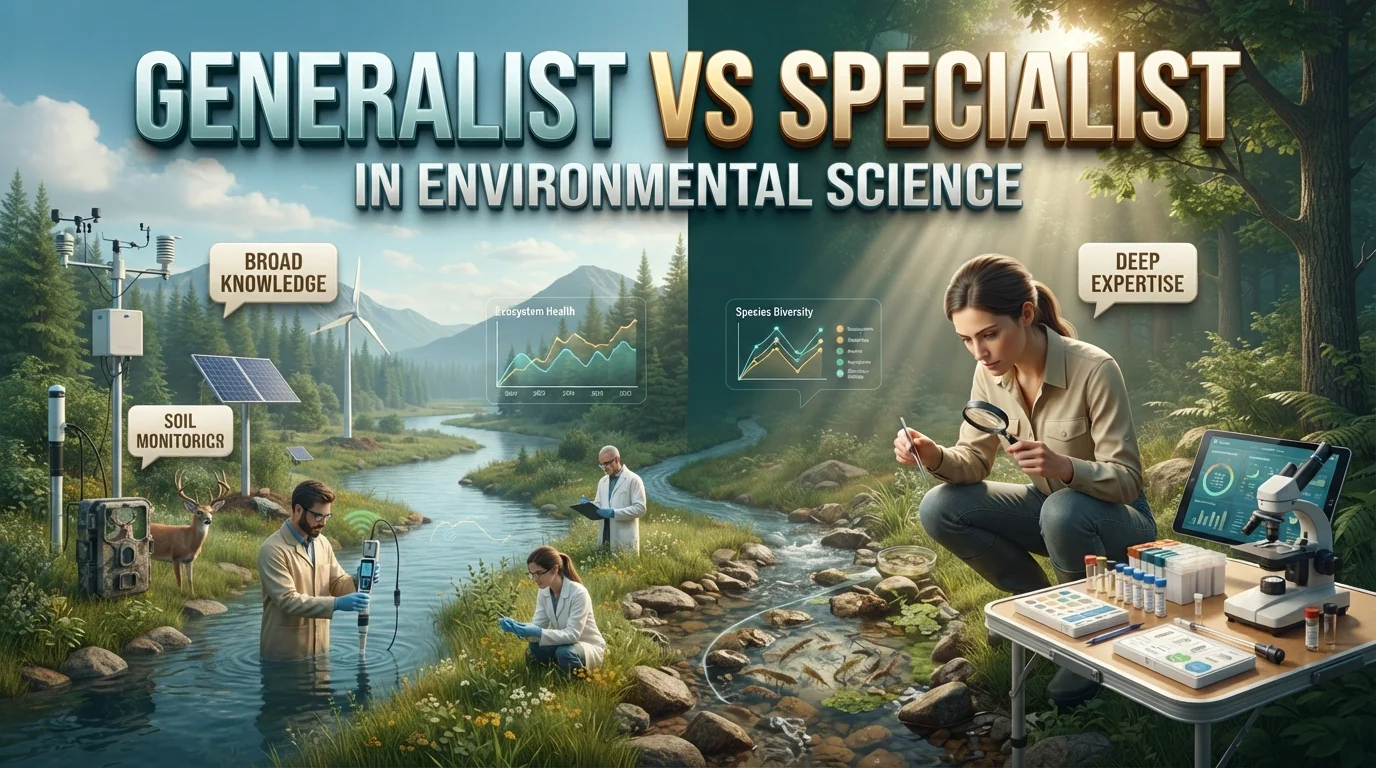
In environmental science, the distinction between a generalist and a specialist usually relates to the breadth and depth of knowledge.
An environmental science generalist may understand several areas, such as ecology, environmental policy, sustainability, pollution control, conservation, and environmental assessment. This broad knowledge can be useful when a project involves several environmental disciplines.
A specialist, on the other hand, concentrates on a particular area. Examples include:
- Environmental toxicology
- Wildlife biology
- Water-quality analysis
- Climate science
- Soil science
- Environmental impact assessment
- Conservation biology
For example, an environmental generalist might coordinate different aspects of an environmental assessment, while a water-quality specialist may focus specifically on analyzing pollutants and assessing water conditions.
The two approaches can overlap. An environmental professional may begin with broad knowledge and later develop specialist expertise in one particular field.
Generalist or Specialist Job Description
A generalist job description usually includes responsibilities across several related areas. The role may require someone to adapt to different tasks, work with multiple teams, and understand a broad range of processes.
For example, a generalist marketing position might involve:
- Content creation
- SEO
- Social media
- Email marketing
- Basic analytics
- Campaign coordination
A specialist job description normally focuses on a narrower area and expects deeper knowledge of that subject.
For example, an SEO specialist may be responsible for:
- Keyword research
- Technical SEO
- On-page optimization
- Search performance analysis
- Competitor research
- SEO reporting
The key difference is breadth versus depth. A generalist typically covers a wider range of responsibilities, whereas a specialist develops deeper expertise within a defined area.
Generalist or Specialist Jobs
Both generalist and specialist jobs exist across many industries.
Generalist roles are often designed around versatility. Employers may look for candidates who can handle different responsibilities and move between related tasks.
Examples include:
- HR generalist
- Marketing generalist
- Business operations generalist
- Environmental generalist
- Administrative generalist
Specialist roles concentrate on a specific skill or professional discipline.
Examples include:
- SEO specialist
- Tax specialist
- Cybersecurity specialist
- Environmental compliance specialist
- Data analytics specialist
A job title does not always tell the whole story. Two positions with the word generalist or specialist in their titles can have substantially different responsibilities depending on the employer.
Generalist vs Specialist Salary
There is no universal rule that specialists always earn more than generalists. Compensation depends on the particular occupation and labor market.
For example, a specialist with a highly technical and difficult-to-replace skill may receive higher compensation than a generalist in the same broad industry. In another organization, an experienced generalist who manages multiple functions may have a higher salary than an entry-level specialist.
When comparing generalist vs specialist salary, look beyond the titles and compare:
- Years of experience
- Education and certifications
- Technical or professional skills
- Level of responsibility
- Industry
- Location
- Company size
- Management responsibilities
- Demand for the particular skill
This gives a more meaningful salary comparison than treating “generalist” and “specialist” as fixed salary categories.
Generalist vs Specialist Examples
A simple example can make the distinction clearer.
Imagine a digital marketing team.
A generalist might work on SEO, content, email campaigns, social media, and basic analytics. Their strength is understanding how the different parts of marketing work together.
A specialist might work exclusively on technical SEO. They could have much deeper knowledge of crawling, indexing, structured data, site architecture, and search performance.
Another example is healthcare. A general practitioner handles a broad range of common health concerns, while a specialist focuses on a particular medical field.
In environmental science, a professional may have broad knowledge of environmental systems as a generalist, while another professional may specialize in areas such as water quality, conservation, or toxicology.
These examples show that generalist does not mean inexperienced, and specialist does not automatically mean more qualified. The terms describe the scope of someone’s professional expertise.
Generalist vs Specialist vs Versatilist
A generalist has knowledge across multiple related areas. A specialist develops deep expertise in one particular area. A versatilist is generally described as someone who combines expertise in a primary area with the ability to apply knowledge across different disciplines or situations.
For example:
- Generalist: Understands SEO, content, social media, email, and analytics.
- Specialist: Focuses deeply on technical SEO.
- Versatilist: Has deep SEO expertise but can also connect SEO with content strategy, analytics, UX, and broader digital marketing objectives.
The concept of a versatilist is useful because careers are not always limited to two categories. Professionals can develop depth in one core discipline while maintaining enough breadth to collaborate across related fields.
Ultimately, the difference is easiest to remember this way:
Generalist = broad knowledge
Specialist = deep expertise
Versatilist = depth combined with cross-disciplinary flexibility

Generalist vs Specialist: Quick Answer
A generalist has knowledge and skills across multiple areas and can adapt to different roles and challenges.
A specialist has deep expertise in a specific field and is often sought after for advanced knowledge and problem-solving within that area.
In simple terms: Generalists know a little about many things, while specialists know a lot about one thing.
What Does Generalist Mean?
Definition
A generalist is a person who possesses broad knowledge, skills, or experience across several fields rather than focusing on one narrow specialty.
Usage Context
Generalists are often valued for:
- Adaptability
- Problem-solving
- Leadership
- Cross-functional collaboration
- Strategic thinking
Common Fields Where Generalists Thrive
- Business management
- Entrepreneurship
- Project management
- Operations
- Startups
- Executive leadership
Real Examples
- A startup founder handling marketing, sales, and operations is a generalist.
- A project manager coordinating multiple departments is often a generalist.
- A business consultant may act as a generalist by understanding many business functions.
Key Insight
Generalists connect ideas, people, and processes across different areas.
What Does Specialist Mean?
Definition
A specialist is a person with advanced expertise and deep knowledge in a particular field, subject, or profession.
Usage Context
Specialists are valued for:
- Technical expertise
- Precision
- Advanced problem-solving
- Innovation within a field
- Professional authority
Common Fields Where Specialists Thrive
- Medicine
- Engineering
- Law
- Cybersecurity
- Data science
- Academic research
Real Examples
- A heart surgeon is a medical specialist.
- A cybersecurity analyst may specialize in network security.
- A tax attorney is a legal specialist.
Key Insight
Specialists solve highly specific problems that require deep expertise.
Generalist vs Specialist: Key Differences
Meaning
- Generalist: Broad knowledge across multiple areas.
- Specialist: Deep expertise in one area.
Focus
- Generalists focus on versatility.
- Specialists focus on mastery.
Career Path
- Generalists often move into leadership roles.
- Specialists often become subject-matter experts.
Problem-Solving Style
- Generalists connect different disciplines.
- Specialists dive deeply into technical issues.
Comparison Table
| Feature | Generalist | Specialist |
|---|---|---|
| Knowledge | Broad | Deep |
| Focus | Multiple areas | One specific area |
| Flexibility | High | Moderate |
| Expertise Level | Wide-ranging | Advanced |
| Career Strength | Adaptability | Authority |
| Common Roles | Manager, Founder, Consultant | Surgeon, Engineer, Lawyer |
| Problem Solving | Cross-functional | Technical and detailed |
Real-World Usage Scenarios
Example 1: Startup Company
A startup founder handles:
- Marketing
- Sales
- Hiring
- Customer service
This person is a generalist.
🎯 Lesson: Small businesses often need people with broad skills.
Example 2: Heart Surgery
A patient needs complex heart surgery.
A specialist surgeon performs the operation.
🎯 Lesson: Highly technical tasks require deep expertise.
Example 3: Corporate Leadership
A CEO understands finance, marketing, operations, and strategy.
The CEO often acts as a generalist.
🎯 Lesson: Leadership roles frequently benefit from broad knowledge.
Example 4: Software Development
A software architect may understand many technologies.
A database optimization expert may be a specialist.
🎯 Lesson: Both roles can coexist within the same organization.
Example 5: Consulting
A business consultant evaluates multiple business functions.
A tax consultant may focus only on taxation.
🎯 Lesson: The first is more generalist, while the second is more specialist.
Common Mistakes People Make
Mistake 1: Assuming Specialists Are Always Better
Many people think deeper expertise automatically leads to greater success.
Reality:
Organizations often need both generalists and specialists.
Why It Happens
Specialists are highly visible because of their expertise.
Mistake 2: Thinking Generalists Lack Expertise
Generalists are not necessarily less skilled.
They simply spread their expertise across multiple domains.
Why It Happens
People often confuse breadth with a lack of competence.
Mistake 3: Believing You Must Choose One Forever
Many professionals begin as specialists and later become generalists.
Others start broadly and eventually specialize.
Why It Happens
Career paths evolve over time.
Memory Tricks
Trick 1: General = Broad
Think:
General = General Knowledge
Broad understanding across many topics.
Trick 2: Special = Specific
Think:
Specialist = Specific Expertise
Deep focus on one area.
Trick 3: Width vs Depth
Imagine a graph:
- Generalist = Wide knowledge
- Specialist = Deep knowledge
This visual makes the difference easy to remember.
Career Advantages of Generalists
Benefits
- Greater flexibility
- Easier career transitions
- Strong leadership potential
- Better cross-functional communication
- Adaptability to changing industries
Challenges
- May lack deep expertise in one area
- Can face competition from specialists
Career Advantages of Specialists
Benefits
- Higher expertise
- Strong professional reputation
- Greater authority in a niche
- Often higher demand for technical roles
Challenges
- Less flexibility
- Skills may become outdated if industries change
Expert Insight
The modern job market increasingly values T-shaped professionals.
A T-shaped professional combines:
- Broad knowledge across many areas (generalist traits)
- Deep expertise in one area (specialist traits)
Many successful executives, entrepreneurs, consultants, and industry leaders blend both approaches. They understand multiple disciplines while maintaining expertise in at least one field.
This combination often creates the strongest long-term career advantage.