
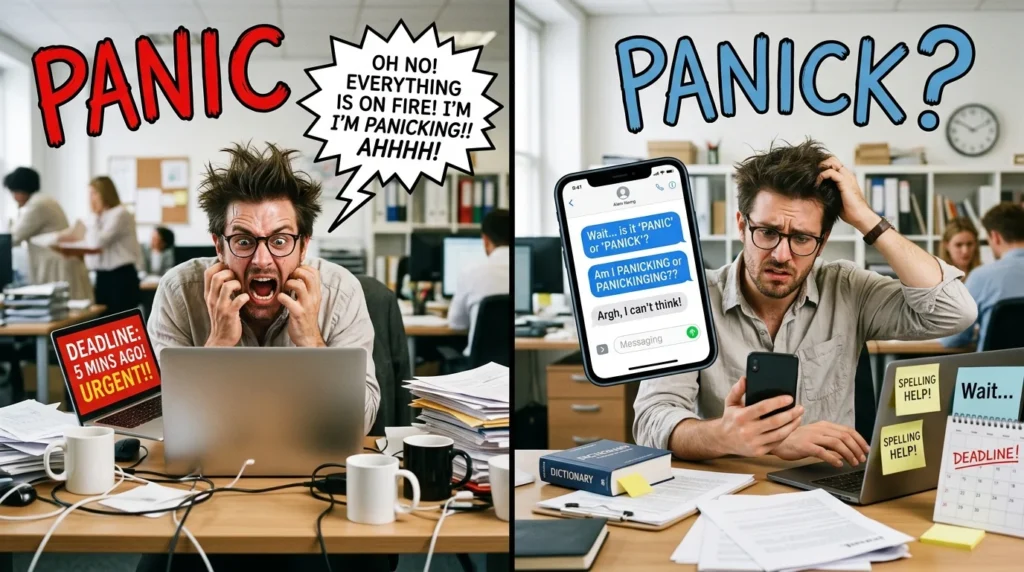
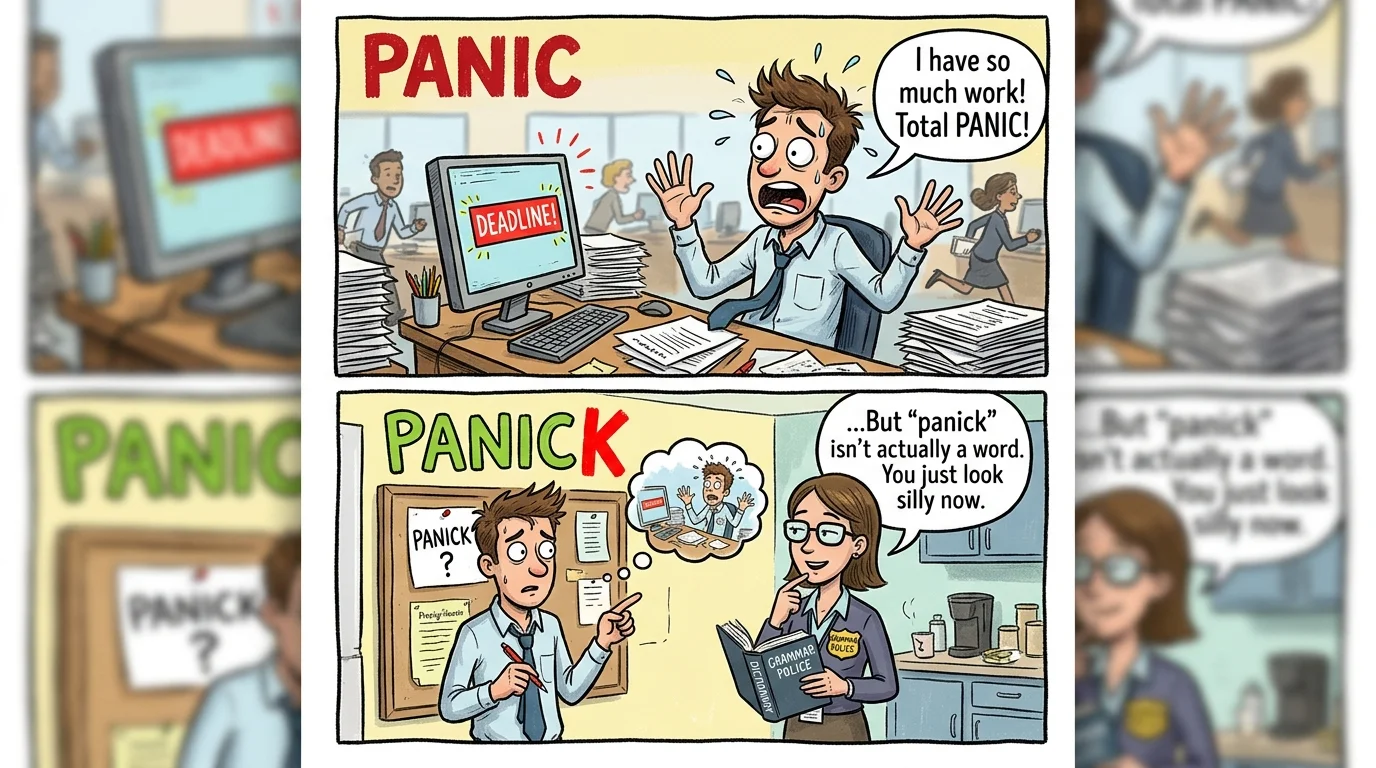
Quick Answer: Panic vs Panick
- Panic is the correct spelling.
- Panick is incorrect and should be avoided.
Quick Examples
✅ Don’t panic during an emergency.
✅ The sudden noise caused panic among the crowd.
❌ Don’t panick during an emergency.
❌ The sudden noise caused panick among the crowd.
What Does “Panic” Mean?
Panic can function as both a noun and a verb.
As a Noun
It refers to sudden fear, anxiety, or a feeling of losing control.
Examples
- A sense of panic spread through the building.
- The news caused widespread panic.
As a Verb
It means to become frightened, anxious, or overwhelmed.
Examples
- Don’t panic if you make a mistake.
- Investors panicked after the market decline.
Key Insight
Whether used as a noun or verb, panic is always spelled without a final k.
What Does “Panick” Mean?
Panick is not a recognized standard English word.
It is usually a misspelling of panic.
Why Does This Mistake Happen?
The confusion often comes from seeing words like:
- Panicked
- Panicking
Since these forms include a k, some writers mistakenly assume that the base word must also end with k.
However, the base word remains:
Panic
Examples
Incorrect:
- Please don’t panick.
- The announcement caused panick.
Correct:
- Please don’t panic.
- The announcement caused panic.
Key Insight
If you see panick, it should almost always be corrected to panic.
Panic vs Panick: Key Differences
Quick Comparison
- Panic = Correct spelling
- Panick = Misspelling
Comparison Table
| Feature | Panic | Panick |
|---|---|---|
| Correct English Spelling | Yes | No |
| Dictionary Recognition | Yes | No |
| Can Be a Noun | Yes | No |
| Can Be a Verb | Yes | No |
| Accepted in Formal Writing | Yes | No |
Real-World Usage Scenarios
Example 1
❌ Don’t panick before the exam.
✅ Don’t panic before the exam.
🎯 Lesson: The base verb is panic.
Example 2
❌ The crowd went into a state of panick.
✅ The crowd went into a state of panic.
🎯 Lesson: The noun form is also panic.
Example 3
Friend: What should I do if something goes wrong?
Friend: Stay calm and don’t panic.
🎯 Lesson: Use panic when referring to fear or anxiety.
Example 4
❌ Investors began to panick.
✅ Investors began to panic.
🎯 Lesson: The infinitive form never ends with k.
Example 5
❌ The false rumor created panick.
✅ The false rumor created panic.
🎯 Lesson: Panick is not accepted in standard English.
Common Mistakes People Make
Mistake 1: Adding an Unnecessary K
Incorrect:
- Panick
Correct:
- Panic
Why It Happens
People confuse the base word with its derived forms.
Mistake 2: Confusing Panic with Panicked
Incorrect assumption:
- Panic → Panick
Correct pattern:
- Panic → Panicked
- Panic → Panicking
Why It Happens
English spelling sometimes adds letters when suffixes are attached.
Mistake 3: Using Panick in Professional Writing
Incorrect:
- Employees started to panick.
Correct:
- Employees started to panic.
Why It Matters
Misspellings reduce clarity and professionalism.
Memory Tricks to Remember the Difference
Trick 1: The Base Word Has No K
Remember:
Panic = No K
Only derived forms may add a k.
Trick 2: Think of Similar Words
Words ending in -ic often do not end with k:
- Music
- Logic
- Public
- Panic
Trick 3: Remember the Pattern
Correct:
- Panic
- Panicked
- Panicking
Incorrect:
- Panick
- Panicked
- Panicking
The k appears only when adding certain suffixes.
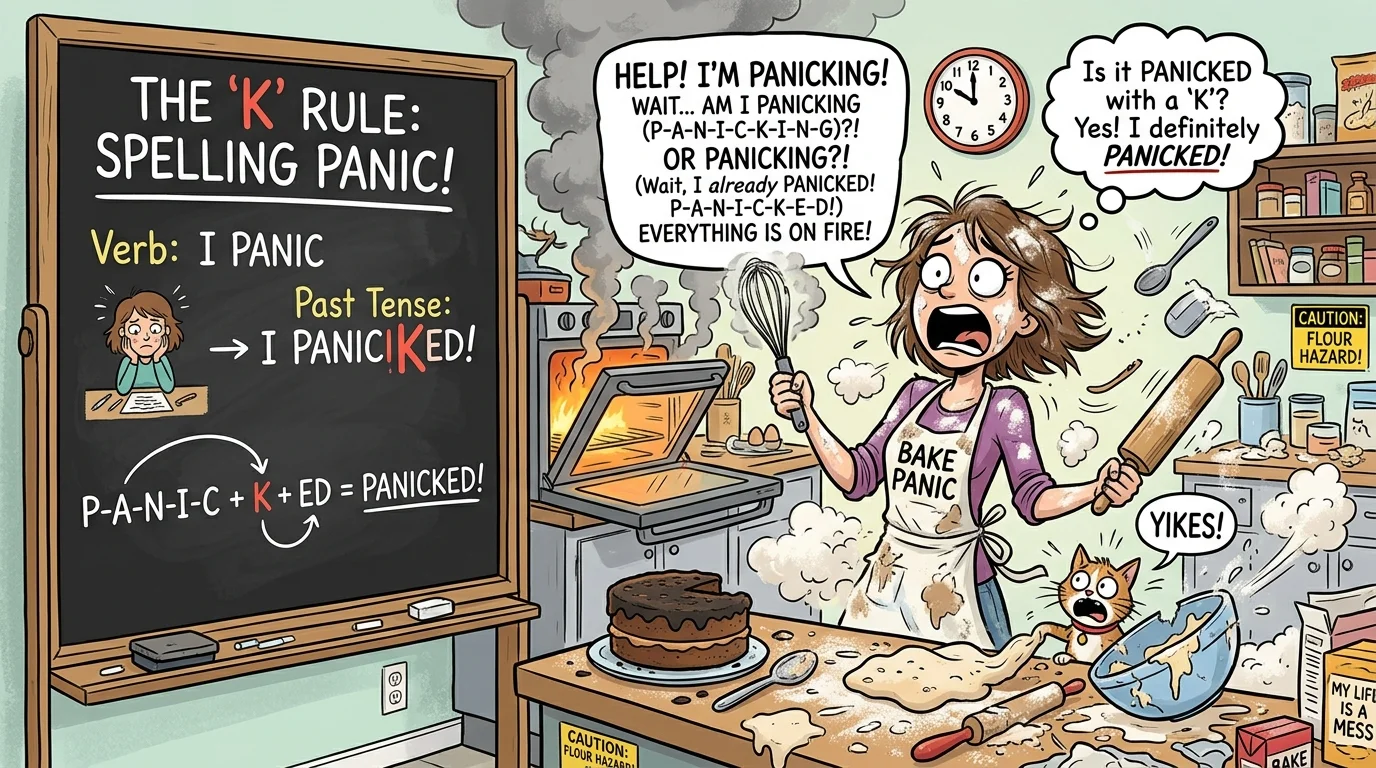
Expert Insight: Why Panicked Has a K but Panic Doesn’t
One reason people write panick is because they frequently encounter:
- Panicked
- Panicking
In English spelling, a k is often inserted before suffixes like -ed and -ing to preserve the hard “c” sound.
Without the k, words such as:
- Paniced
- Panicing
might be pronounced differently.
Therefore:
- Panic → Panicked
- Panic → Panicking
But the original base word remains panic.
This same pattern appears in other English words ending in -ic.