
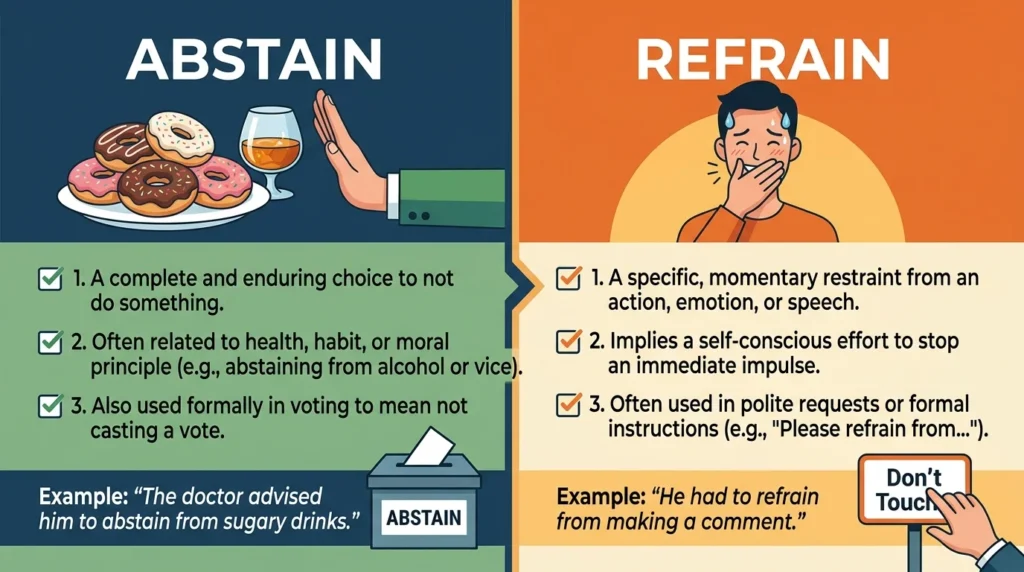
Quick Answer: Abstain vs. Refrain
Abstain means to deliberately choose not to participate in, vote on, or consume something.
Several members abstained from voting.
Refrain means to deliberately stop yourself from doing or saying something.
Please refrain from using your phone.
The easiest rule
Abstain = choose not to participate or consume
Refrain = hold yourself back from an action
A useful shortcut:
Abstain from something
Refrain from doing something
What Does “Abstain” Mean?
Abstain means to deliberately avoid or not take part in something, especially something that you could otherwise participate in.
It is commonly used in three major contexts:
- Voting
- Consumption
- Deliberately avoiding an activity
Abstain From Voting
This is one of the most common uses.
Three members abstained from voting.
This means they chose not to vote.
They did not necessarily vote against the proposal. They simply did not cast a vote.
Abstain From Alcohol
He decided to abstain from alcohol.
This means he deliberately does not drink alcohol.
Abstain From Certain Foods
She abstains from eating meat.
This means she deliberately avoids consuming meat.
🎯 Key Insight: Abstain often describes a deliberate decision not to participate in or consume something.
What Does “Refrain” Mean?
Refrain means to deliberately stop yourself from doing, saying, or expressing something.
It often involves self-control or restraint.
Examples
Please refrain from smoking.
She refrained from commenting.
He refrained from making a decision until he had more information.
I tried to refrain from laughing.
In these sentences, someone has the opportunity or temptation to act but holds themselves back.
🎯 Key Insight: Refrain focuses on restraining yourself from an action.

Abstain vs. Refrain: Main Difference
| Feature | Abstain | Refrain |
|---|---|---|
| Basic meaning | Deliberately avoid or not participate | Hold yourself back from an action |
| Common contexts | Voting, food, alcohol, participation | Speaking, acting, commenting, behavior |
| Typical structure | Abstain from + noun/gerund | Refrain from + noun/gerund |
| Main idea | Choosing not to take part | Exercising restraint |
| Example | She abstained from voting. | She refrained from commenting. |
| Memory clue | Don’t participate/consume | Hold yourself back |
Bottom Line
Abstain = deliberately choose not to participate or consume.
Refrain = deliberately hold yourself back from doing something.
Abstain in Voting and Politics
One of the clearest uses of abstain is voting.
Five members voted in favor, three voted against, and two abstained.
The two people who abstained did not vote for or against the proposal.
Important Distinction
Abstaining is not the same as voting against something.
Vote against = actively choose “no.”
Abstain = do not cast a vote for either side.
Example
The committee member abstained from the vote because of a conflict of interest.
This means the member deliberately did not participate in the vote.
🎯 Lesson: Abstain is especially natural when talking about votes and formal decisions.
Abstain From Food, Alcohol, or Other Activities
Abstain can also mean deliberately avoiding consumption or participation.
Food
He abstains from eating meat.
Alcohol
She has chosen to abstain from alcohol.
Certain Activities
The athlete abstained from strenuous activity before the competition.
In these contexts, abstain suggests a deliberate choice to avoid something.
🎯 Lesson: When someone intentionally avoids consuming or participating in something, abstain is often a strong choice.
Refrain From Speaking or Acting
Refrain is especially common when someone chooses not to say or do something.
Speaking
She refrained from commenting on the issue.
Laughing
He struggled to refrain from laughing.
Responding
I decided to refrain from responding immediately.
Acting
The company refrained from taking legal action.
In each case, the person could have acted but chose to hold back.
🎯 Lesson: Refrain is strongly associated with self-restraint.
Abstain vs. Refrain: Real-World Usage Scenarios
Scenario 1: Voting
A: Did the committee member vote?
B: No. She abstained from voting.
🎯 Lesson: Use abstain when someone deliberately does not participate in a vote.
Scenario 2: A Public Statement
A: Did the spokesperson comment on the accusation?
B: No. He refrained from commenting.
🎯 Lesson: Use refrain when someone deliberately holds back from speaking.
Scenario 3: Consumption
A: Does she drink alcohol?
B: No. She abstains from alcohol.
🎯 Lesson: Abstain is commonly used for deliberate avoidance of consumption.
Scenario 4: Anger
A: Why didn’t you respond to his insult?
B: I refrained from arguing with him.
🎯 Lesson: Refrain emphasizes self-control.
Scenario 5: Formal Instructions
Please refrain from using your phone during the examination.
🎯 Lesson: Refrain from is common in formal instructions and notices.
Abstain vs. Refrain: Can They Be Interchanged?
Sometimes, but not always naturally.
Consider:
She abstained from commenting.
This is grammatically possible, but it sounds more formal and may suggest deliberate avoidance.
More natural:
She refrained from commenting.
Why?
Because commenting is an action from which someone can hold themselves back.
Now consider:
The senator refrained from voting.
This is grammatically possible, but:
The senator abstained from voting.
is more precise and idiomatic in a voting context.
The Difference in Emphasis
Abstained from voting → deliberately did not participate in the vote.
Refrained from commenting → deliberately held back from making a comment.
🎯 Key Insight: Grammar alone does not determine the best choice. Collocation and context matter.
Common Mistakes With Abstain and Refrain
Mistake 1: Using “Abstain” Without “From”
A common error is:
❌ She abstained voting.
Correct:
✅ She abstained from voting.
The normal construction is:
abstain from + noun/gerund
Mistake 2: Using “Refrain” Without “From”
❌ Please refrain using your phone.
Correct:
✅ Please refrain from using your phone.
Again:
refrain from + noun/gerund
Mistake 3: Saying “Abstain to Vote”
❌ He abstained to vote.
Correct:
✅ He abstained from voting.
Abstain from is the standard construction.
Mistake 4: Saying “Refrain to Comment”
❌ She refrained to comment.
Correct:
✅ She refrained from commenting.
Mistake 5: Thinking Abstain Means Vote Against
❌ He abstained, so he voted against the proposal.
Not necessarily.
Abstaining means he did not cast a vote for or against.
🎯 Lesson: Abstain ≠ oppose.
Abstain From vs. Refrain From
Both expressions are followed by from.
Abstain From
abstain from + noun/gerund
Examples:
abstain from alcohol
abstain from voting
abstain from eating meat
abstain from certain activities
Refrain From
refrain from + noun/gerund
Examples:
refrain from speaking
refrain from commenting
refrain from laughing
refrain from making assumptions
Important Grammar Rule
After from, use a noun or -ing form.
refrain from commenting ✅
abstain from voting ✅
Not:
❌ refrain from to comment
❌ abstain from to vote
Abstain vs. Refrain in Formal English
Both words are relatively formal compared with everyday alternatives.
Abstain
Common in:
- Legal writing
- Political contexts
- Voting
- Health and lifestyle discussions
- Formal decisions
The director abstained from the vote.
Refrain
Common in:
- Formal instructions
- Polite requests
- Official notices
- Professional writing
Please refrain from entering this area.
Please refrain from making personal comments.
🎯 Key Insight: Refrain from is particularly useful when politely telling someone not to do something.
Abstain vs. Avoid
These words are related but not identical.
Avoid
Means stay away from or prevent something.
Try to avoid unnecessary arguments.
Abstain
Implies a more deliberate decision not to participate in or consume something.
He abstains from alcohol.
Compare
I avoid sugary drinks.
This simply means I try not to have them.
I abstain from sugary drinks.
This sounds more deliberate, formal, or principled.
Refrain vs. Avoid
Refrain
Emphasizes self-restraint.
She refrained from responding angrily.
Avoid
Emphasizes staying away from something.
She avoided the argument.
Simple Difference
Refrain = hold yourself back
Avoid = stay away
Memory Tricks: Abstain vs. Refrain
🗳️ Trick 1: Abstain = Abstain From Participation
Think of a vote:
Abstain = don’t take part
This makes abstain easy to remember in political and formal contexts.
🤐 Trick 2: Refrain = Restrain
Notice that refrain sounds similar to restrain.
Refrain = restrain yourself
So:
refrain from speaking
refrain from arguing
refrain from laughing
⭐ One-Line Memory Trick
Abstain = don’t participate or consume.
Refrain = hold yourself back.
Expert Insight: The Semantic Difference
The two verbs overlap because both describe deliberate non-action, but they focus on different aspects.
Abstain often presents non-participation or avoidance as a choice or decision.
The member abstained from voting.
The emphasis is on not participating.
Refrain presents non-action as restraint.
She refrained from responding.
The emphasis is on controlling an action that might otherwise have occurred.
This is why certain collocations are strongly preferred:
abstain from voting
refrain from commenting
Although alternatives may be grammatically possible, native usage and context determine which sounds most natural.
Quick Test: Abstain or Refrain?
1. The senator ________ from voting.
Answer: abstained
Voting is a classic context for abstain.
2. Please ________ from talking during the presentation.
Answer: refrain
This is a request for someone to hold back from an action.
3. She decided to ________ from alcohol.
Answer: abstain
This describes deliberate avoidance of consumption.
4. He ________ from making a rude comment.
Answer: refrained
He held himself back from saying something.
5. Two committee members ________ from the vote.
Answer: abstained
They chose not to participate in the vote.
6. I tried to ________ from laughing.
Answer: refrain
The speaker tried to control the urge to laugh.