
Quick Answer: Bryce or Zion?
Choose Bryce Canyon if you want unique hoodoos, spectacular viewpoints, cooler temperatures, and a park that can be explored relatively quickly.
Choose Zion if you want enormous canyon scenery, more extensive hiking opportunities, dramatic trails, and a larger variety of outdoor experiences.
The easiest rule
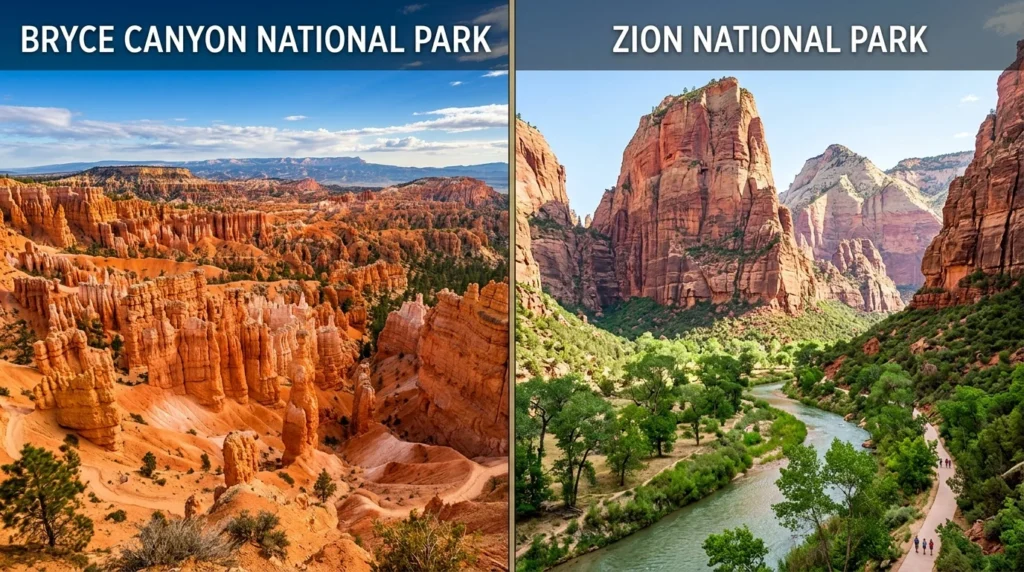
Bryce = hoodoos and amphitheaters.
Zion = towering cliffs and canyons.
If you have enough time, visiting both is ideal because their landscapes are dramatically different.
What Is Bryce Canyon?
Bryce Canyon National Park is famous for its collection of tall, thin rock formations called hoodoos.
These formations create one of the most distinctive landscapes in the American Southwest.
What Makes Bryce Special?
Bryce is especially known for:
- Hoodoos
- Bryce Amphitheater
- Sunrise and sunset views
- Red, orange, and white rock formations
- High-elevation scenery
- Scenic overlooks
- Hiking among the hoodoos
- Dark night skies
One of Bryce’s biggest advantages is that you can see an enormous amount of scenery from relatively accessible viewpoints.
Example
The Bryce Amphitheater is filled with thousands of colorful hoodoos.
🎯 Key Insight: If your main goal is seeing unusual rock formations unlike almost anywhere else, Bryce is hard to beat.
What Is Zion?
Zion National Park is famous for its immense sandstone cliffs and dramatic canyon landscape.
Unlike Bryce, where the hoodoos dominate the scenery, Zion’s defining visual feature is the scale of its canyon walls.
What Makes Zion Special?
Zion is particularly known for:
- Zion Canyon
- Massive sandstone cliffs
- The Virgin River
- The Narrows
- Angels Landing
- Scenic drives
- Extensive hiking
- Canyoneering
- Diverse elevations and ecosystems
Example
Zion Canyon is surrounded by enormous sandstone cliffs.
🎯 Key Insight: If you want dramatic canyon scenery and major hiking adventures, Zion is the stronger choice.
Bryce vs. Zion: Main Difference
| Feature | Bryce Canyon | Zion |
|---|---|---|
| Famous for | Hoodoos | Massive canyon walls |
| Landscape | Amphitheaters and rock spires | Deep canyons and cliffs |
| Elevation | Higher | Generally lower in the main canyon |
| Weather | Often cooler | Often warmer |
| Hiking | Excellent | Exceptional |
| Major adventure hikes | Moderate to strenuous | Moderate to very strenuous |
| Best for photography | Hoodoos, sunrise, sunset | Cliffs, canyon landscapes |
| Water features | Less prominent | Virgin River and The Narrows |
| Time needed | Can be experienced in a shorter visit | Benefits from more time |
| Overall atmosphere | Otherworldly and compact | Vast and dramatic |
Bottom Line
Bryce is the better choice for unique geological formations.
Zion is the better choice for dramatic canyon hiking and adventure.
Bryce Canyon
Bryce Canyon National Park is famous for its distinctive hoodoos, tall rock formations shaped by erosion, and colorful natural amphitheaters. Located in southern Utah, the park offers panoramic viewpoints, scenic drives, and hiking trails that take visitors among its unusual geological formations.
Some of the most popular places to explore include Sunrise Point, Sunset Point, Inspiration Point, and Bryce Point. These viewpoints provide excellent opportunities to appreciate the park’s red, orange, and pink rock formations.
Visitors who want to explore beyond the overlooks can hike the Queen’s Garden and Navajo Loop trails. These routes descend into the amphitheater, allowing hikers to see the hoodoos up close.
Bryce Canyon is an excellent destination for photographers, families, and travelers who enjoy scenic landscapes without needing to undertake strenuous hikes. However, the park’s high elevation can bring cooler temperatures, particularly in the morning, evening, and winter months.
Bryce vs. Zion: Which Is Better?
Bryce Canyon and Zion National Park offer two very different experiences, so the better destination depends on your interests, available time, and preferred activities.
Bryce Canyon is best known for its hoodoos, natural amphitheaters, and panoramic viewpoints. Zion, by comparison, features towering sandstone cliffs, deep canyons, the Virgin River, and a wide variety of hiking opportunities.
Bryce Canyon is often easier to explore during a short visit because many of its major viewpoints are relatively close together. Zion offers more opportunities for immersive canyon exploration, but popular trails and transportation arrangements may require additional planning.
If you enjoy photography, unusual geological formations, and scenic overlooks, Bryce Canyon may be the better choice. If you prefer hiking, river walks, dramatic canyon walls, and outdoor adventures, Zion may appeal to you more.
Neither park is universally better. If you have enough time, visiting both provides a more varied experience of southern Utah’s landscapes.
Bryce vs. Zion Reddit
Discussions on Reddit about Bryce Canyon versus Zion often reflect different travel preferences. Some travelers favor Zion for its towering cliffs, adventurous hikes, and immersive canyon scenery, while others prefer Bryce Canyon for its unusual rock formations, panoramic viewpoints, and compact sightseeing experience.
Three common perspectives help explain why visitors disagree about which park is better.
Zion is often preferred for hiking and adventure. Visitors who enjoy challenging trails, dramatic canyon scenery, and walking alongside the Virgin River may find Zion more rewarding. Popular activities include the Riverside Walk, The Narrows, and Angels Landing, although trail access, conditions, and permit requirements vary.
Bryce Canyon appeals to travelers who enjoy distinctive landscapes. Its hoodoos and natural amphitheaters create scenery that differs significantly from Zion. The major viewpoints also make it possible to experience much of the park’s signature scenery without committing to a long hike.
Crowds can influence the experience. Zion’s popular trailheads and main canyon can become particularly busy during peak travel periods. Bryce Canyon also attracts many visitors, especially around its most famous viewpoints, but the overall experience differs because of the park’s layout and activities.
These opinions are subjective rather than a definitive ranking. The most useful approach is to choose according to your priorities instead of relying entirely on other travelers’ preferences.

Zion vs. Bryce vs. Arches
Zion National Park, Bryce Canyon National Park, and Arches National Park are three major destinations in Utah, each offering a different type of landscape.
Zion is famous for its enormous sandstone cliffs, deep canyons, river scenery, and adventurous hiking trails. It is a strong choice for travelers who want to explore the landscape on foot and experience the scale of a dramatic canyon.
Bryce Canyon is known for its hoodoos, colorful rock formations, and natural amphitheaters. Its scenic overlooks make it particularly appealing to photographers and travelers who want to see unusual geological features during a relatively short visit.
Arches National Park, near Moab, is recognized for its natural sandstone arches, rock fins, pinnacles, and balanced rocks. Delicate Arch is one of its most famous landmarks, and the park also offers scenic drives and hiking opportunities.
Here is how the three parks compare:
Feature | Zion | Bryce Canyon | Arches |
|---|---|---|---|
Signature scenery | Towering cliffs and deep canyons | Hoodoos and natural amphitheaters | Natural sandstone arches |
Best for | Canyon exploration and varied hiking | Scenic viewpoints and unusual rock formations | Desert landscapes and arch photography |
Short sightseeing visit | Possible with planning | Particularly convenient | Possible with selected stops |
Hiking experience | Ranges from easy walks to strenuous trails | Rim walks and trails among hoodoos | Trails to arches and rock formations |
Landscape | Dramatic canyon terrain | High-elevation rocky amphitheaters | Open desert and sculpted sandstone |
If you have limited time, Zion and Bryce Canyon make a practical combination because they are relatively close to one another. Arches is farther east, near Moab, so including all three generally requires additional driving time and a longer itinerary.
Choose Zion for canyon adventures, Bryce for hoodoos and viewpoints, and Arches for its distinctive natural stone arches.
Zion Canyon
Zion Canyon is the main scenic canyon area of Zion National Park. It features towering sandstone walls, the Virgin River, forested riverbanks, and trails that allow visitors to explore the landscape at different levels of difficulty.
One of the most accessible experiences is the Riverside Walk, a relatively gentle route that follows the Virgin River. It is a good option for visitors who want to enjoy the canyon without attempting a strenuous hike, although accessibility and trail conditions should be checked before visiting.
The Narrows is another famous Zion experience. This hike follows the Virgin River through a narrow section of the canyon, where tall rock walls rise above the water. Because the route involves walking in the river, water levels, flash-flood risk, temperature, and equipment are important safety considerations.
Angels Landing is a demanding hike known for its exposed sections and dramatic views. A permit is required for the route beyond Scout Lookout. Visitors who prefer a less strenuous experience can enjoy other canyon walks and viewpoints instead.
Zion Canyon is particularly appealing to travelers who want to feel surrounded by massive rock walls rather than simply observe the landscape from a distant overlook. Its combination of river scenery, hiking trails, and towering cliffs makes it one of Utah’s most recognizable natural destinations.
Zion and Bryce Canyon Map
Zion National Park and Bryce Canyon National Park are both located in southern Utah, but they occupy different areas of the region. Zion is near Springdale, while Bryce Canyon lies farther northeast.
The drive between the parks generally takes around 1.5 to 2 hours, depending on the route, traffic, and road conditions. Many travelers visit Zion first and then continue north toward Bryce Canyon, although the best direction depends on their starting point and onward destination.
When planning the drive, allow extra time for scenic stops, parking, and possible delays. The Zion–Mount Carmel Highway offers a scenic route, but vehicle restrictions may affect larger vehicles. Check current road conditions and restrictions before choosing your route.
Transportation within Zion also requires planning. Shuttle services operate in the main canyon during much of the busy visitor season, and private vehicle access can be restricted on certain roads at particular times.
Bryce Canyon is generally more straightforward to explore by vehicle, with major viewpoints connected by a scenic park road. However, winter weather and temporary closures can affect access.
A well-planned route helps you spend more time exploring both parks and less time dealing with transportation issues.
Zion and Bryce Canyon in 2 Days
Two days is enough to experience major highlights of Zion and Bryce Canyon if you prioritize scenic viewpoints and a limited number of hikes. It is not enough to explore every trail, so choosing activities in advance will make your trip more enjoyable.
Day 1: Explore Zion National Park
Begin early to make the most of your first day in Zion.
Morning: Head into Zion Canyon and explore its major viewpoints. If transportation arrangements allow, use the park shuttle to reach popular stops without worrying about finding parking at each location.
Late morning: Walk the Riverside Walk if the trail is open and conditions are suitable. This relatively gentle route provides an excellent introduction to Zion’s river scenery and towering canyon walls.
Afternoon: Choose an additional hike based on your fitness, available time, and trail conditions. Travelers seeking a challenging adventure can research the requirements for Angels Landing, while those who prefer an easier visit can explore other accessible walks and viewpoints.
Evening: Spend some time in Springdale, the nearby gateway town, where you can find accommodation and prepare for the following day’s drive.
Day 2: Visit Bryce Canyon National Park
Leave early for Bryce Canyon, allowing approximately 1.5 to 2 hours for the drive from the Zion area under typical conditions.
Morning: Start at Sunrise Point and Sunset Point to appreciate the park’s distinctive hoodoos and natural amphitheater.
Late morning: Continue to Inspiration Point and Bryce Point for additional panoramic views. These overlooks provide different perspectives of the park’s colorful rock formations.
Afternoon: If you have enough time and the trail is suitable, hike the Queen’s Garden and Navajo Loop combination. This route takes you below the rim and among the hoodoos, offering a closer look at the geological features that make Bryce Canyon unique.
Later afternoon: If time permits, visit another viewpoint along the park’s scenic road before continuing to your next destination.
Where Should You Stay?
For a more relaxed trip, spend the first night near Zion and the second night near Bryce Canyon if your travel schedule extends beyond two days. If you have only one overnight stay, you can still visit both parks, but you will need to limit your hiking and allow enough time for the drive.
Before departing, check weather forecasts, park alerts, shuttle schedules, and trail conditions. Seasonal changes can significantly affect hiking plans, particularly in The Narrows at Zion and on trails descending into Bryce Canyon’s amphitheater.
The most practical strategy is to spend the first day exploring Zion’s dramatic canyon scenery and the second day discovering Bryce Canyon’s distinctive hoodoos. This approach provides a rewarding introduction to both parks without making the itinerary unnecessarily rushed.
Bryce vs. Zion for Scenery
Bryce Canyon Scenery
Bryce’s scenery is unusual because erosion has created countless narrow rock pillars known as hoodoos.
From viewpoints around the amphitheater, you can see large concentrations of these formations packed together.
The landscape often looks almost otherworldly.
Zion Scenery
Zion offers a different kind of drama.
Its towering sandstone cliffs rise dramatically around Zion Canyon, creating a sense of enormous scale.
Instead of looking down into a colorful amphitheater filled with hoodoos, you often find yourself surrounded by towering canyon walls.
Which Has Better Scenery?
It depends on your preference.
Choose Bryce if you prefer:
- Hoodoos
- Colorful formations
- Panoramic amphitheater views
- Unusual geology
Choose Zion if you prefer:
- Massive cliffs
- Deep canyons
- River landscapes
- Dramatic vertical scenery
🎯 Verdict: Bryce wins for uniqueness; Zion wins for scale.
Bryce vs. Zion for Hiking
Both parks offer excellent hiking, but the experiences are different.
Hiking at Bryce
Bryce offers trails that allow visitors to descend among the hoodoos and experience the formations from below.
Popular hiking areas include:
- Navajo Loop
- Queen’s Garden
- Fairyland area
- Rim Trail
One of the major advantages is that even a relatively short hike can provide spectacular geological scenery.
Hiking at Zion
Zion is particularly famous for challenging and iconic hikes.
Well-known trails include:
- Angels Landing
- The Narrows
- Observation Point area
- Emerald Pools
- Canyon Overlook
Zion provides opportunities for both casual visitors and experienced hikers.
🎯 Verdict: Zion generally offers a broader and more adventurous hiking experience, while Bryce offers extraordinary scenery on a smaller scale.
Bryce vs. Zion for Families
Bryce Canyon
Bryce can be an excellent choice for families because many of its major viewpoints are relatively accessible.
Children can quickly appreciate the unusual hoodoos without needing to complete a long hike.
Zion
Zion can also be excellent for families, but the canyon’s terrain and some popular trails may require more planning.
Some activities can involve:
- Steep elevation changes
- Exposure
- Water
- Long distances
- Seasonal conditions
🎯 Verdict: Bryce may be easier for families who want spectacular scenery with less strenuous hiking.
Bryce vs. Zion for Experienced Hikers
If you’re specifically looking for challenging outdoor adventures, Zion usually has the edge.
Its landscape provides opportunities for:
- Steep climbs
- Canyon hiking
- River hiking
- Technical canyoneering
- Long backcountry routes
Bryce still offers challenging trails, particularly when elevation changes and longer routes are involved, but Zion has a stronger reputation for major adventure hikes.
🎯 Verdict: Zion wins for serious hiking and adventure.
Bryce vs. Zion for Photography
Bryce
Bryce is particularly impressive for:
- Sunrise
- Sunset
- Hoodoo close-ups
- Panoramic amphitheater photographs
- Night-sky photography
The repeated shapes and colors of the hoodoos create exceptional compositions.
Zion
Zion is ideal for:
- Towering cliffs
- Canyon photography
- River scenes
- Dramatic shadows
- Large-scale landscapes
🎯 Verdict: If you’re a photographer seeking unusual formations, choose Bryce. If you want massive canyon landscapes, choose Zion.
Bryce vs. Zion for Sunrise and Sunset
Bryce is particularly famous for sunrise because light can gradually illuminate the hoodoos and bring out their colors.
The viewpoints around the Bryce Amphitheater are especially popular.
Zion also provides spectacular light, particularly when the canyon walls are illuminated by changing sunlight.
Best Choice
Sunrise: Bryce has a particularly strong advantage.
Canyon light: Zion is spectacular.
Bryce vs. Zion for Weather
One important difference is elevation.
Bryce sits at a significantly higher elevation than Zion’s main canyon area, so temperatures can be noticeably cooler.
Bryce
Expect:
- Cooler conditions
- Snow in winter
- Cold mornings
- Significant seasonal variation
Zion
The lower elevation of the main canyon generally means:
- Warmer temperatures
- Hotter summer conditions
- Greater heat exposure on some hikes
🎯 Lesson: If you dislike extreme heat, Bryce can be more comfortable, especially compared with Zion during hot periods.
Bryce vs. Zion for Winter
Winter can dramatically change the appearance of both parks.
Bryce in Winter
Snow can cover the hoodoos and create a striking contrast between white snow and red-orange rock.
Bryce is particularly beautiful when its amphitheater is snow-covered.
Zion in Winter
Snow can also create spectacular scenery in Zion, but conditions vary significantly throughout the park.
Some higher-elevation routes may have challenging winter conditions.
🎯 Verdict: Bryce is especially spectacular for a snowy winter landscape.
Bryce vs. Zion for a Short Trip
If you only have a few hours or one day, Bryce can be easier to experience comprehensively.
You can visit major viewpoints and potentially complete a short hike without needing to cover a huge area.
Zion can require more planning, especially if you’re trying to experience major hikes and canyon areas.
If You Have One Day
Bryce: Great for viewpoints + a hike.
Zion: Great for a focused hike + canyon experience.
🎯 Verdict: Bryce is often easier to experience efficiently in a very short visit.
Bryce vs. Zion for a Longer Trip
With several days available, Zion becomes particularly rewarding because there are more opportunities to explore different trails and outdoor activities.
A longer trip also allows you to experience Zion beyond its most famous attractions.
Best Strategy
If your itinerary allows it:
Visit both.
The parks are close enough geographically to be combined into a southern Utah road trip, while offering very different landscapes.
Bryce vs. Zion: Real-World Travel Scenarios
Scenario 1: “I Love Unique Landscapes.”
Choose:
Bryce
The hoodoos provide a landscape that is visually distinctive.
🎯 Lesson: Unique geology → Bryce.
Scenario 2: “I Want an Epic Hike.”
Choose:
Zion
Zion offers iconic hikes and more extensive adventure opportunities.
🎯 Lesson: Serious hiking → Zion.
Scenario 3: “I’m Traveling With Young Children.”
Consider:
Bryce
Its viewpoints make it possible to enjoy spectacular scenery without relying entirely on long or strenuous hikes.
🎯 Lesson: Easy scenic access → Bryce.
Scenario 4: “I Want to Walk Through a Canyon.”
Choose:
Zion
The Narrows provides one of the park’s signature canyon experiences, subject to conditions and access requirements.
🎯 Lesson: Canyon adventure → Zion.
Scenario 5: “I Only Have One Day.”
Consider:
Bryce
You can see its major landscape highlights efficiently.
🎯 Lesson: Short visit + maximum visual impact → Bryce.
Common Mistakes When Choosing Bryce or Zion
Mistake 1: Thinking the Parks Look the Same
They don’t.
Bryce is dominated by hoodoos and amphitheaters, while Zion is dominated by massive cliffs and canyon landscapes.
Mistake 2: Assuming Zion Is Always Better Because It Is More Famous
Popularity doesn’t automatically make one park better for every traveler.
Someone who loves geological formations may prefer Bryce.
Someone who loves challenging hikes may prefer Zion.
Mistake 3: Underestimating Zion’s Heat
Zion can become very hot during warm periods.
Visitors planning strenuous hikes should consider temperature, sun exposure, water requirements, and current trail conditions.
Mistake 4: Assuming Bryce Is Easy Because It Is Smaller
Bryce’s elevation and steep trail sections can still make some hikes physically demanding.
Shorter does not always mean effortless.
Mistake 5: Visiting Only the Most Famous Viewpoint
Both parks reward exploration beyond a single overlook.
If time permits, add at least one hike or additional viewpoint to your itinerary.
Memory Trick: Bryce vs. Zion
🟠 Bryce = Hoodoos
Think:
Bryce = bizarre rock spires
🏔️ Zion = Canyon
Think:
Zion = giant canyon walls
⭐ One-Line Memory Trick
Bryce shows you the rocks.
Zion surrounds you with them.
Expert Insight: Why the Landscapes Look So Different
The dramatic difference between the parks comes from their geology, elevation, and erosion patterns.
At Bryce, erosion has sculpted sedimentary rock into thousands of narrow pillars known as hoodoos.
At Zion, erosion by the Virgin River and other geological processes has helped carve a massive canyon through sandstone.
As a result:
Bryce emphasizes vertical rock spires.
Zion emphasizes enormous canyon walls.
This geological difference is why visiting both parks doesn’t feel repetitive.
Quick Test: Bryce or Zion?
Choose Bryce if you want:
- 🟠 Hoodoos
- 🌅 Spectacular sunrise
- 📸 Unique geological photography
- ❄️ Snowy scenery
- 🌡️ Cooler temperatures
- 🚶 A relatively compact park experience
- 👨👩👧👦 Accessible scenic viewpoints
Choose Zion if you want:
- 🏔️ Massive cliffs
- 🥾 Serious hiking
- 🌊 River and canyon experiences
- 🧗 Adventure
- 🌄 Dramatic canyon scenery
- 🏕️ More extensive outdoor exploration