
Quick Answer: Placemats vs. Chargers
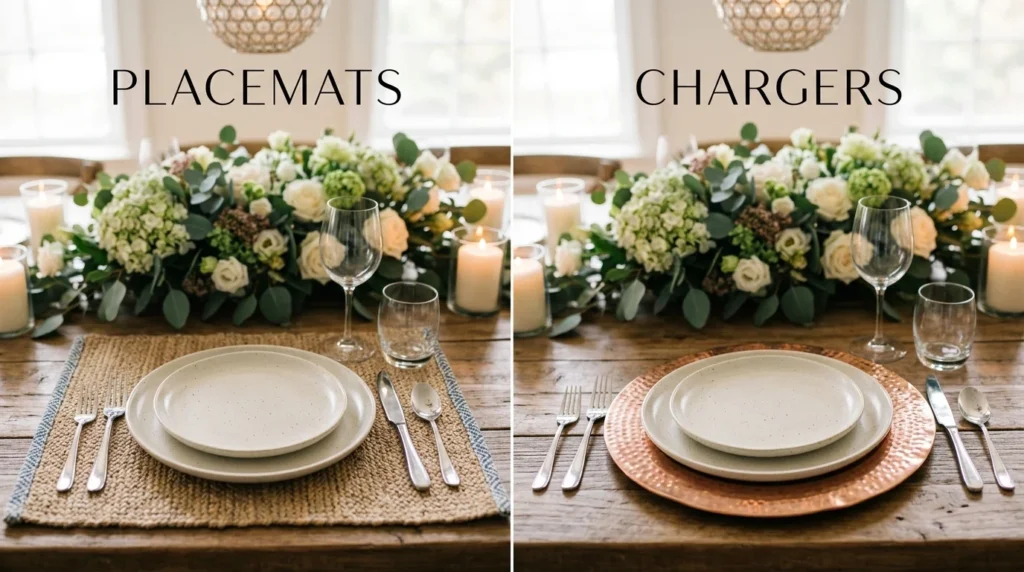
Placemats are larger mats that sit directly on the table and hold a person’s dishes, utensils, and glassware.
Chargers are decorative base plates placed directly under the dinner plate.
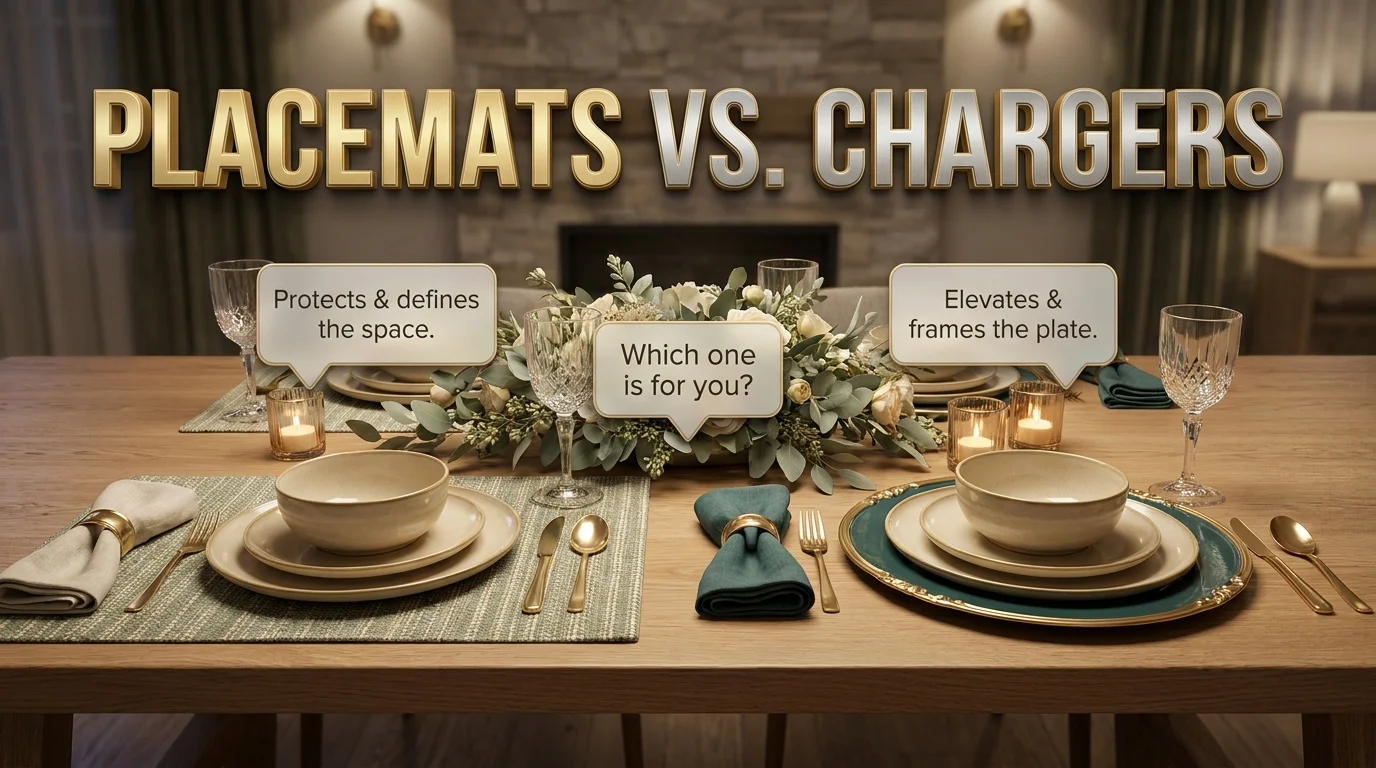
Placemat = mat under the entire place setting
Charger = decorative plate under the dinner plate
You can also use both together for a layered tablescape, although the style should be intentional.
What Is a Placemat?
A placemat is a flat piece of material placed on a dining table underneath an individual’s place setting.
Placemats can be made from:
- Fabric
- Cotton
- Linen
- Bamboo
- Rattan
- Plastic
- Vinyl
- Woven materials
What Does a Placemat Do?
A placemat can:
- Protect the table from spills
- Protect against heat and scratches
- Define each person’s dining space
- Add color and texture
- Make casual meals look more organized
- Create a decorative foundation for dishes
Examples
She placed a linen placemat beneath each dinner plate.
The woven placemats added texture to the dining table.
🎯 Key Insight: A placemat creates a surface or zone for the entire place setting.
What Is a Charger?
A charger is a large decorative plate or plate-like base that sits underneath the dinner plate.
It is sometimes called a:
- Charger plate
- Service plate
- Underplate
The exact terminology and use can vary by dining tradition and table-setting style.
What Does a Charger Do?
A charger can:
- Add visual layering
- Frame the dinner plate
- Protect the tablecloth or table surface from some spills
- Create a formal appearance
- Add color, texture, or contrast
Example
The gold charger was placed underneath the white dinner plate.
🎯 Key Insight: A charger is primarily a decorative foundation for the dinnerware, rather than a surface for the entire place setting.
Placemats vs. Chargers: Main Difference
| Feature | Placemats | Chargers |
|---|---|---|
| What they are | Flat mats | Large decorative plates/base plates |
| Position | Directly on the table | Directly underneath the dinner plate |
| Supports | Usually the entire place setting | Mainly the dinner plate |
| Main purpose | Protection + decoration | Decoration + formal presentation |
| Material | Fabric, woven material, plastic, etc. | Ceramic, metal, glass, wood, acrylic, etc. |
| Typical size | Larger rectangular or round mat | Usually plate-shaped |
| Style | Casual to formal | Usually decorative/formal |
| Can be used alone? | Yes | Yes |
| Can be combined? | Yes | Yes |
Bottom Line
A placemat defines the whole place setting.
A charger frames the dinner plate.
Where Does a Placemat Go?
A placemat goes directly on the table.
The dinnerware is then arranged on top of it.
A typical arrangement might look like:
Table → Placemat → Dinner Plate → Bowl/Salad Plate
Utensils and glassware are also positioned around the plate within the general area defined by the placemat.
Simple Visual Order
TABLE
↓
PLACEMAT
↓
DINNERWARE
🎯 Lesson: The placemat is the foundation of the place setting.
Where Does a Charger Go?
A charger goes:
Table → Charger → Dinner Plate
The charger is larger than the dinner plate, allowing its edge to remain visible around the plate.
Simple Visual Order
TABLE
↓
CHARGER
↓
DINNER PLATE
↓
FOOD
🎯 Lesson: The charger sits immediately underneath the dinner plate.
Can You Use Placemats and Chargers Together?
Yes.
Using both can create a more layered and sophisticated table setting.
The arrangement would be:
Table → Placemat → Charger → Dinner Plate
This works particularly well for:
- Holiday dinners
- Weddings
- Dinner parties
- Formal entertaining
- Seasonal tablescapes
- Decorative tables
Example
A woven placemat can provide texture, while a metallic charger creates contrast underneath a white dinner plate.
🎯 Key Insight: Using both isn’t necessary, but they can complement each other when their colors, textures, and proportions work together.
Placemats vs. Chargers for Everyday Dining
For everyday meals, placemats are usually the more practical choice.
They provide a defined area for the place setting and can protect the table from spills and scratches.
Choose Placemats If You Want:
- Easy cleanup
- Everyday protection
- A casual look
- Color and texture
- A defined dining space
Best everyday choice: Placemats
Placemats vs. Chargers for Formal Dining
For a more formal or decorative table, chargers can create a polished layered appearance.
They’re particularly effective when paired with:
- Dinner plates
- Salad plates
- Coordinating napkins
- Table linens
- Decorative centerpieces
Best for formal presentation: Chargers
Placemats vs. Chargers for Table Protection
Both can provide some protection, but they protect different areas.
Placemat
A placemat covers a relatively large area beneath the place setting.
It can help protect against:
- Food spills
- Minor scratches
- Heat from dishes
- Water marks
Charger
A charger primarily provides a decorative base beneath the dinnerware.
It can catch some crumbs or spills around the plate, but it does not replace a placemat as a broad table-protection surface.
🎯 Verdict: For practical table protection, placemats generally have the advantage.
Placemats vs. Chargers for Style
Choose Placemats for:
- Rustic tables
- Coastal decor
- Farmhouse style
- Casual dining
- Natural textures
- Everyday tables
Choose Chargers for:
- Formal tables
- Elegant dinners
- Holiday settings
- Weddings
- Glamorous tablescapes
- Layered dinnerware
Of course, either can be styled in many different ways.
Placemats vs. Chargers: Real-World Usage Scenarios
Scenario 1: Everyday Family Dinner
Use woven placemats under each place setting.
🎯 Lesson: Placemats are practical and easy for everyday dining.
Scenario 2: Formal Dinner Party
Place decorative chargers underneath the dinner plates.
🎯 Lesson: Chargers add a formal, layered appearance.
Scenario 3: Holiday Table
Use a textured placemat, a decorative charger, and a white dinner plate.
🎯 Lesson: You can combine both for a richer tablescape.
Scenario 4: Minimalist Table
Use a simple dinner plate directly on the table without either.
🎯 Lesson: Neither item is mandatory for every meal.
Scenario 5: Protecting a Wooden Table
Place a placemat underneath each setting.
🎯 Lesson: Placemats provide broader protection for the table surface.
Common Mistakes With Placemats and Chargers
Mistake 1: Thinking a Charger Is a Serving Plate
A charger is generally a base or decorative plate, not the plate from which food is normally eaten.
The dinner plate sits on top of it.
Mistake 2: Putting the Charger Under the Placemat
This reverses the normal layering.
The typical arrangement is:
Table → Placemat → Charger → Dinner Plate
not:
Table → Charger → Placemat → Dinner Plate
🎯 Why? The charger is designed to sit directly beneath the dinnerware.
Mistake 3: Treating a Placemat Like a Plate
A placemat is not dinnerware.
It defines the area where the place setting is arranged.
Mistake 4: Assuming You Must Use Both
You don’t.
You can use:
- Placemats alone
- Chargers alone
- Both
- Neither
The right choice depends on the occasion and your desired style.
How to Choose Between Placemats and Chargers
Choose Placemats If:
- You want practical table protection
- You’re setting the table for everyday meals
- You want texture or color
- You prefer a casual or relaxed look
- You want to define each person’s place
Choose Chargers If:
- You want a formal appearance
- You’re creating a layered table setting
- You want to highlight your dinner plates
- You’re hosting a special occasion
- You want a decorative foundation beneath the plate
Choose Both If:
- You want a layered tablescape
- The colors complement each other
- The table isn’t visually overcrowded
- You’re hosting a special dinner
Memory Tricks: Placemats vs. Chargers
🧺 Trick 1: Placemat = Place
Think:
Place + mat = mat for your place setting
It holds the general dining area for one person.
🍽️ Trick 2: Charger = Plate Under Plate
Think:
Charger = a decorative plate that “charges” the dinner plate’s presentation.
The charger goes directly beneath the dinner plate.
⭐ One-Line Memory Trick
Placemat = under the place setting.
Charger = under the dinner plate.
Expert Insight: Why Chargers Are Called “Chargers”
The word charger has a long history in table-setting terminology and is associated with a large plate or platter used as part of a formal place setting.
In modern tablescaping, chargers are frequently used as decorative underplates.
They help create visual layers by adding a border around the dinner plate.
This makes the table setting look more structured and intentional.
Quick Test: Placemat or Charger?
1. “Put the ________ on the table before arranging the utensils.”
Answer: Placemat
2. “Place the dinner plate on the ________.”
Answer: Charger
3. “The woven ________ protects the tabletop.”
Answer: Placemat
4. “The gold ________ created a formal look.”
Answer: Charger
5. “Can I use both?”
Answer: Yes.
A common layering arrangement is:
Placemat → Charger → Dinner Plate