
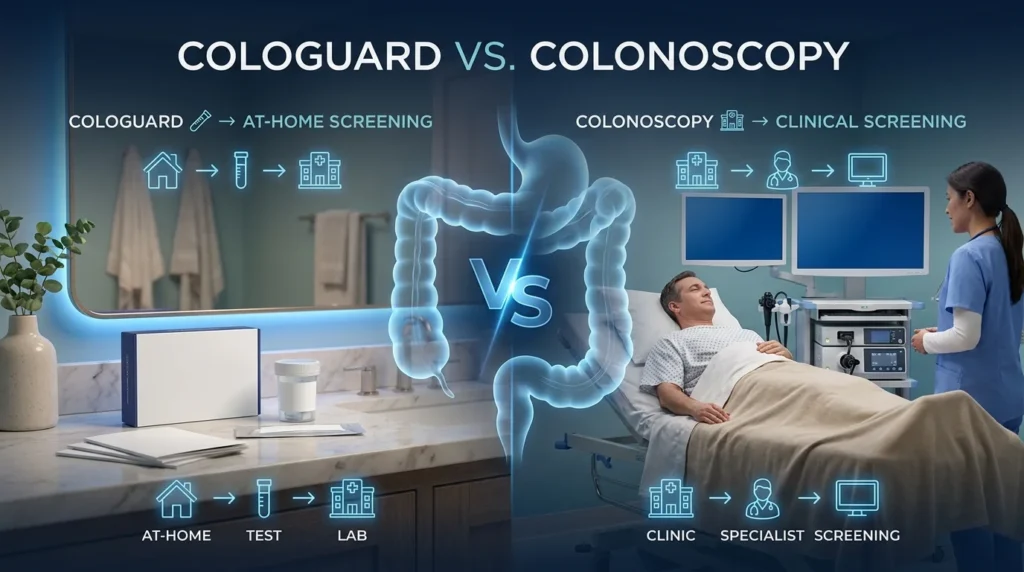
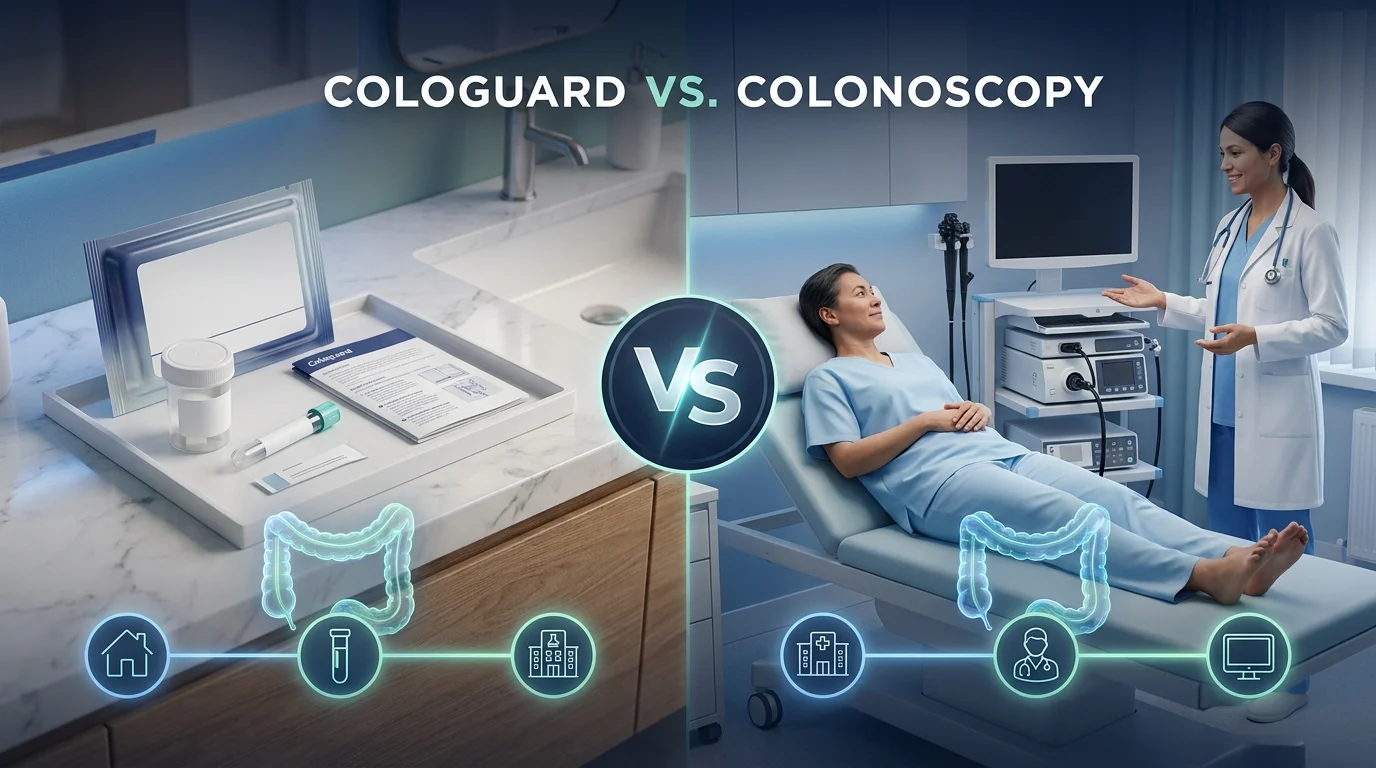
Quick Answer: Cologuard vs. Colonoscopy
Cologuard is easier and noninvasive, requiring a stool sample collected at home. Colonoscopy requires bowel preparation and a medical procedure, but it allows doctors to directly inspect the colon and remove suspicious polyps.
Cologuard = convenient, noninvasive screening
Colonoscopy = direct examination + ability to remove polyps
An important point: a positive Cologuard result requires follow-up colonoscopy.
What Is Cologuard?
Cologuard is a stool-based colorectal cancer screening test. It looks for certain DNA markers and blood in stool that can be associated with colorectal cancer or advanced precancerous lesions.
The sample is collected at home and sent to a laboratory.
Advantages of Cologuard
- Noninvasive
- No colonoscopy procedure
- Collected at home
- No bowel preparation for the test
- Generally convenient
- Does not require sedation
The current Cologuard Plus test is intended for adults age 45 and older who are at average risk for colorectal cancer.
Important Limitation
A negative Cologuard result does not guarantee that cancer or precancerous lesions are absent. False-negative and false-positive results can occur.
What Is a Colonoscopy?
A colonoscopy is a procedure in which a doctor uses a flexible instrument with a camera to examine the inside of the colon and rectum.
Unlike Cologuard, colonoscopy allows the doctor to:
- Directly inspect the colon
- Identify polyps
- Take biopsies when appropriate
- Remove many polyps during the procedure
- Investigate abnormal findings
This makes colonoscopy both a screening and potentially therapeutic procedure.
The Main Drawback
Colonoscopy generally requires:
- Bowel preparation
- A medical appointment
- Temporary dietary restrictions according to the preparation instructions
- Sedation in many settings
- Recovery time afterward
🎯 Key Insight: Colonoscopy is more invasive than Cologuard, but it provides something a stool test cannot: direct visualization and removal of many precancerous polyps during the same procedure.
Cologuard vs. Colonoscopy: Main Difference
| Feature | Cologuard | Colonoscopy |
|---|---|---|
| Type | Stool-based screening test | Medical procedure |
| Invasive? | No | Yes |
| Where performed? | Sample collected at home | Medical facility |
| Bowel preparation | No | Yes |
| Sedation | No | Often used |
| Directly views colon? | No | Yes |
| Can remove polyps? | No | Yes |
| Positive result | Requires colonoscopy | Doctor can investigate immediately |
| Convenience | High | Lower |
| Best suited for | Average-risk screening | Screening and direct evaluation |
Cologuard vs. Colonoscopy: Screening vs. Diagnosis
This distinction is extremely important.
Cologuard
Cologuard is a screening test for certain average-risk adults.
It does not allow a doctor to look directly inside your colon.
Colonoscopy
Colonoscopy can be used for screening, diagnosis, and treatment of certain findings.
For example, if a doctor discovers a polyp, it can often be removed during the procedure.
🎯 Lesson: Cologuard can tell you that something may need further investigation; colonoscopy can actually look for the source and address certain findings.
What Happens if Cologuard Is Positive?
A positive Cologuard result does not mean you have cancer.
It means the test detected findings associated with colorectal cancer or precancer that require further evaluation.
The recommended next step is:
Positive Cologuard → follow-up colonoscopy
The follow-up colonoscopy is important because the stool test cannot determine exactly what caused the abnormal result.
What Happens if Cologuard Is Negative?
A negative result means the test did not detect the targeted abnormal DNA and/or blood in the stool.
However:
Negative does not mean zero risk.
False negatives can occur, so people using stool-based screening need to continue screening according to an appropriate schedule.
For Cologuard Plus, the company currently states that the American Cancer Society recommends repeating screening three years after a negative result.
Cologuard vs. Colonoscopy: Real-World Usage Scenarios
Scenario 1: Someone Wants an At-Home Option
“I don’t want a procedure and would rather collect a sample at home.”
A stool-based screening test such as Cologuard may be an option for an eligible average-risk adult.
🎯 Lesson: Convenience is one of Cologuard’s biggest advantages.
Scenario 2: Someone Wants the Colon Directly Examined
“I want a test that allows the doctor to see inside my colon and remove polyps if necessary.”
Colonoscopy provides that capability.
🎯 Lesson: Colonoscopy offers direct visualization and intervention.
Scenario 3: Cologuard Comes Back Positive
“My Cologuard result was positive. Can I just repeat Cologuard?”
A positive result should generally be followed by a colonoscopy, rather than simply repeating the stool test.
🎯 Lesson: Cologuard is not designed to replace the follow-up colonoscopy after a positive result.
Scenario 4: Someone Has Higher Colorectal Cancer Risk
“I have a personal or first-degree family history of colorectal cancer.”
Cologuard may not be appropriate because it is intended for average-risk screening and is not a replacement for diagnostic or surveillance colonoscopy in high-risk individuals.
🎯 Lesson: Risk level matters when choosing a screening strategy.
Common Mistakes About Cologuard and Colonoscopy
Mistake 1: Thinking Cologuard Replaces Every Colonoscopy
❌ “If I do Cologuard, I’ll never need a colonoscopy.”
Not necessarily.
A positive Cologuard result requires follow-up colonoscopy.
Mistake 2: Thinking a Negative Cologuard Guarantees No Cancer
❌ “My Cologuard was negative, so I definitely don’t have cancer.”
That’s too strong.
False-negative results can occur.
Mistake 3: Thinking Colonoscopy Is Only for People With Symptoms
Colonoscopy can also be used for routine colorectal cancer screening in appropriate patients.
It can also be used to evaluate abnormal screening results.
Mistake 4: Assuming Cologuard Is Appropriate for Everyone
Cologuard is intended for average-risk adults 45 and older. The manufacturer specifically says it should not be used as a replacement for diagnostic or surveillance colonoscopy in high-risk individuals.
Cologuard vs. Colonoscopy: Which Is Better?
There is no single answer for everyone.
Cologuard may appeal to people who want:
- An at-home test
- A noninvasive option
- No bowel preparation
- No sedation
- Greater convenience
Colonoscopy may be preferable when:
- Direct examination of the colon is needed
- Polyps need to be removed
- A previous screening test was positive
- A doctor recommends diagnostic evaluation
- A person has circumstances that make stool-based screening inappropriate
🎯 Expert Takeaway: The most important question isn’t simply “Which test is better?” It’s “Which screening strategy is appropriate for this person’s risk and circumstances?”
Cologuard vs. Colonoscopy: Risk Level Matters
Cologuard is specifically designed for average-risk screening.
The manufacturer advises against using it in people with certain higher-risk circumstances, including:
- A personal history of colorectal cancer
- A personal history of adenomas
- Inflammatory bowel disease
- Certain hereditary syndromes
- A first-degree family history of colorectal cancer
In those situations, you should discuss the appropriate screening strategy with your healthcare professional.
Memory Trick: Cologuard vs. Colonoscopy
🏠 Cologuard = Home
Think:
Cologuard → collect stool at home
🔎 Colonoscopy = Camera
Think:
Colonoscopy → camera looks inside the colon
⭐ One-Line Memory Trick
Cologuard screens the stool; colonoscopy sees the colon.
Expert Insight: Why Both Tests Exist
Colorectal cancer screening involves balancing effectiveness, convenience, patient preference, risk, and follow-up.
A test that is easier for people to complete can help increase screening participation.
But a stool-based test and colonoscopy serve different purposes.
A stool test can detect signals associated with disease without physically examining the colon. Colonoscopy, by contrast, allows direct visualization and removal of many polyps.
That’s why a positive stool test is not the end of the screening process—it is a reason to move to a more definitive examination.
Quick Test: Cologuard or Colonoscopy?
1. At-home stool collection
Answer: Cologuard ✅
2. Directly viewing the colon
Answer: Colonoscopy ✅
3. Removing a detected polyp
Answer: Colonoscopy ✅
4. Positive Cologuard result
Next step: Colonoscopy ✅
5. No bowel preparation
Answer: Cologuard ✅
6. Screening intended for average-risk adults 45+
Answer: Cologuard can be an option ✅