
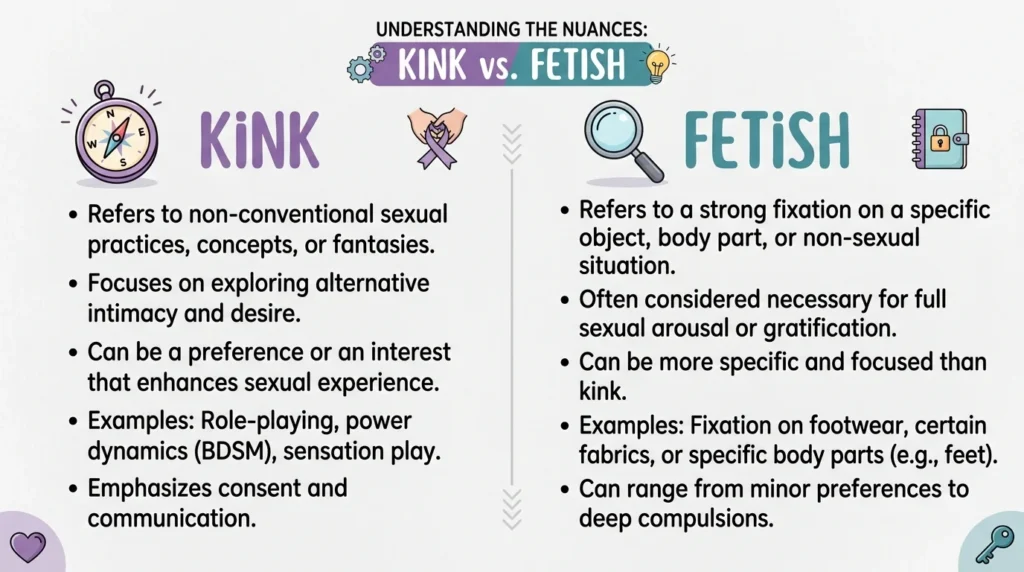

Quick Answer: Kink vs. Fetish
Kink = a broad, unconventional sexual interest or preference.
Fetish = a specific sexual focus on an object, body part, material, or particular stimulus.
A fetish can be considered a type of kink in some everyday usage, but not every kink is a fetish.
What Does “Kink” Mean?
Kink is a broad term for a sexual interest, activity, fantasy, or preference that falls outside what a person considers conventional sexual behavior.
The word is generally used as an informal, nonjudgmental term.
Examples of Kink
Depending on the individual, kink can involve interests such as:
- Role-play
- Power dynamics
- Specific scenarios or fantasies
- Bondage
- Certain forms of consensual sensation play
- Particular relationship dynamics
A person can enjoy a kink without being sexually focused on a particular physical object.
For example:
Someone may enjoy role-play as part of their sexual life.
🎯 Key Insight: Kink is the broader category. It can describe an interest, activity, fantasy, or dynamic rather than one specific object or stimulus.
What Does “Fetish” Mean?
A fetish generally refers to sexual interest or arousal associated with a specific object, body part, material, or other particular stimulus.
Examples can include sexual interest focused on:
- A particular material
- A specific type of clothing
- A particular body part
- A specific object
For example:
Someone may experience sexual attraction specifically associated with a particular material.
🎯 Key Insight: A fetish is usually more specific and stimulus-focused than the broader term kink.
Kink vs. Fetish: Main Difference
| Feature | Kink | Fetish |
|---|---|---|
| Meaning | Broad unconventional sexual interest | Specific sexual focus or stimulus |
| Scope | Broad | More specific |
| Can involve objects? | Yes | Often |
| Can involve activities? | Yes | Sometimes |
| Can involve fantasies? | Yes | Yes |
| Can involve a body part? | Yes | Yes |
| Must involve one specific stimulus? | No | Typically more focused |
| Relationship between terms | Broad category | Can be considered a type of kink |
Kink vs. Fetish: The Key Distinction
The easiest distinction is breadth.
Kink
Think:
“I have a particular sexual interest or preference.”
That interest could involve an activity, fantasy, dynamic, or scenario.
Fetish
Think:
“My sexual interest is specifically connected to this particular object, body part, material, or stimulus.”
🎯 Lesson: A fetish is generally more specific, while kink is the broader umbrella term.
Real-World Usage Scenarios
Scenario 1: Role-Play
Person: “I enjoy role-playing particular characters with my partner.”
This would generally be described as a kink, rather than necessarily a fetish.
🎯 Lesson: Kink can involve an activity or scenario rather than an object.
Scenario 2: Specific Material
Person: “I’m specifically sexually attracted to a particular material.”
This may be described as a fetish.
🎯 Lesson: A strong sexual focus on a particular material is more specific than the general concept of kink.
Scenario 3: Power Dynamic
Person: “I enjoy consensual power dynamics with my partner.”
This is generally described as a kink.
🎯 Lesson: A relationship dynamic can be a kink without being a fetish.
Scenario 4: Specific Body Part
Person: “My sexual interest is specifically focused on a particular body part.”
This can be described as a fetish.
🎯 Lesson: Fetishes can involve specific body parts rather than objects alone.
Common Mistakes About Kink and Fetish
Mistake 1: Assuming They’re Exact Synonyms
❌ “Kink and fetish mean exactly the same thing.”
Not quite.
They overlap, but kink is broader.
Mistake 2: Thinking Every Kink Is a Fetish
❌ Not necessarily.
A kink can involve an activity, fantasy, or dynamic without being centered on one particular stimulus.
Mistake 3: Thinking Every Fetish Is Automatically a Mental Disorder
❌ This is an important misconception.
Having an unusual sexual interest does not automatically mean someone has a mental disorder.
Clinical terminology distinguishes between an unusual sexual interest and a condition involving significant distress, impairment, or harm.
Mistake 4: Assuming the Terms Are Always Used Clinically
Kink is primarily an informal term.
Fetish can be used both casually and in clinical contexts, where it has a more specific meaning.
🎯 Lesson: Context matters when interpreting these words.
Kink vs. Fetish in Psychology
In everyday language, people often use fetish simply to describe a specific sexual interest.
Clinical terminology is more precise.
A fetishistic interest does not automatically mean a person has a psychiatric disorder. A clinical diagnosis involves additional criteria, including clinically significant distress or impairment, or behavior involving non-consenting individuals.
This distinction is important because unusual does not automatically mean unhealthy.
Memory Trick: Kink vs. Fetish
🔄 Kink = Broad
Think:
Kink = a broad sexual preference or interest.
🎯 Fetish = Focused
Think:
Fetish = a specific sexual focus.
⭐ One-Line Memory Trick
Kink is the umbrella; fetish is a more specific type of sexual interest.
Expert Insight: Why People Confuse the Terms
The confusion exists because fetish can be used as a broad everyday word, while kink is also used loosely.
In casual conversation, someone might call almost any unconventional sexual preference a “fetish.”
However, a more precise distinction is:
Kink describes the broader category of unconventional sexual interests, while fetish generally describes a specific sexual focus associated with an object, body part, material, or stimulus.
The terminology can vary between communities, everyday conversation, and clinical psychology, so the exact meaning depends on context.
Quick Test: Kink or Fetish?
1. A sexual interest involving a particular role-play scenario
More likely: Kink ✅
2. A sexual focus specifically involving a particular material
More likely: Fetish ✅
3. A consensual power dynamic
More likely: Kink ✅
4. A sexual focus on a particular body part
More likely: Fetish ✅
5. An unconventional sexual preference in general
More likely: Kink ✅