
Quick Answer
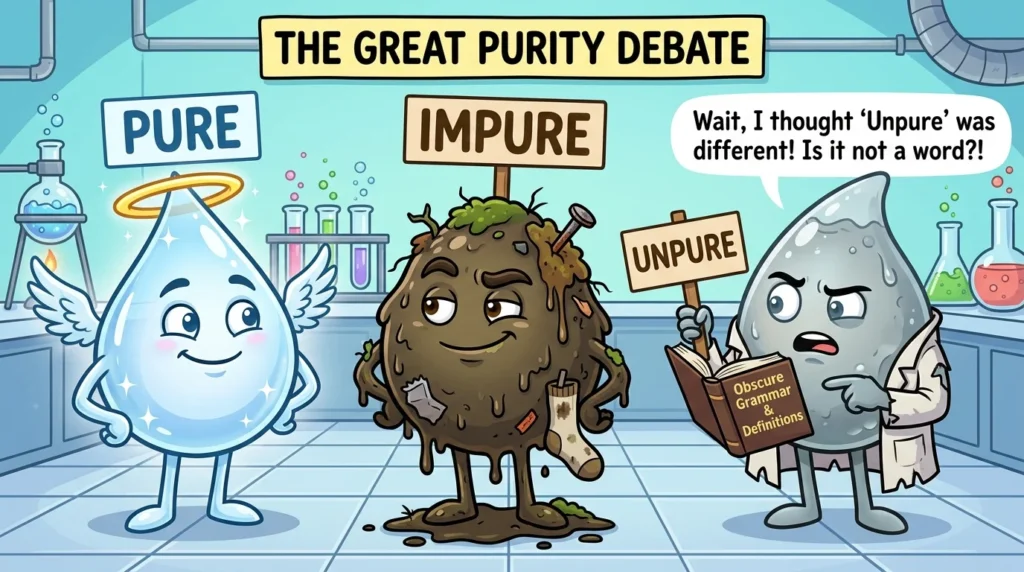
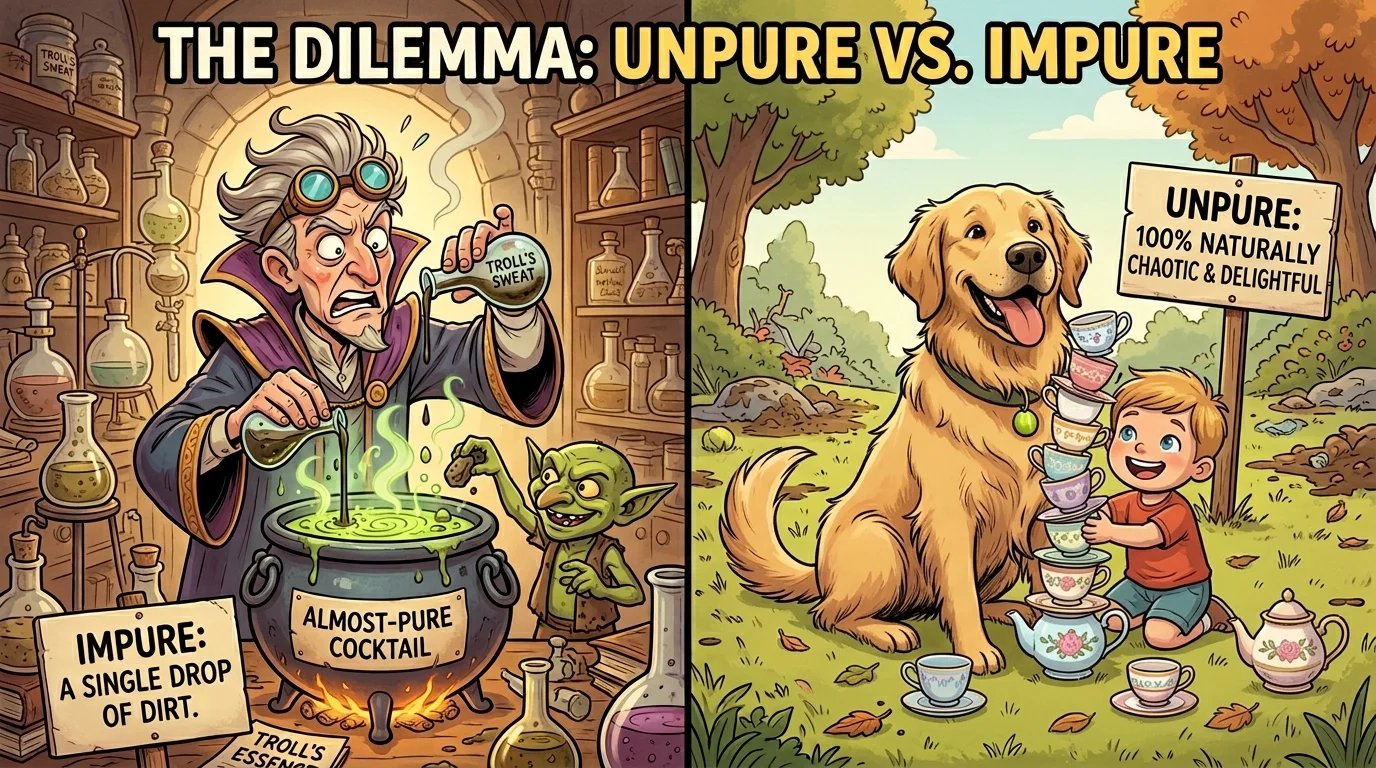
Impure is the correct and standard English word meaning “not pure” or “contaminated.”
Unpure is a rare, nonstandard, or outdated form that is generally avoided in modern English.
In almost all situations, you should use impure instead of unpure.
Deep Explanation: Unpure
Definition
Unpure literally means “not pure.” However, it is not the preferred form in modern English.
Most dictionaries either label it as rare, archaic, or significantly less common than impure.
Usage Rules
In contemporary English, unpure is rarely used in:
- Academic writing
- Professional communication
- Journalism
- Scientific writing
- Everyday conversation
Context
You might occasionally encounter unpure in:
- Historical texts
- Older literature
- Religious writings
- Poetic language
- Deliberate stylistic choices
Examples
Rare or outdated usage:
- The water was considered unpure.
- They sought to remove all unpure elements.
Modern alternatives:
- The water was considered impure.
- They sought to remove all impure elements.
Key Insight
While unpure may be understandable, it sounds unnatural to most modern English speakers.
Deep Explanation: Impure
Definition
Impure is an adjective meaning:
- Not pure
- Contaminated
- Mixed with unwanted substances
- Morally or spiritually unclean in certain contexts
Usage Rules
Use impure whenever you want to describe something lacking purity.
Common Contexts
- Impure water
- Impure gold
- Impure chemicals
- Impure thoughts
- Impure motives
- Impure air
Real Examples
- The laboratory rejected the impure sample.
- Impure gold contains other metals.
- The filter removes impure particles from the water.
- Some traditions refer to impure thoughts or actions.
Key Insight
Impure is the accepted standard form in modern English and appears regularly in dictionaries, textbooks, and professional writing.
Unpure vs Impure
Key Differences
- Impure is standard English.
- Unpure is rare and generally avoided.
- Impure appears frequently in modern writing.
- Unpure sounds unusual to most native speakers.
- Professional and academic writing strongly favor impure.
Comparison Table
| Feature | Unpure | Impure |
|---|---|---|
| Meaning | Not pure | Not pure |
| Standard English | Rarely | Yes |
| Modern Usage | Uncommon | Very common |
| Professional Writing | Avoid | Use |
| Dictionary Acceptance | Limited | Widely accepted |
| Example | Unpure water (rare) | Impure water (correct) |
Real-World Usage Scenarios
Scenario 1
Student: “The sample was unpure.”
Teacher: “The standard word is impure.”
🎯 Lesson: Scientific and academic writing uses impure.
Scenario 2
Jeweler: “This gold is impure.”
Customer: “So it contains other metals?”
🎯 Lesson: Impure commonly describes materials mixed with other substances.
Scenario 3
Writer: “The air was impure due to pollution.”
Editor: “That’s the correct usage.”
🎯 Lesson: Environmental discussions typically use impure.
Scenario 4
Researcher: “The experiment failed because of impure chemicals.”
Assistant: “We’ll use a purer sample next time.”
🎯 Lesson: Scientific fields overwhelmingly prefer impure.
Scenario 5
English Learner: “Can I say unpure water?”
Tutor: “People will understand it, but impure is the natural choice.”
🎯 Lesson: Native speakers almost always choose impure.
Common Mistakes
Mistake 1: Assuming Every Opposite Uses “Un-“
Many words form opposites with un-:
- Happy → Unhappy
- Fair → Unfair
- Clear → Unclear
Because of this pattern, learners often assume:
- Pure → Unpure
Why It Happens
English uses several negative prefixes, not just un-.
For pure, the established opposite became impure.
Mistake 2: Using Unpure in Formal Writing
Incorrect or awkward:
- Unpure chemicals
- Unpure air
- Unpure water
Preferred:
- Impure chemicals
- Impure air
- Impure water
Mistake 3: Thinking Unpure Is More Logical
While unpure may seem logical, English usage is determined by convention as much as by logic.
The conventional choice is impure.
Memory Tricks
Trick 1: Remember Similar Word Pairs
Many English words use im- rather than un-:
- Possible → Impossible
- Mature → Immature
- Pure → Impure
Trick 2: Think of Science Class
You often hear phrases like:
- Impure substance
- Impure sample
- Impure metal
These common phrases reinforce the correct form.
Trick 3: Use the Dictionary Test
If you encounter a phrase involving contamination or lack of purity, impure will almost always sound more natural and professional.
Expert Insight
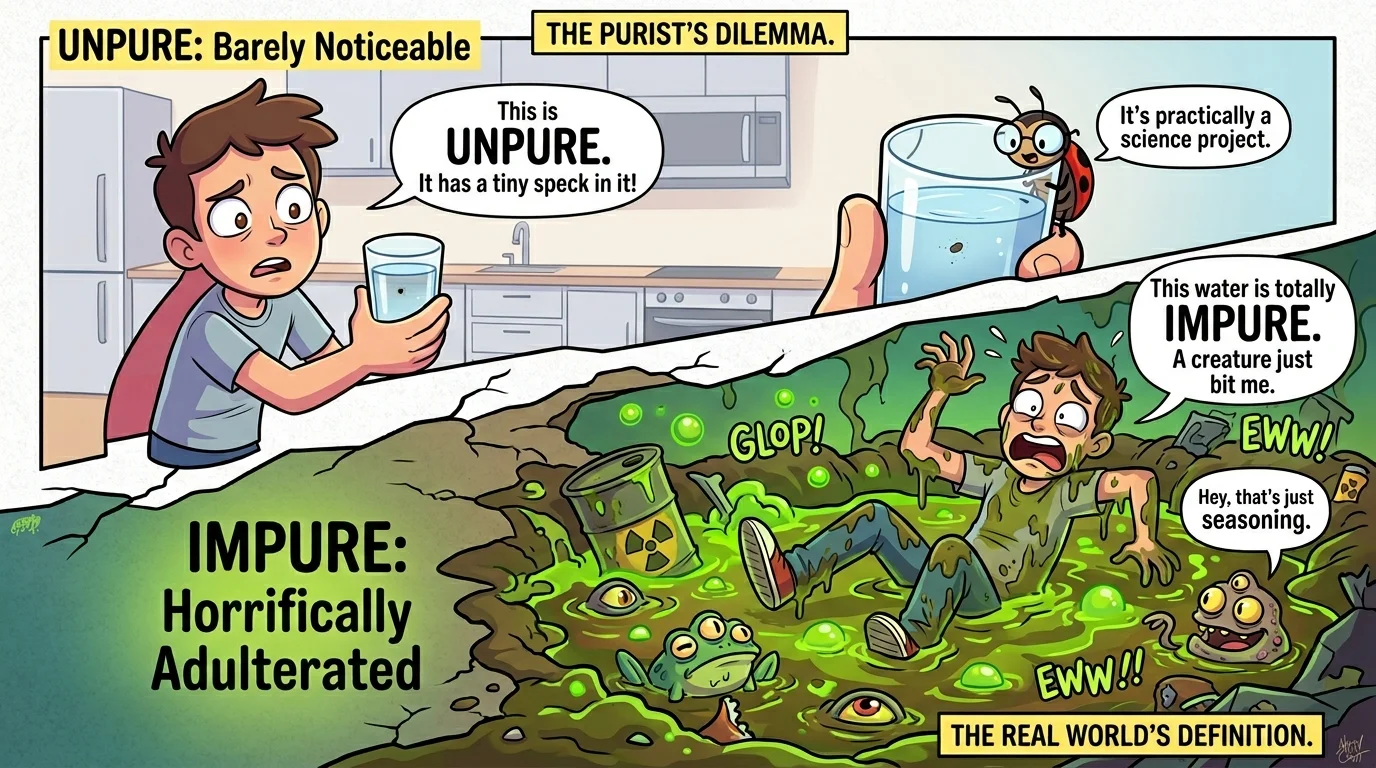
The word impure comes from Latin roots and entered English through historical language development. The prefix im- is a variation of in-, which often means “not.”
English contains many negative prefixes that evolved from Latin and French influences. As a result, some opposites use un-, while others use im-, in-, ir-, or il-.
Because impure became the established form centuries ago, it remains the dominant and preferred word in modern English. Although unpure occasionally appears in historical texts, it never achieved the same level of acceptance.
This is why dictionaries, educators, editors, and style guides consistently recommend impure.