


Quick Answer: Indure vs Endure
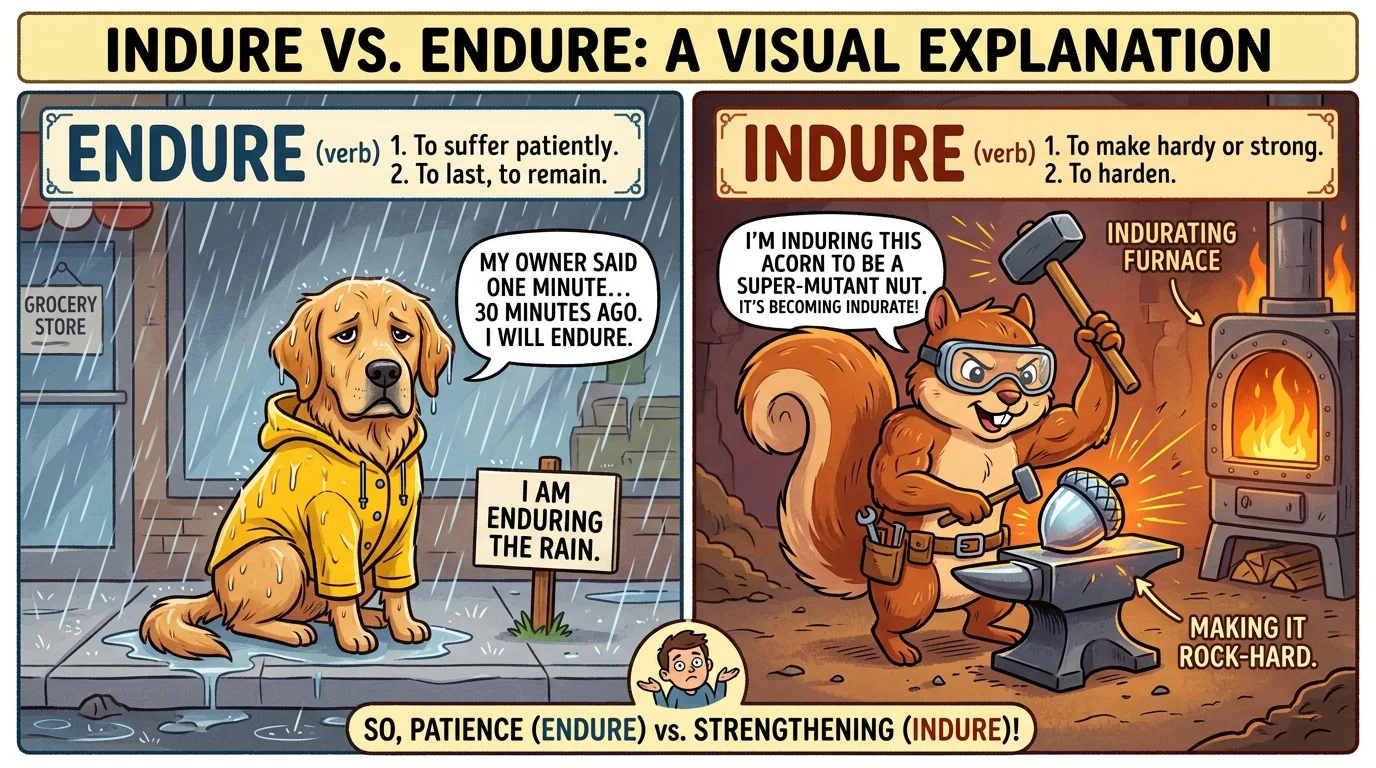
Endure is the correct English word. It means to suffer through, tolerate, withstand, or continue despite difficulties.
Indure is not recognized as a standard modern English word and is usually considered a misspelling of endure.
Example:
✔ She had to endure years of hardship.
✘ She had to indure years of hardship.
What Does Endure Mean?
Definition
Endure is a verb that means:
- To withstand pain, hardship, or difficulty
- To tolerate something unpleasant
- To remain in existence over time
- To survive challenging circumstances
Usage
The word is commonly used in:
- Everyday conversations
- Literature
- Motivational writing
- Academic writing
- Historical discussions
Examples
- They endured harsh weather during the expedition.
- True friendships endure over time.
- She endured months of treatment.
- The ancient monument has endured for centuries.
Key Insight
Endure is the standard and correct spelling used in modern English.
What Does Indure Mean?
Definition
Indure is generally not recognized as a standard English word today.
Historically, it appeared as an obsolete variant of endure, but it has fallen out of modern usage.
Usage
You may encounter indure in:
- Very old texts
- Historical manuscripts
- Spelling mistakes
- User-generated online content
Examples
Incorrect in modern English:
- He could not indure the pain.
- The structure indured for generations.
Correct:
- He could not endure the pain.
- The structure endured for generations.
Key Insight
In modern writing, you should almost always use endure, not indure.
Indure vs Endure: Key Differences
Quick Comparison
- Endure = Correct modern spelling
- Indure = Obsolete or incorrect spelling
- Endure = Used in all formal writing
- Indure = Rarely seen today
- Endure = Accepted by dictionaries
- Indure = Not accepted in standard usage
Comparison Table
| Feature | Indure | Endure |
|---|---|---|
| Valid Modern English Word | No | Yes |
| Dictionary Recognition | Generally No | Yes |
| Formal Writing | Incorrect | Correct |
| Meaning | Obsolete variant | To withstand or tolerate |
| Modern Usage | Rare | Common |
| Example | Indure hardship | Endure hardship |
Why Is It “Endure” and Not “Indure”?
The word endure comes from Old French and Latin roots associated with lasting, enduring, and remaining strong through hardship.
Over time, endure became the standardized English spelling recognized by dictionaries and grammar authorities.
While historical spellings sometimes varied, modern English universally uses endure.
Real-World Usage Scenarios
Scenario 1: Personal Challenges
Incorrect:
“She had to indure many obstacles.”
Correct:
“She had to endure many obstacles.”
🎯 Lesson: Use endure when talking about surviving difficulties.
Scenario 2: Long-Lasting Relationships
“Their friendship has endured for decades.”
🎯 Lesson: Endure can describe something that lasts over time.
Scenario 3: Physical Pain
“He endured the discomfort without complaining.”
🎯 Lesson: Endure often refers to tolerating pain or hardship.
Scenario 4: Historical Structures
“The castle has endured centuries of weather and war.”
🎯 Lesson: Endure can mean remaining intact over a long period.
Scenario 5: Workplace Challenges
“Employees endured significant changes during the merger.”
🎯 Lesson: Endure is common in professional and formal writing.
Common Mistakes
Mistake 1: Replacing “Endure” with “Indure”
Many writers mistakenly assume indure is an acceptable alternative spelling.
Correction: Use endure in all modern writing.
Mistake 2: Trusting Phonetic Spelling
Some people spell the word based on how they hear it.
Correction: Remember that standard English uses the prefix “en-“.
Mistake 3: Copying Outdated Spellings
Occasionally, old texts may contain nonstandard variants.
Correction: Modern English grammar and dictionaries use endure.
Why This Happens
The pronunciation of endure can lead some writers to substitute the letter “i” for “e,” creating the incorrect form indure.
Easy Memory Tricks
Trick 1: Think “Endure to the End”
Both words begin with End-.
If you survive until the end, you endure.
Trick 2: Remember Common Phrases
- Endure hardship
- Endure pain
- Endure challenges
- Endure suffering
You’ll almost never see indure in these expressions.
Trick 3: Trust the Dictionary Form
If you’re unsure, remember that every major dictionary lists endure, not indure.
Expert Insight: The Linguistic Background
The verb endure has been part of English for centuries and traces its roots to Latin and Old French words meaning “to last” or “to withstand.” As English spelling became standardized, endure emerged as the accepted form used in literature, education, law, and everyday communication.
While historical texts occasionally show variant spellings, modern English overwhelmingly favors endure, making it the only correct choice for contemporary writing.