
Quick Answer Section
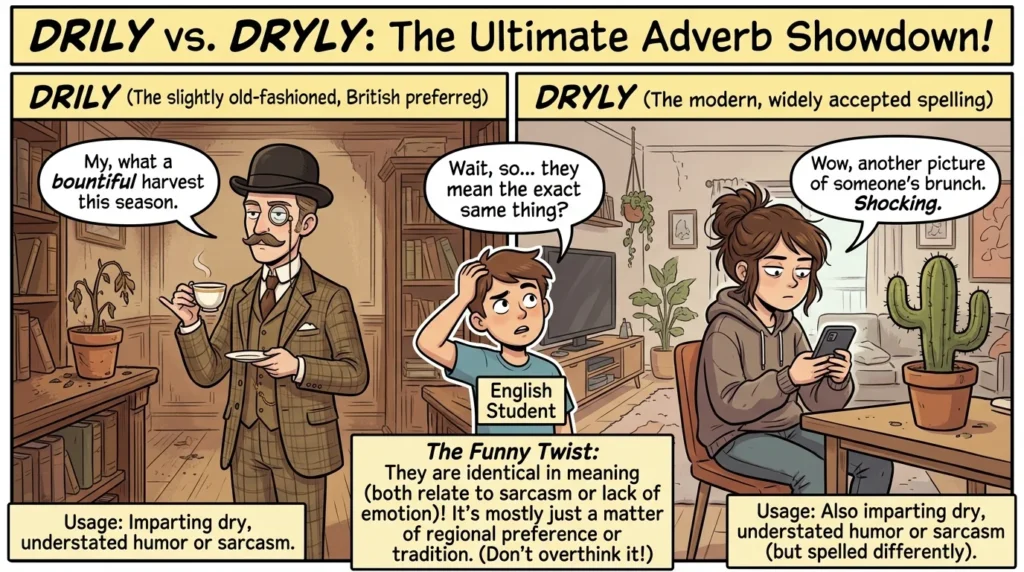
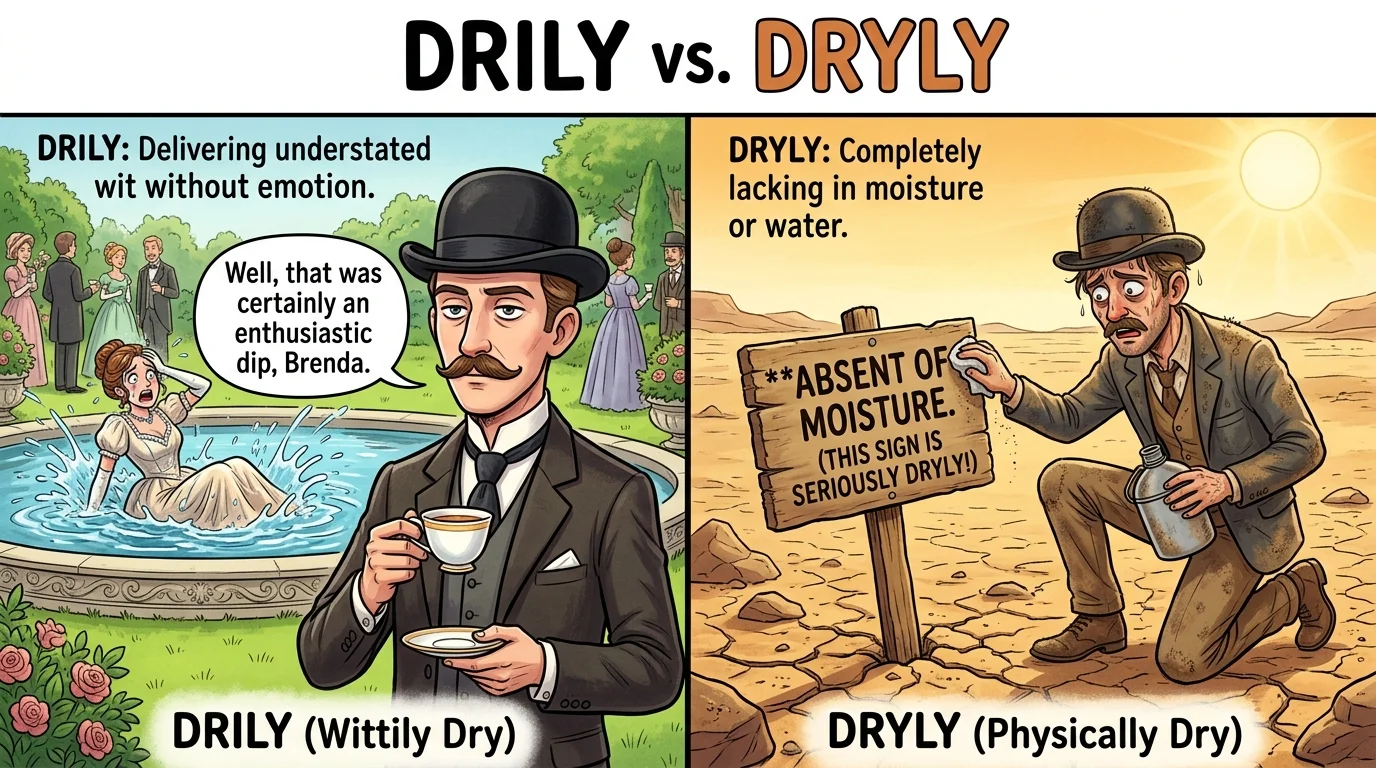
Drily and dryly are both correct spellings of the same adverb meaning “in a dry manner” or “with dry, subtle humor.”
- Dryly is more commonly used in modern English.
- Drily is an accepted alternative spelling.
- Both forms have the same meaning and can usually be used interchangeably.
Deep Explanation: Drily
Definition
Drily is an adverb derived from the adjective dry. It means:
- In a dry manner
- Without emotion or enthusiasm
- With subtle, understated humor
Usage Rules
The spelling drily follows a traditional pattern in which the adjective dry becomes drily when converted into an adverb.
While less common today, it remains grammatically correct and appears in many respected publications and literary works.
Examples
- He drily remarked that the meeting could have been an email.
- The professor drily noted the obvious flaw in the argument.
- She answered drily, showing little interest in the discussion.
Key Insights
- Accepted standard spelling.
- Often found in literary and formal writing.
- Less common than dryly in modern usage.
Deep Explanation: Dryly
Definition
Dryly is the more commonly used modern spelling of the adverb derived from dry.
It carries the same meanings as drily:
- In a dry manner
- Without strong emotion
- With deadpan or subtle humor
Usage Rules
Many modern style guides and publications favor dryly because it closely follows the appearance of the original adjective dry.
As a result, contemporary readers often find it more familiar.
Examples
- He dryly commented that the project was only six months behind schedule.
- She dryly observed that the weather forecast had been completely wrong.
- The actor dryly delivered the joke, making it even funnier.
Key Insights
- Most common modern spelling.
- Frequently used in journalism and online writing.
- Preferred by many contemporary writers.
Drily vs Dryly: Key Differences
Although both spellings mean the same thing, there are some practical distinctions.
Bullet-Point Differences
- Meaning: No difference.
- Function: Both are adverbs.
- Usage: Interchangeable in most contexts.
- Popularity: Dryly is more common today.
- Style Preference: Drily may appear more traditional or literary.
- Common Mistake: Assuming one spelling is incorrect.
Comparison Table
| Feature | Drily | Dryly |
|---|---|---|
| Meaning | In a dry manner; with dry humor | In a dry manner; with dry humor |
| Usage | Correct but less common | Correct and more common |
| Context | Literary and formal writing | Modern general writing |
| Example | He drily noted the error. | He dryly noted the error. |
| Popularity | Lower | Higher |
Real-World Usage Scenarios
Scenario 1
Incorrect: Only “dryly” is a real word.
Correct: Both “dryly” and “drily” are correct spellings.
🎯 Lesson: Don’t assume that less common spellings are wrong.
Scenario 2
Person A: Which spelling should I use in a blog post?
Person B: Dryly is usually the safer modern choice.
🎯 Lesson: Use the spelling most familiar to your audience.
Scenario 3
Editor: This novel uses “drily” throughout.
Writer: That’s fine because it’s a valid alternative spelling.
🎯 Lesson: Consistency matters more than choosing one specific form.
Scenario 4
Student: My teacher marked “drily” as wrong.
Tutor: Many teachers prefer “dryly,” but both are accepted in standard English.
🎯 Lesson: Follow your style guide when required.
Scenario 5
Reporter: The spokesperson dryly dismissed the rumors.
Editor: Good choice—the spelling aligns with modern publication standards.
🎯 Lesson: Dryly is often preferred in contemporary media.
Common Mistakes
Mistake 1: Thinking One Spelling Is Wrong
Many people believe only dryly is correct.
Correction: Both spellings are accepted.
Mistake 2: Switching Spellings in the Same Article
Using drily in one paragraph and dryly in another can look inconsistent.
Correction: Choose one spelling and use it throughout.
Mistake 3: Assuming Different Meanings
Some writers think the two forms have separate definitions.
Correction: They share the same meaning.
Why This Happens
English contains many words with alternative spellings that developed through historical changes in usage and style preferences.
Memory Tricks
Trick 1: Modern Writing = Dryly
If you’re unsure which form to use, choose dryly because it is more common in modern English.
Trick 2: Same Meaning, Different Spelling
Remember:
Drily = Dryly
The spelling changes, but the meaning stays the same.
Trick 3: Consistency Is Key
Pick one spelling and stick with it throughout your document.
Expert Insight
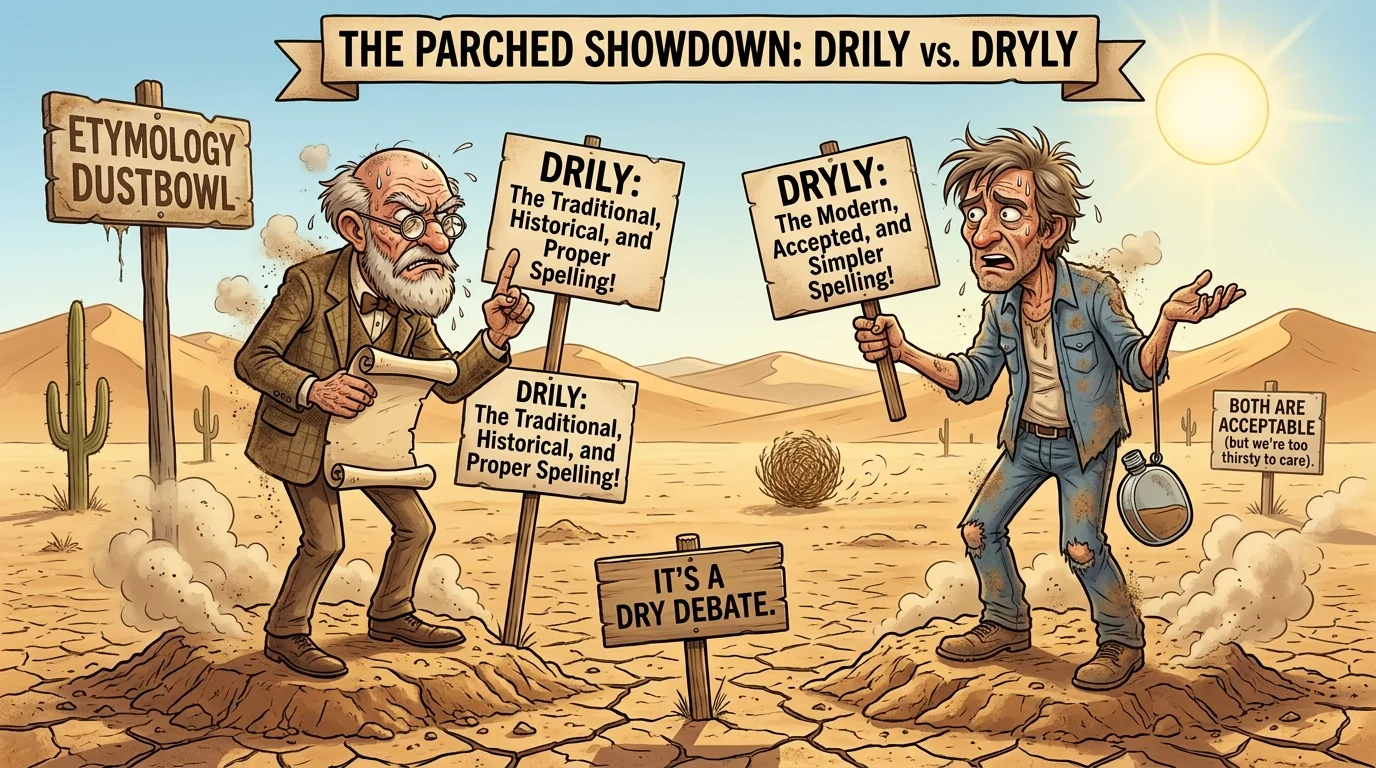
The existence of both drily and dryly reflects the flexibility of English spelling. Historically, some adjectives ending in -y formed adverbs by replacing the y with i before adding -ly, producing forms such as drily.
Over time, writers increasingly favored dryly, which preserves the original spelling of the adjective. As a result, modern English accepts both forms, although dryly has become the dominant spelling in contemporary publications.
From a linguistic perspective, neither spelling is more correct than the other. The choice is largely a matter of style, audience expectations, and consistency.