
Quick Answer
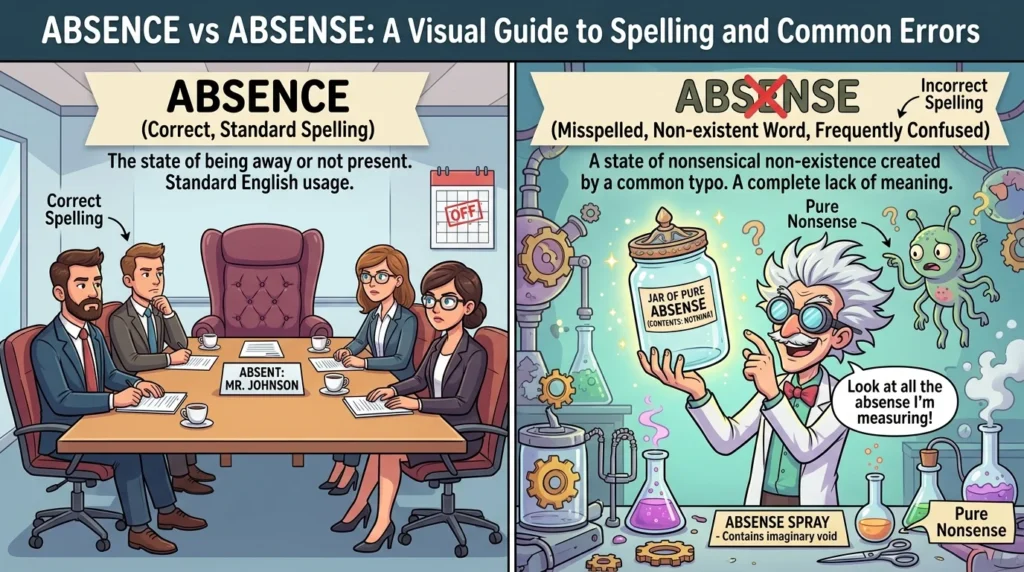
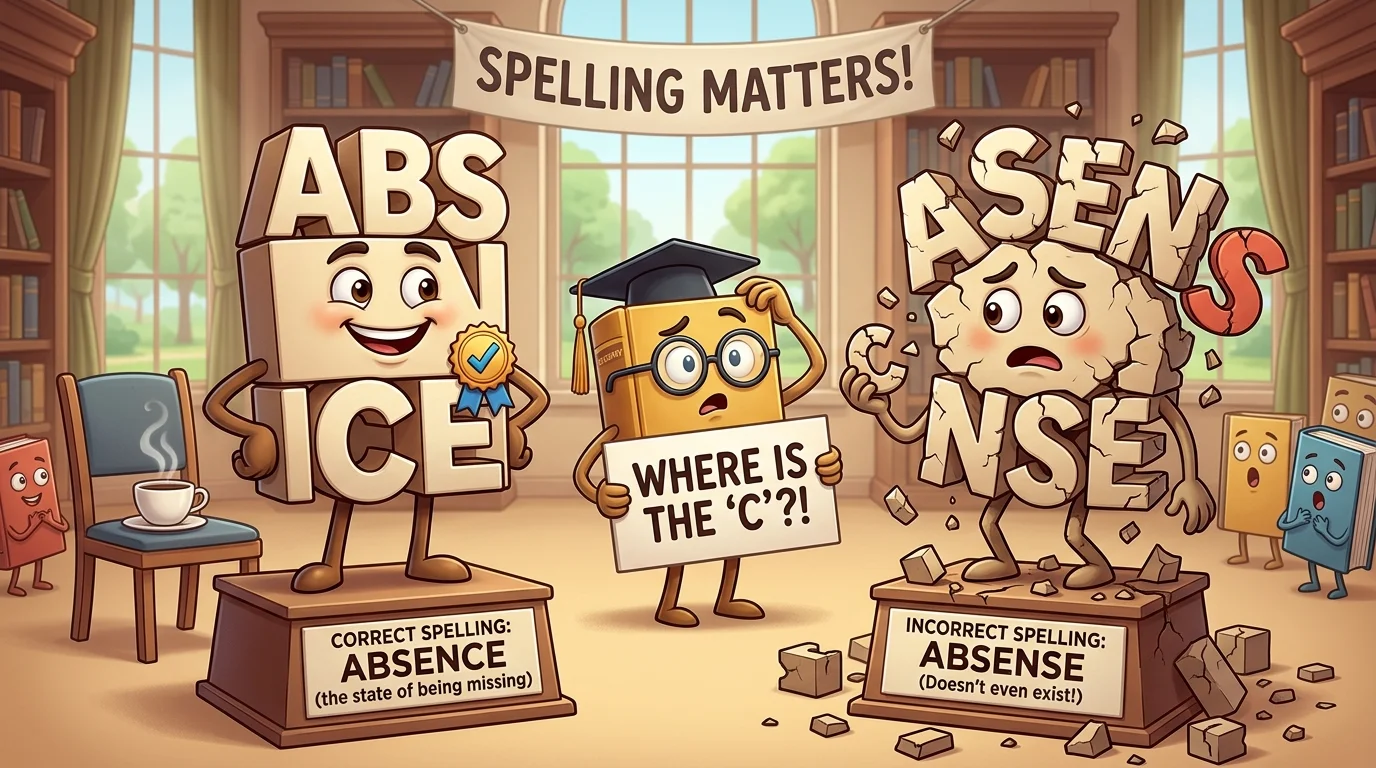
Absence is the correct spelling.
Absense is incorrect and should not be used in standard English.
Use absence whenever you’re referring to the state of being away, missing, or not present.
Examples:
- Correct: Her absence was noticed immediately.
- Correct: The teacher explained his absence.
- Incorrect: Her absense was noticed immediately.
Deep Explanation: Absense
Definition
Absense is a misspelling of absence.
It is not recognized as a standard English word in dictionaries.
Usage Rules
Avoid using absense in:
- Academic writing
- Business emails
- Reports
- School assignments
- Professional documents
- Online publications
Context
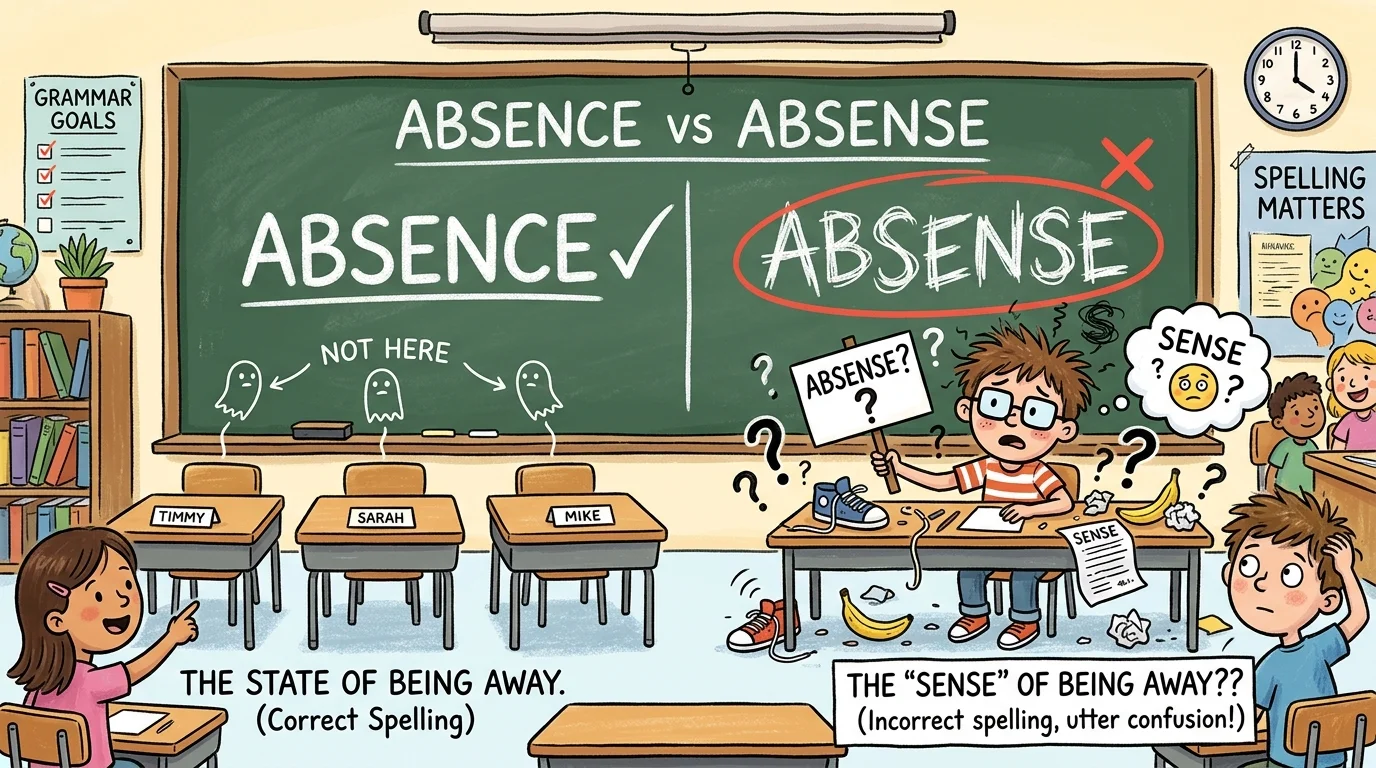
People often write absense because the ending sounds similar to words like:
- Sense
- Common sense
- Nonsense
However, absence follows a different spelling pattern.
Examples
Incorrect:
- His absense affected the meeting.
- The absense of evidence raised questions.
- We noted her absense from class.
Correct:
- His absence affected the meeting.
- The absence of evidence raised questions.
- We noted her absence from class.
Key Insight
If you’re referring to someone or something not being present, absense is never the correct spelling.
Deep Explanation: Absence
Definition
Absence is a noun that means:
- The state of being away
- The condition of not being present
- A lack or shortage of something
- A period during which someone is missing
Usage Rules
Use absence whenever discussing:
- Missing people
- School attendance
- Workplace attendance
- Lack of something
- Physical or emotional absence
Common Contexts
- Absence from school
- Absence from work
- Leave of absence
- Absence of evidence
- Absence of leadership
- Absence of communication
Real Examples
- Her absence was deeply felt by the team.
- He explained his absence from work.
- The absence of proof made the case difficult.
- We noticed the absence of any warning signs.
Key Insight
Absence is the only correct spelling recognized in standard English.
Absence vs Absense
Key Differences
- Absence is correct.
- Absense is incorrect.
- Absence appears in dictionaries.
- Absense is a spelling error.
- Professional writing always uses absence.
Comparison Table
| Feature | Absense | Absence |
|---|---|---|
| Correct Spelling | No | Yes |
| Dictionary Recognition | No | Yes |
| Standard English | No | Yes |
| Professional Writing | Incorrect | Correct |
| Meaning | None | State of being absent |
| Example | School absense ❌ | School absence ✔ |
Real-World Usage Scenarios
Scenario 1
Teacher: “Please provide a reason for your absence.”
Student: “I was sick.”
🎯 Lesson: School-related contexts use absence.
Scenario 2
Manager: “Your absence was noted during the meeting.”
Employee: “I apologize for missing it.”
🎯 Lesson: Workplace communication requires the correct spelling.
Scenario 3
Lawyer: “The absence of evidence is important.”
Client: “I understand.”
🎯 Lesson: Legal and professional writing uses absence.
Scenario 4
Friend: “Your absence was noticeable at the party.”
Guest: “I couldn’t make it.”
🎯 Lesson: Everyday English consistently uses absence.
Scenario 5
Doctor: “The absence of symptoms is encouraging.”
Patient: “That’s good news.”
🎯 Lesson: Medical contexts also use absence.
Common Mistakes
Mistake 1: Spelling It Like “Sense”
Incorrect:
- Absense
Correct:
- Absence
Why It Happens
The pronunciation makes many people assume the ending should be -sense.
However, the correct spelling uses -sence.
Mistake 2: Relying on Sound Instead of Spelling
English contains many words that don’t follow phonetic spelling patterns.
Writers who spell by sound often write absense incorrectly.
Mistake 3: Repeating the Error in Professional Writing
Using absense in resumes, reports, emails, or assignments can create a negative impression.
Always use absence.
Memory Tricks
Trick 1: Remember the Word “Absent”
The word absence comes from absent.
Think:
- Absent → Absence
Both keep the -ent / -ence pattern.
Trick 2: Link the Words Together
If someone is absent, their absence is noticed.
This connection helps reinforce the correct spelling.
Trick 3: Think “Absent Creates Absence”
Remember the formula:
Absent → Absence
Not:
Absent → Absense
Expert Insight
The word absence originates from Latin through French and has been part of English for centuries. It belongs to a family of words ending in -ence, including:
- Presence
- Existence
- Patience
- Independence
Because of its historical development, the spelling absence became standardized in dictionaries, educational materials, and professional writing.
Although absense sounds plausible based on pronunciation, it never became an accepted spelling. This is why grammar experts, editors, teachers, and style guides consistently recommend absence.