

Quick Answer
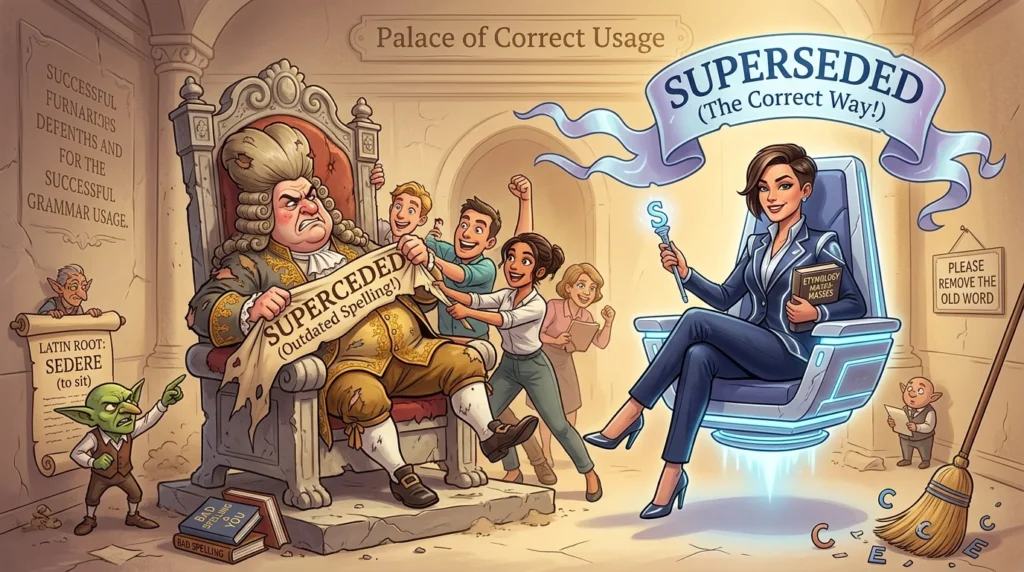
Superseded is the correct spelling.
Superceded is incorrect and should not be used in standard English.
Use superseded when something has been replaced, overridden, made obsolete, or taken the place of something older.
Examples:
- Correct: The new policy superseded the old one.
- Correct: This software version has been superseded.
- Incorrect: The new policy superceded the old one.
Deep Explanation: Superceded
Definition
Superceded is a misspelling of superseded.
It is not recognized as the standard spelling in modern English dictionaries.
Usage Rules
Avoid using superceded in:
- Academic writing
- Legal documents
- Business reports
- Professional emails
- Technical documentation
- Government publications
Context
The error occurs because writers often assume the word follows the spelling pattern of:
- Proceed
- Succeed
- Concede
However, supersede has a different historical origin.
Examples
Incorrect:
- The document was superceded.
- This regulation has been superceded.
- The old system was superceded by new technology.
Correct:
- The document was superseded.
- This regulation has been superseded.
- The old system was superseded by new technology.
Key Insight
Even though superceded looks logical, it is not the accepted spelling.
Deep Explanation: Superseded
Definition
Superseded is the past tense and past participle of supersede.
It means:
- Replaced by something newer
- Made obsolete
- Overridden
- Set aside in favor of something else
Usage Rules
Use superseded whenever one thing takes the place of another.
Common Contexts
- Superseded policy
- Superseded law
- Superseded software
- Superseded document
- Superseded procedure
- Superseded regulation
Real Examples
- The updated policy superseded the previous version.
- New technology has superseded older systems.
- The revised contract superseded the original agreement.
- This standard has been superseded by a newer guideline.
Key Insight
Superseded is the only correct spelling recognized in standard English.
Superseded vs Superceded
Key Differences
- Superseded is correct.
- Superceded is incorrect.
- Superseded appears in dictionaries.
- Superceded is a common misspelling.
- Professional writing always uses superseded.
Comparison Table
| Feature | Superceded | Superseded |
|---|---|---|
| Correct Spelling | No | Yes |
| Dictionary Recognition | No | Yes |
| Standard English | No | Yes |
| Professional Writing | Incorrect | Correct |
| Meaning | None | Replaced or overridden |
| Example | Superceded policy ❌ | Superseded policy ✔ |
Real-World Usage Scenarios
Scenario 1
Manager: “The old procedure has been superseded.”
Employee: “I’ll follow the new process.”
🎯 Lesson: Business communication uses superseded.
Scenario 2
Lawyer: “This law was superseded by later legislation.”
Client: “So the old law no longer applies?”
🎯 Lesson: Legal writing commonly uses superseded.
Scenario 3
Software Engineer: “Version 2.0 has been superseded by Version 3.0.”
User: “I’ll update immediately.”
🎯 Lesson: Technology documentation often uses superseded.
Scenario 4
Researcher: “The theory was superseded by newer evidence.”
Student: “That makes sense.”
🎯 Lesson: Academic writing frequently uses superseded.
Scenario 5
Editor: “This draft has been superseded.”
Writer: “I’ll use the latest version.”
🎯 Lesson: Publishing and documentation rely on superseded.
Common Mistakes
Mistake 1: Writing Superceded Instead of Superseded
Incorrect:
- Superceded document
- Superceded policy
- Superceded software
Correct:
- Superseded document
- Superseded policy
- Superseded software
Why It Happens
Writers often expect the spelling to follow the pattern of similar-looking English words.
Mistake 2: Assuming the Word Contains “Cede”
Many people associate the word with:
- Concede
- Recede
- Proceed
However, supersede is an exception.
Why It Happens
English spelling frequently preserves historical forms that don’t always match modern expectations.
Mistake 3: Using Superceded in Professional Documents
Using superceded can make writing appear careless or unedited.
Always use superseded.
Memory Tricks
Trick 1: Remember the Double “S”
The correct spelling contains:
Super + sede
Result:
Supersede → Superseded
Trick 2: Think “Superseded Standard”
Many official documents use the phrase:
Superseded standard
Seeing the correct spelling repeatedly helps reinforce it.
Trick 3: Remember the Exception
Even though words like proceed and succeed use -ceed, supersede is the famous exception.
Expert Insight
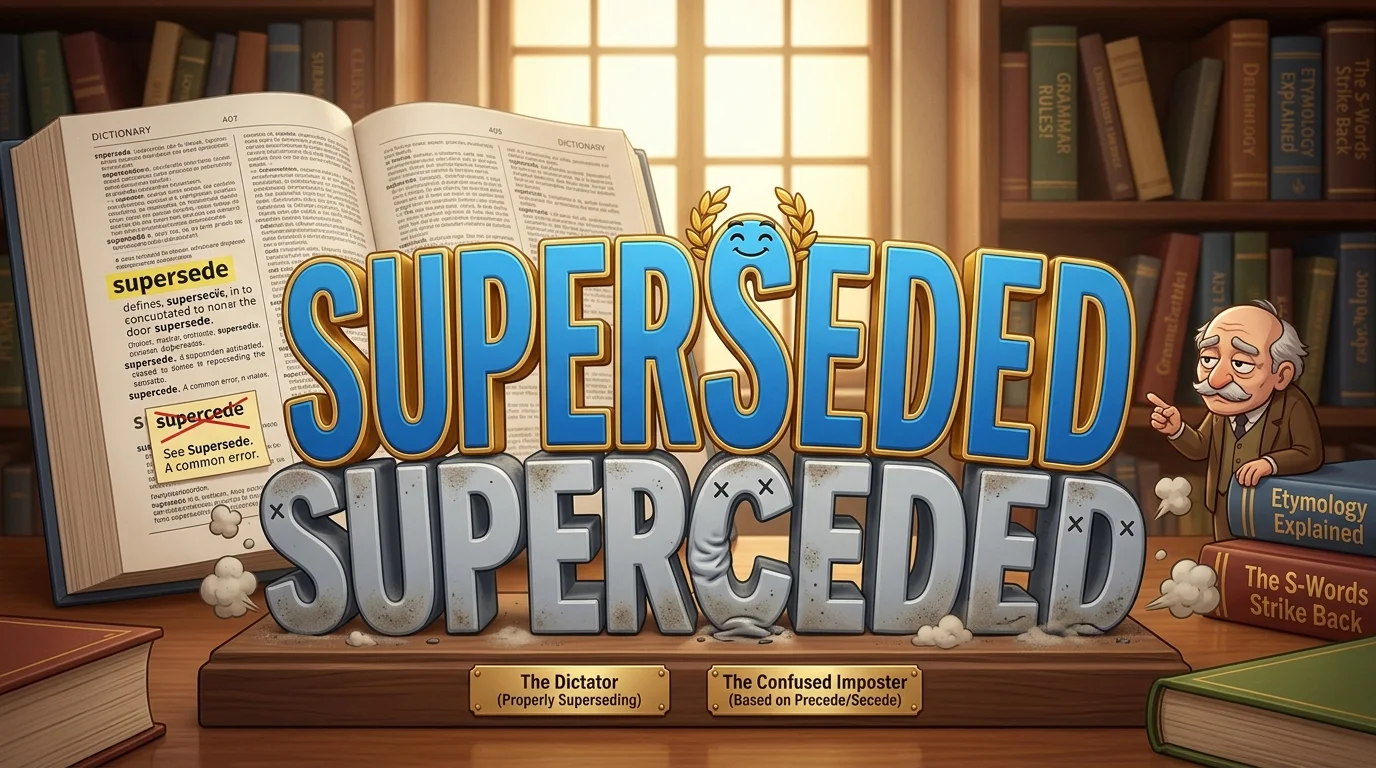
The word supersede comes from Latin roots meaning “to sit above” or “to take the place of.” Unlike many English words ending in -ceed, supersede developed through a different linguistic path.
Historically, this unique origin preserved the -sede spelling, making supersede one of English’s most notable spelling exceptions. Because the word is frequently used in legal, governmental, academic, and technical contexts, spelling accuracy is particularly important.
As a result, dictionaries, style guides, editors, and grammar experts consistently recognize superseded as the only correct form.