
Quick Answer
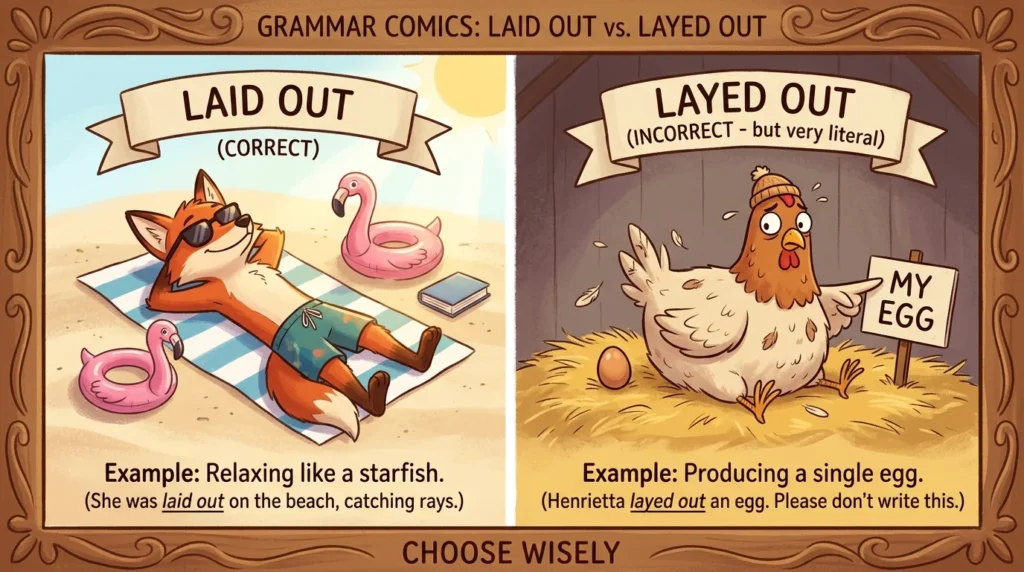
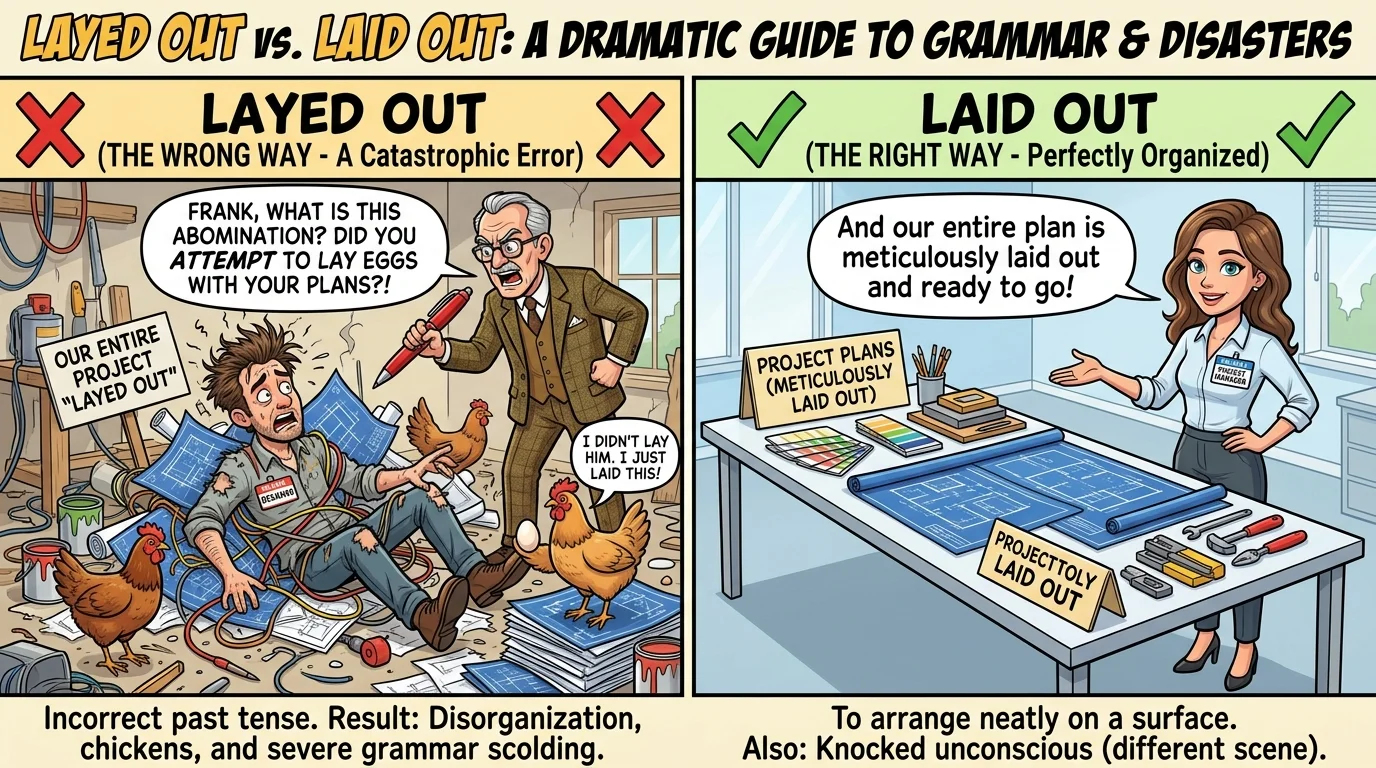
Laid out is the correct phrase in English. It is the past tense and past participle form of the phrasal verb lay out, which means to arrange, organize, explain, display, or stretch something out.
Layed out is incorrect because layed is not the standard past tense of the verb lay.
Examples:
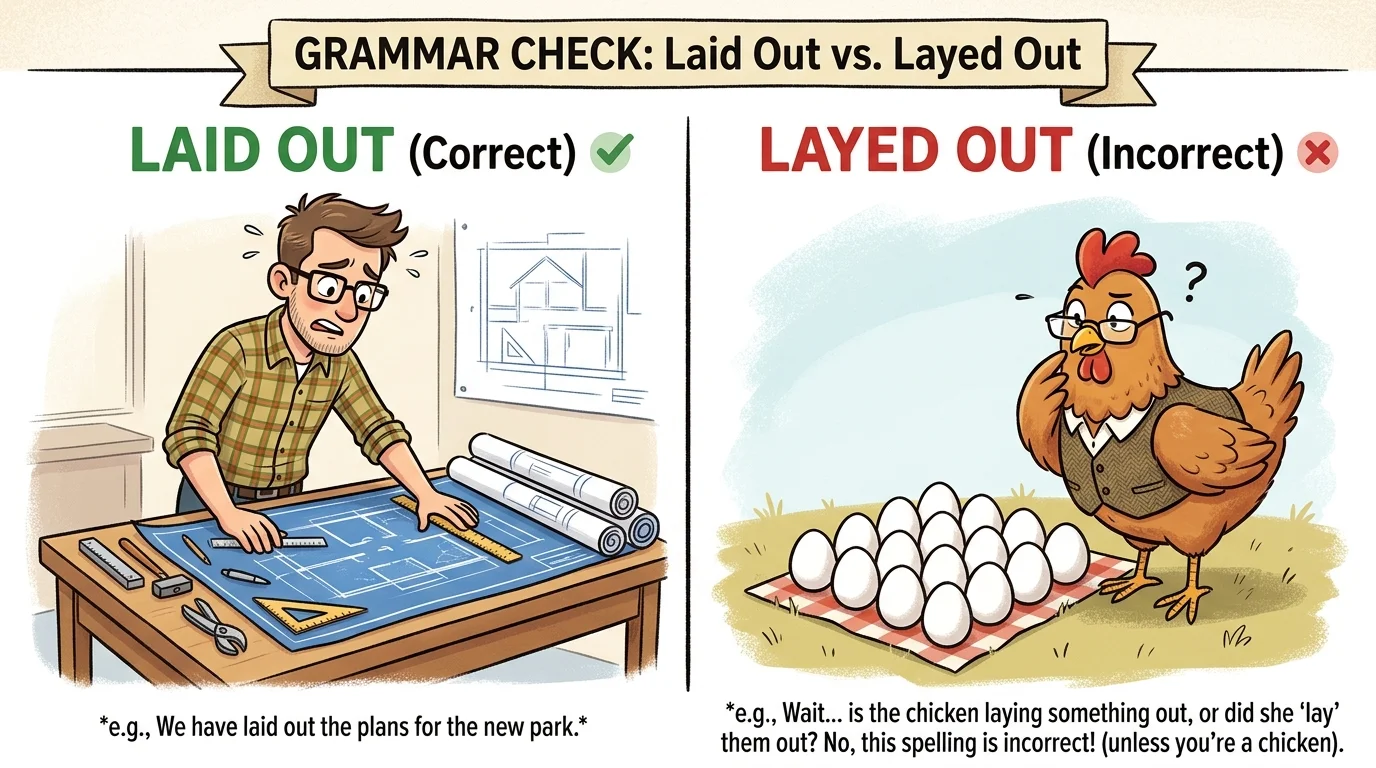
- Correct: She laid out the documents on the table.
- Incorrect: She layed out the documents on the table.
Deep Explanation: Layed Out
Layed out is a spelling error in standard English.
Many people create the word layed because they think the verb lay follows the same pattern as regular verbs.
For example:
- Play → Played
- Stay → Stayed
- Display → Displayed
However, lay is an irregular verb and does not follow the regular -ed rule.
Its correct forms are:
- Present: Lay
- Past: Laid
- Past Participle: Laid
Therefore, layed out should be avoided in formal and standard English.
Why Do People Write “Layed Out”?
People commonly write layed out because:
- It sounds similar to laid out.
- They assume all verbs become past tense by adding -ed.
- The verb lay has an irregular conjugation that many people forget.
Incorrect Examples
❌ He layed out his clothes for tomorrow.
❌ The manager layed out the new strategy.
❌ She layed out all the ingredients on the counter.
Each sentence should use laid out instead.
Deep Explanation: Laid Out
Laid out is the correct expression.
The phrasal verb lay out can have several meanings depending on the context.
Meaning 1: Arrange Something
To place things in an organized manner.
Examples:
- She laid out the books on the desk.
- The chef laid out the ingredients before cooking.
Meaning 2: Explain Something Clearly
To present information in a clear and organized way.
Examples:
- The teacher laid out the rules for the project.
- The lawyer laid out the evidence.
Meaning 3: Spread Something Out
To extend or position something fully.
Examples:
- They laid out blankets on the grass.
- The architect laid out the design plans.
Meaning 4: Knock Someone Unconscious (Informal)
Examples:
- The punch nearly laid him out.
- The illness completely laid her out for two days.
Key Insight
Laid out can describe physical arrangement, explanations, planning, or even someone becoming physically exhausted or unconscious.
Layed Out vs Laid Out: Key Differences
Quick Differences
- Layed out is incorrect.
- Laid out is correct.
- Laid out is the proper past form of lay out.
- The phrase has multiple meanings depending on context.
| Feature | Layed Out | Laid Out |
|---|---|---|
| Meaning | Incorrect spelling | Past form of “lay out” |
| Grammar | Nonstandard form | Correct phrase |
| Usage | Should be avoided | Standard English |
| Context | Grammar error | Arrangement, explanation, planning, or spreading |
| Example | She layed out the plans. ❌ | She laid out the plans. ✅ |
Real-World Usage Scenarios
Example 1
Person A: Where are the meeting documents?
Person B: I laid out all the papers on your desk.
🎯 Lesson: Use laid out when arranging items.
Example 2
Manager: Before we start, let me lay out our goals.
Later:
The manager laid out the company’s new strategy.
🎯 Lesson: Use laid out when explaining plans.
Example 3
Mother: Who prepared the picnic?
Father: I laid out the blankets and food.
🎯 Lesson: Use laid out when spreading items in an organized way.
Example 4
Incorrect Statement:
“I layed out all the clothes.”
Correct Statement:
“I laid out all the clothes.”
🎯 Lesson: The past form is always laid out, never layed out.
Common Mistakes
Mistake 1: Treating Lay as a Regular Verb
❌ Layed out
✅ Laid out
Why it happens: Most English verbs form the past tense by adding -ed, so people mistakenly apply that rule to lay.
Mistake 2: Confusing Lay and Lie
❌ Yesterday I lay out on the sofa.
✅ Yesterday I lay on the sofa.
Why it happens: The verbs lay and lie have different meanings and irregular forms.
Mistake 3: Using Layed in Professional Writing
❌ The manager layed out the proposal.
✅ The manager laid out the proposal.
Why it happens: Many writers are unaware that layed is considered nonstandard.
Memory Tricks
Remember this simple rule:
Lay → Laid
Think of these word pairs:
- Pay → Paid
- Say → Said
- Lay → Laid
A helpful sentence is:
I paid my bills and then laid out my plans.
The similar spelling of paid and laid makes the correct form easier to remember.
Expert Insight
The confusion surrounding layed out vs laid out exists because English contains many irregular verbs that do not follow predictable spelling patterns.
The verb lay is one of these irregular verbs. Its past tense became laid through historical language development rather than by simply adding -ed.
Modern dictionaries, grammar references, educational institutions, and style guides consistently recognize laid out as the correct expression. In professional writing, journalism, academic papers, and business communication, laid out is the accepted standard.