
Quick Answer
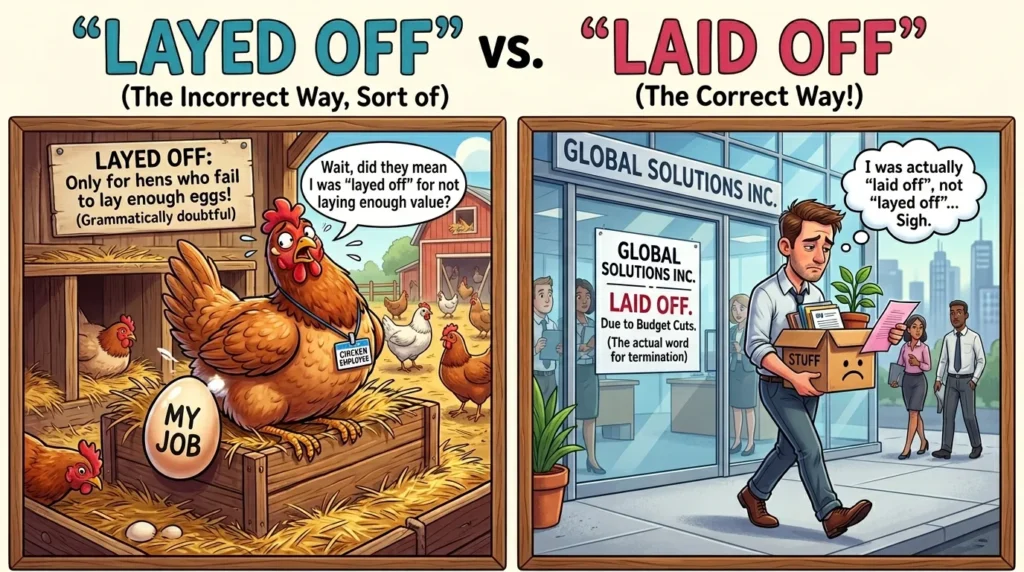
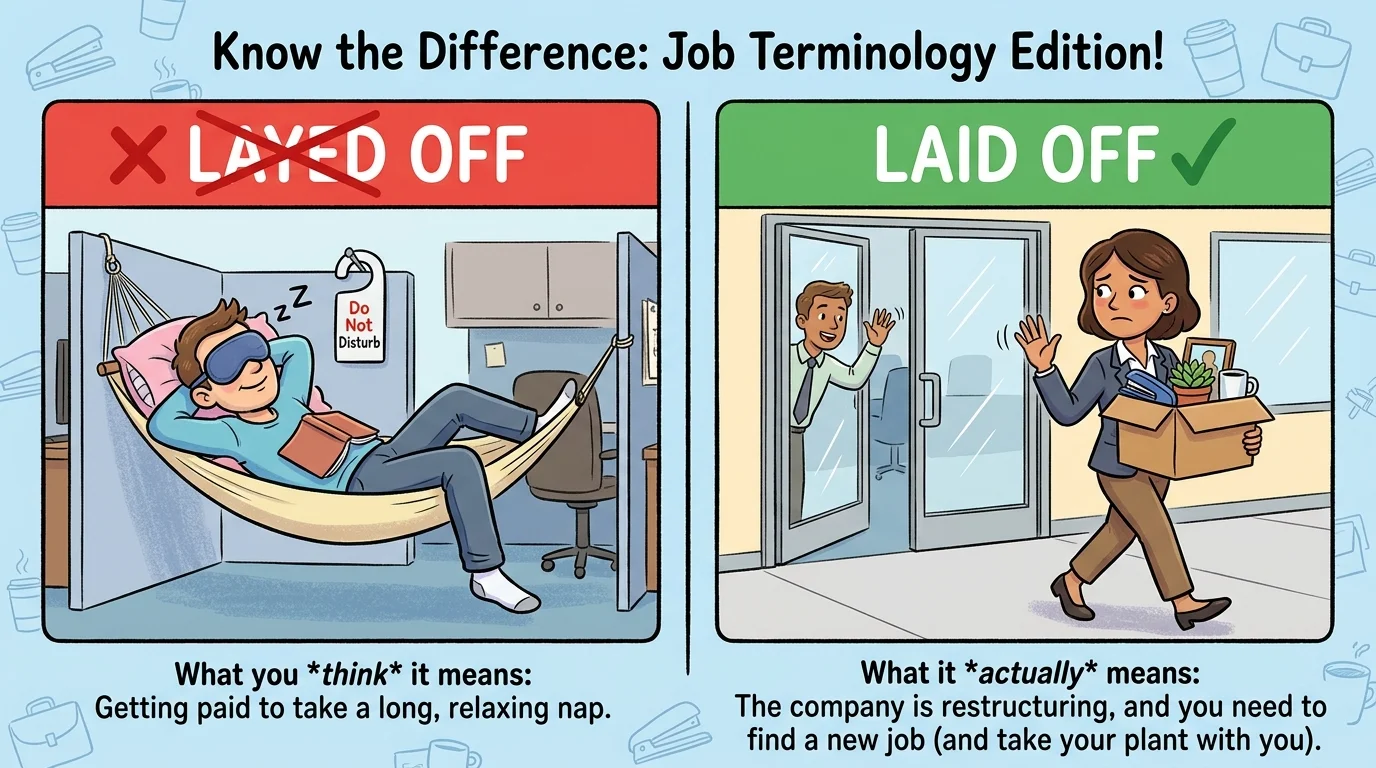
Laid off is the correct phrase in English. It means that an employee has lost their job, usually because of company restructuring, budget cuts, or economic reasons.
Layed off is incorrect because layed is not the standard past tense of the verb lay. The correct past tense and past participle of lay is laid.
Examples:
- Correct: I was laid off last month.
- Incorrect: I was layed off last month.
Deep Explanation: Layed Off
The phrase layed off is a common spelling mistake.
Many people assume that adding -ed to the verb lay creates the past tense, just as we do with regular verbs like:
- Play → Played
- Work → Worked
- Clean → Cleaned
However, lay is an irregular verb.
Its forms are:
- Present: Lay
- Past: Laid
- Past Participle: Laid
Because of this irregular pattern, layed is not considered standard English.
Why Do People Write “Layed Off”?
People often write layed off because:
- It sounds similar to laid off.
- They assume all verbs form the past tense with -ed.
- They rarely use the verb lay in everyday writing.
Incorrect Examples
❌ The company layed off fifty workers.
❌ She was layed off due to budget cuts.
❌ Hundreds of employees were layed off this year.
All of these sentences should use laid off instead.
Deep Explanation: Laid Off
Laid off is the correct expression.
It refers to an employee losing their job because the employer reduces staff, closes departments, reorganizes operations, or faces financial difficulties.
Being laid off usually does not mean the employee did something wrong.
Common Situations
Employees may be laid off because of:
- Company downsizing
- Economic recession
- Automation
- Mergers and acquisitions
- Business restructuring
- Declining sales
Correct Examples
✅ The company laid off 200 employees.
✅ I was laid off during the economic downturn.
✅ Several workers were laid off after the factory closed.
Key Insight
Being laid off differs from being fired.
- Laid off: Job loss due to business reasons.
- Fired: Job loss due to performance or misconduct.
Layed Off vs Laid Off: Key Differences
Quick Differences
- Layed off is incorrect.
- Laid off is correct.
- Layed is not the standard past form of lay.
- Laid off refers to losing employment because of company-related reasons.
| Feature | Layed Off | Laid Off |
|---|---|---|
| Meaning | Incorrect spelling | Job termination due to business reasons |
| Grammar | Nonstandard form | Correct phrase |
| Usage | Should be avoided | Used in professional and everyday English |
| Context | Grammar error | Employment discussions |
| Example | I was layed off. ❌ | I was laid off. ✅ |
Real-World Usage Scenarios
Example 1
Person A: Why aren’t you going to work today?
Person B: I was laid off last week.
🎯 Lesson: Use laid off when talking about losing a job.
Example 2
Resume Statement:
“I was laid off after the company restructured its operations.”
🎯 Lesson: This phrase is appropriate in professional documents.
Example 3
News Headline:
“The technology company laid off hundreds of workers.”
🎯 Lesson: Journalists and business publications always use laid off, not layed off.
Example 4
Incorrect Statement:
“I got layed off yesterday.”
Correct Statement:
“I got laid off yesterday.”
🎯 Lesson: Replace layed off with laid off every time.
Common Mistakes
Mistake 1: Adding “-ed” to Lay
❌ Layed off
✅ Laid off
Why it happens: People assume lay follows regular verb rules.
Mistake 2: Confusing Laid Off with Fired
❌ I was fired because the company closed.
✅ I was laid off because the company closed.
Why it happens: Both involve job loss, but the reasons are different.
Mistake 3: Using Layed in Professional Writing
❌ I was layed off due to restructuring.
✅ I was laid off due to restructuring.
Why it happens: Many people have never learned that lay is irregular.
Memory Tricks
Remember this simple rule:
Lay → Laid
Just like:
- Say → Said
- Pay → Paid
Think:
I got paid and then I got laid off.
The words paid and laid share a similar spelling pattern, making them easier to remember.
Expert Insight
English contains many irregular verbs that do not follow the standard -ed pattern.
The verb lay belongs to this category.
Over time, many English speakers have incorrectly formed the word layed because regular verbs are far more common than irregular ones.
However, dictionaries, style guides, grammar experts, and professional publications consistently recognize only laid off as the correct expression.
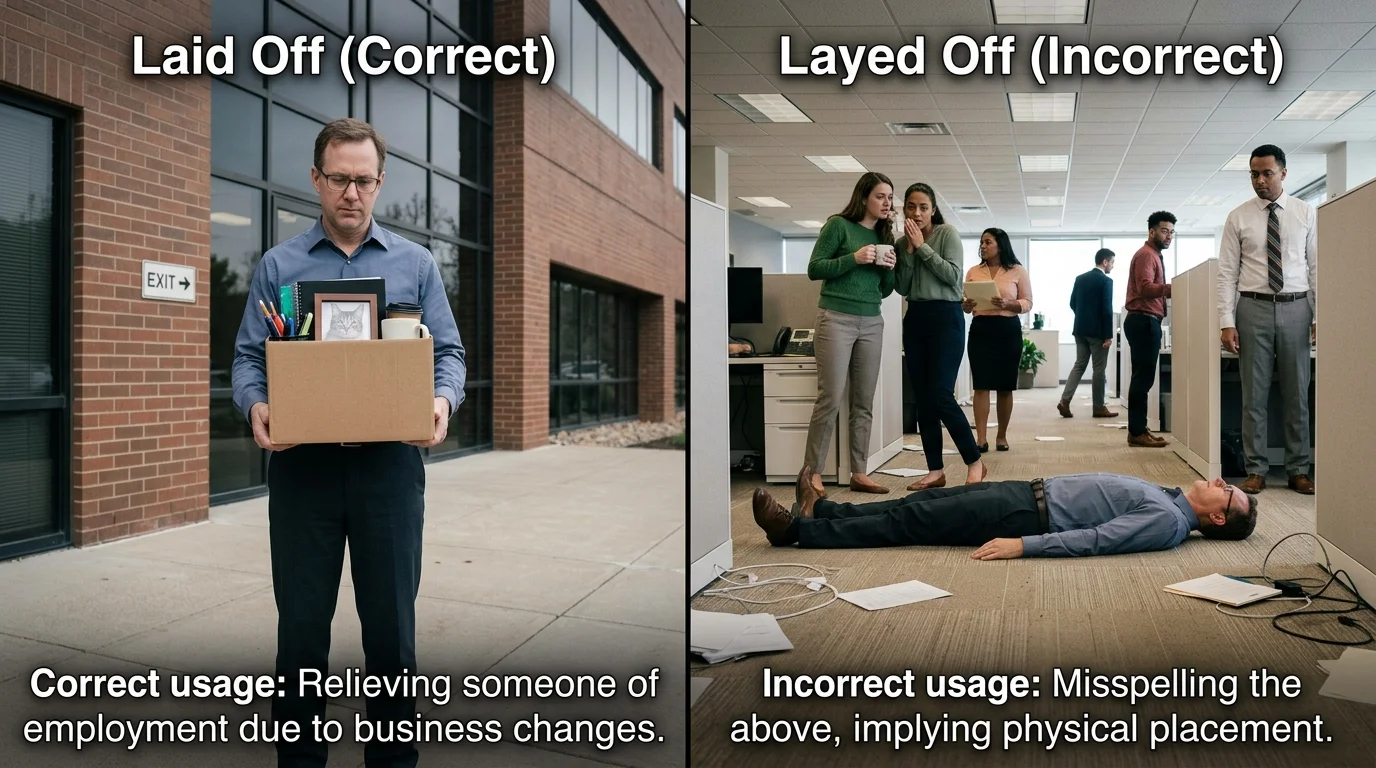
In formal writing, business communication, journalism, and academic English, laid off is always the accepted form.