
Quick Answer
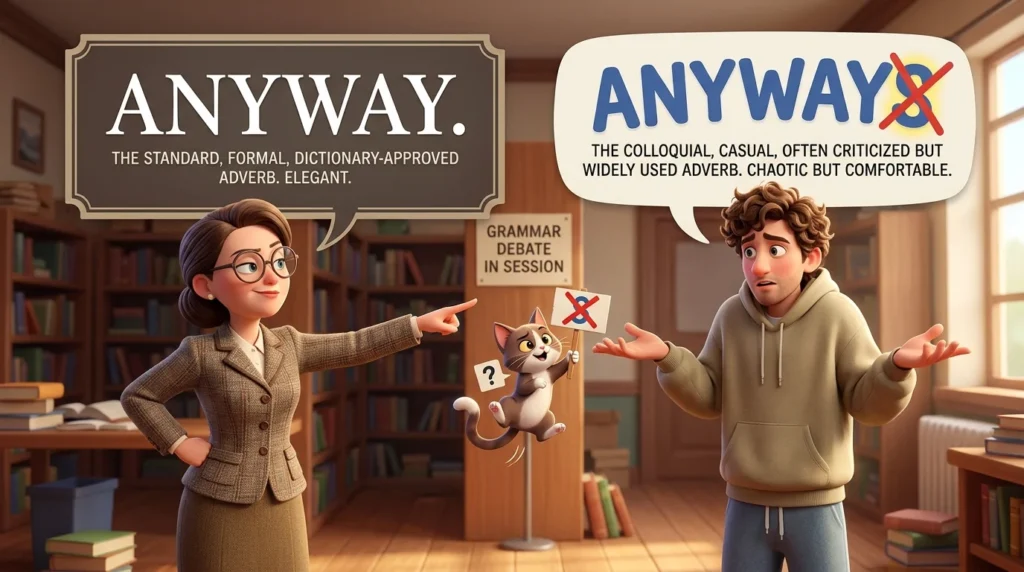
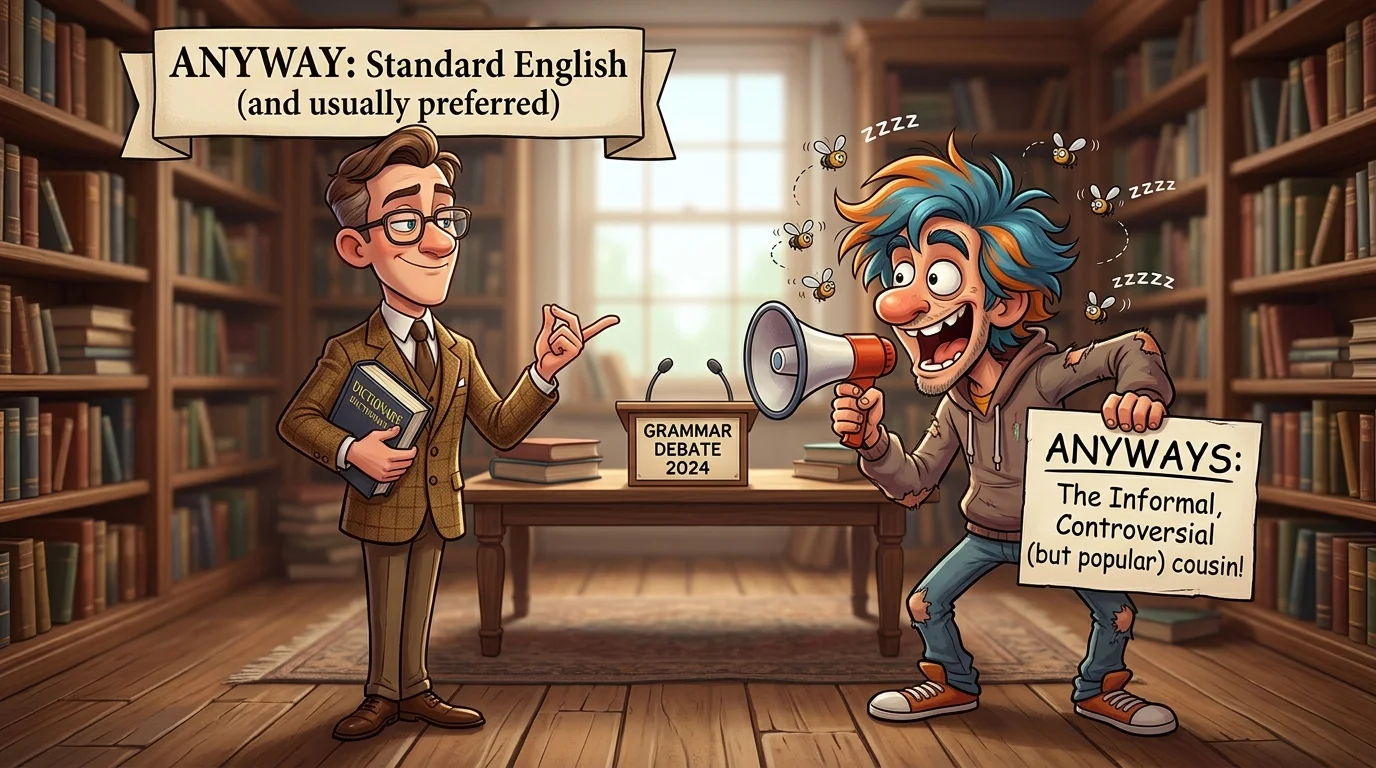
Anyway is the standard English word. It means regardless, in any case, or returning to the main topic of discussion.
Anyways is an informal variant of anyway. It is common in casual conversations but is usually avoided in formal and professional writing.
Examples:
- Standard: I didn’t want to go, but I went anyway.
- Informal: Anyways, let’s continue the meeting.
Deep Explanation: Anyway
Anyway is the standard and preferred form in modern English.
Meaning of Anyway
Anyway can mean:
- Regardless
- In any case
- Despite what happened
- Returning to the original topic
Common Uses of Anyway
Meaning 1: Regardless
Examples:
✅ It was raining, but we went anyway.
✅ She didn’t agree, but he did it anyway.
Meaning 2: In Any Case
Examples:
✅ I probably won’t need it, but I’ll bring it anyway.
✅ The movie might be canceled, but let’s meet anyway.
Meaning 3: Returning to the Main Topic
Examples:
✅ Anyway, let’s discuss the budget.
✅ Anyway, where were we?
Key Insight
Anyway works in both formal and informal situations and is accepted by dictionaries, publishers, and style guides.
Deep Explanation: Anyways
Anyways is an informal variant of anyway.
It is commonly heard in:
- Casual conversations
- Text messages
- Social media posts
- Informal storytelling
Correct Informal Examples
✅ Anyways, I finally finished the project.
✅ Anyways, let’s get back to work.
✅ Anyways, that’s what happened.
Key Insight
Although anyways is widely used in spoken English, many editors and style guides consider it conversational and recommend anyway in professional writing.
Anyway vs Anyways: Key Differences
Quick Differences
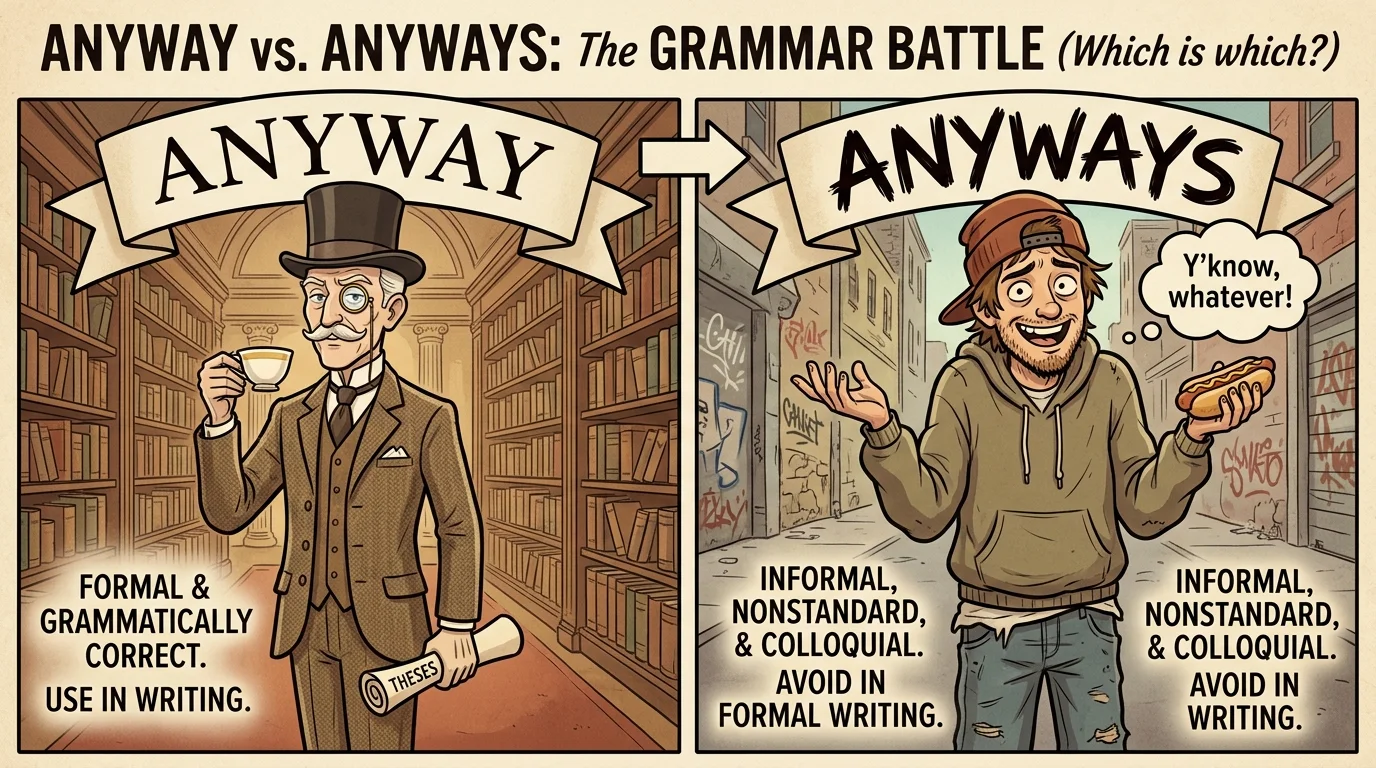
- Anyway is the standard form.
- Anyways is an informal variant.
- Both often have the same meaning.
- Anyway is preferred in academic, business, and professional communication.
| Feature | Anyway | Anyways |
|---|---|---|
| Meaning | Regardless; in any case; returning to a topic | Same meanings in informal speech |
| Grammar | Standard English | Informal variant |
| Usage | Formal and informal contexts | Mostly conversational contexts |
| Dictionary Recognition | Widely accepted | Recognized as informal |
| Example | Anyway, let’s begin. ✅ | Anyways, let’s begin. ⚠️ |
Real-World Usage Scenarios
Example 1
Friend:
I was tired, but I finished my homework anyway.
🎯 Lesson: Use anyway to mean despite that.
Example 2
Teacher:
Anyway, let’s move on to today’s lesson.
🎯 Lesson: Anyway often signals a return to the main topic.
Example 3
Text Message:
Anyways, I’ll call you later.
🎯 Lesson: Anyways is common in casual messaging.
Example 4
Business Email:
❌ Anyways, please review the attached report.
✅ Anyway, please review the attached report.
🎯 Lesson: Professional writing generally prefers anyway.
Common Mistakes
Mistake 1: Using “Anyways” in Formal Writing
❌ Anyways, I would like to discuss the proposal.
✅ Anyway, I would like to discuss the proposal.
Why it happens: Many people use anyways frequently in speech and transfer it into formal writing.
Mistake 2: Assuming “Anyways” Is Always Wrong
❌ Anyways is never acceptable.
✅ Anyways is acceptable in casual conversation.
Why it happens: Some people mistakenly believe only dictionary forms are legitimate in speech.
Mistake 3: Using the Words Interchangeably in Professional Settings
❌ Anyways, the contract has been approved.
✅ Anyway, the contract has been approved.
Why it happens: Both forms sound natural in conversation.
Memory Tricks
Remember this simple phrase:
Formal writing = Anyway
Think:
One way → Anyway
Another easy trick:
The extra S in “anyways” stands for “speech.”
- Anyway → Standard English
- Anyways → Spoken and informal English
Expert Insight
The word anyway has been part of English for centuries and is the form overwhelmingly preferred by dictionaries, publishers, educators, and professional style guides.
The variant anyways emerged in informal speech and regional dialects and became widely used in everyday conversation. Although modern dictionaries recognize anyways, they usually label it as informal, conversational, or nonstandard.
Because formal writing values consistency and professionalism, editors almost always recommend anyway.
Understanding this distinction helps writers choose the right tone for different situations.