
Quick Answer
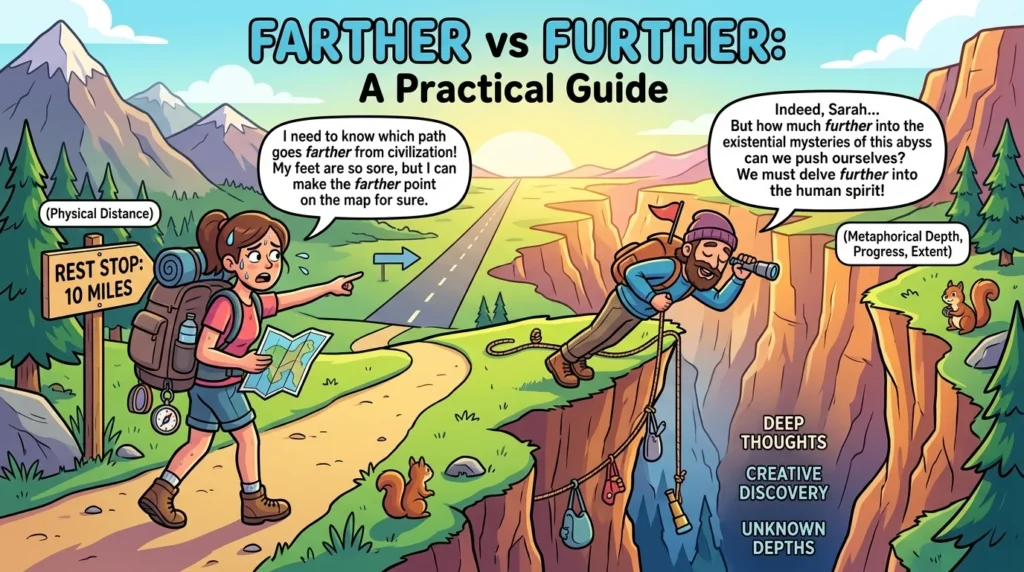
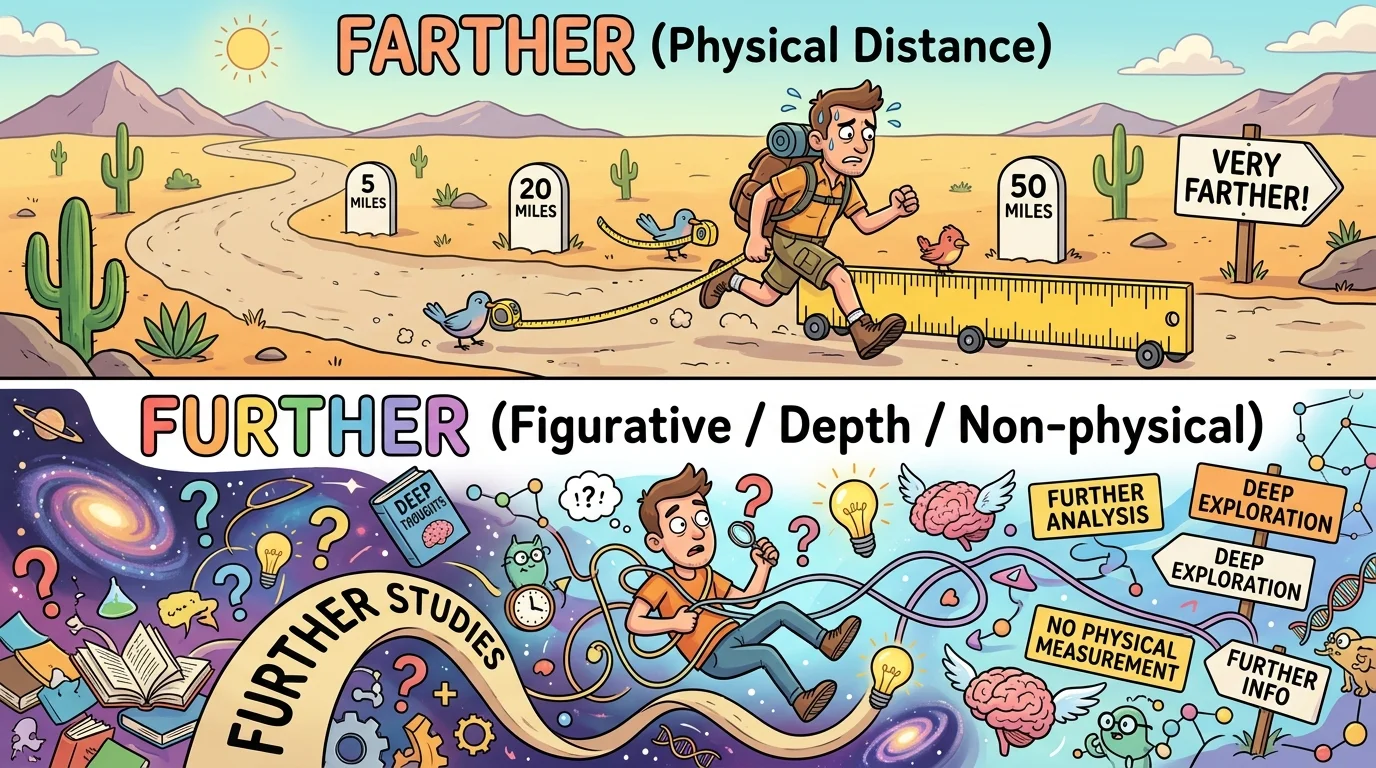
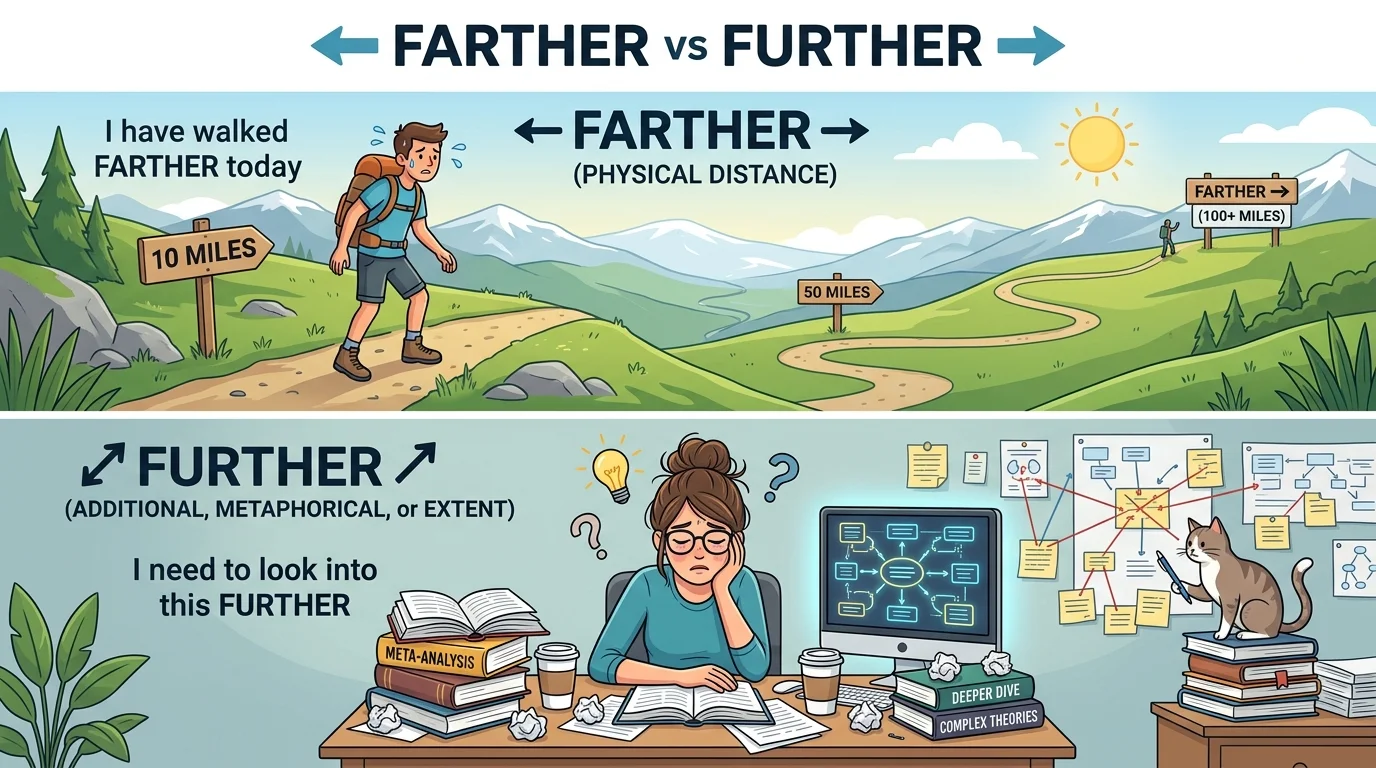
Farther usually refers to physical distance.
Further usually refers to figurative distance, additional information, advancement, or degree.
Examples:
- The gas station is farther down the road.
- For further information, visit our website.
A simple rule is:
- Farther = physical distance
- Further = figurative or additional distance
What Does Farther Mean?
Farther is generally used to describe a greater physical distance.
Definition
Farther means:
- More distant in space
- At a greater physical distance
- Located farther away
Usage Rules
Use farther when discussing:
- Miles and kilometers
- Roads and locations
- Physical movement
- Measurable distances
Examples of Farther
- The beach is farther than I expected.
- We drove farther into the mountains.
- Her house is farther from the city center.
- The store is farther down the street.
Key Insight
If you can measure the distance in feet, miles, kilometers, or meters, farther is usually the best choice.
What Does Further Mean?
Further generally refers to additional degree, advancement, or figurative distance.
Definition
Further means:
- Additional or extra
- To a greater extent
- More advanced
- Beyond what has already been discussed
Usage Rules
Use further when discussing:
- More information
- Progress and development
- Additional action
- Abstract concepts and figurative distance
Examples of Further
- We need further investigation.
- For further information, contact customer service.
- The company plans to further expand its business.
- She refused to discuss the matter further.
Key Insight
If the idea cannot be physically measured, further is usually the correct choice.
Farther vs Further: Key Differences
Although these words overlap in meaning and are sometimes interchangeable, their traditional uses differ.
Quick Differences
- Farther refers to physical distance.
- Further refers to figurative distance and additional information.
- Further can function as an adjective, adverb, and verb.
- Farther primarily functions as an adjective and adverb.
| Feature | Farther | Further |
|---|---|---|
| Main Meaning | Greater physical distance | Additional or figurative distance |
| Distance Type | Physical | Figurative or abstract |
| Common Usage | Locations and measurable distances | Information, progress, advancement |
| Part of Speech | Adjective and adverb | Adjective, adverb, and verb |
| Example | The park is farther away. | We need further discussion. |
Real-World Usage Examples
Example 1
Incorrect: The hotel is further down the road.
Correct: The hotel is farther down the road.
🎯 Lesson: Physical locations usually require farther.
Example 2
Incorrect: For farther details, visit our office.
Correct: For further details, visit our office.
🎯 Lesson: Additional information requires further.
Example 3
Friend: Is the museum close by?
You: No, it’s much farther than I thought.
🎯 Lesson: Measurable distance calls for farther.
Example 4
Manager: Do we need more information?
Employee: Yes, we need further analysis.
🎯 Lesson: Abstract ideas and additional information require further.
Common Mistakes
Mistake 1: Using Further for Physical Distance
Incorrect:
- The school is further down the highway.
Correct:
- The school is farther down the highway.
Why it happens: Many modern speakers use further for both meanings.
Mistake 2: Using Farther for Additional Information
Incorrect:
- Please contact us for farther assistance.
Correct:
- Please contact us for further assistance.
Why it happens: People assume both words are completely interchangeable.
Mistake 3: Ignoring Traditional Style Guidelines
Incorrect:
- We need farther discussion.
Correct:
- We need further discussion.
Why it happens: Writers focus on pronunciation rather than meaning and context.
Memory Tricks
Trick 1
Farther has the word “far” in it.
Think:
Farther = far away physically.
Trick 2
Further = further information.
If you can replace the word with additional, use further.
Trick 3
Remember this sentence:
The park is farther away, but I need further directions.
Expert Insights
Historically, farther and further shared similar meanings and were often used interchangeably. Over time, grammar experts and style guides developed a practical distinction:
- Farther for physical distance
- Further for figurative distance and additional information
Modern dictionaries acknowledge that native speakers sometimes use further for physical distance. However, maintaining the traditional distinction improves clarity and is widely recommended in formal, academic, and professional writing.