
Quick Answer
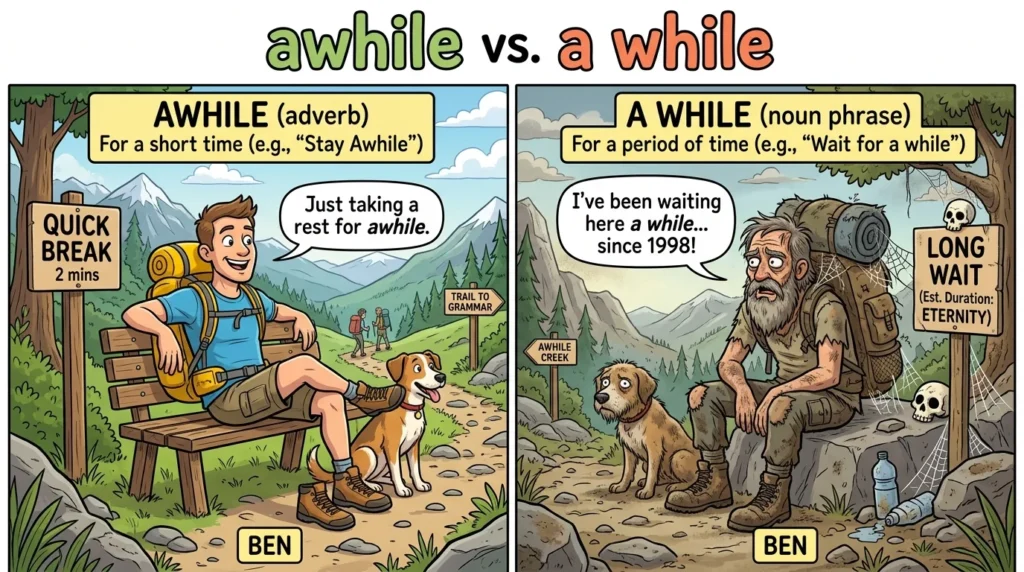
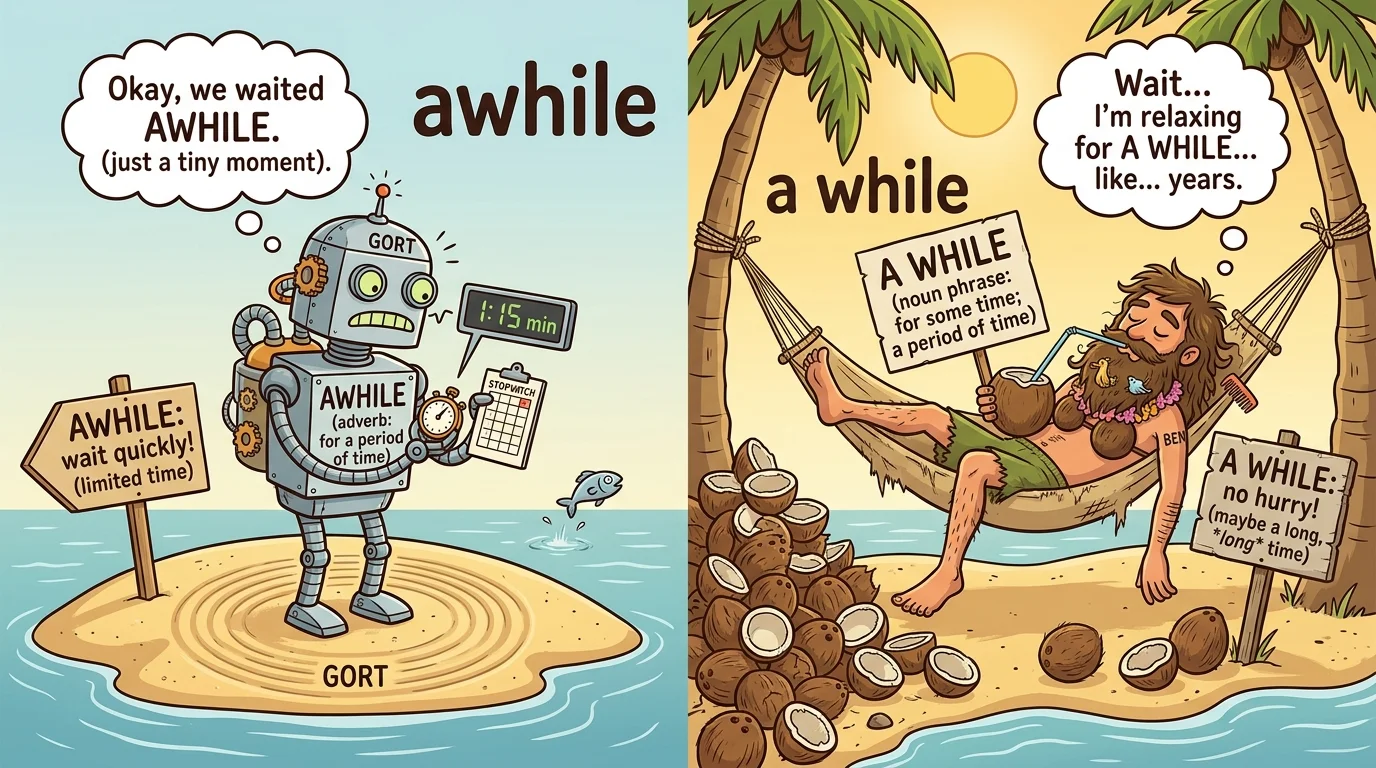
Awhile is an adverb that means for a short time.
A while is a noun phrase that means a period of time.
Examples:
- Please stay awhile.
- I haven’t seen him for a while.
A simple rule is this:
- No preposition before it? Usually use awhile.
- A preposition like for, after, or in before it? Usually use a while.
What Does Awhile Mean?
Awhile is an adverb that means for a short time.
Definition
Awhile means:
- For a brief period
- For some time
- Temporarily
Usage Rules
Use awhile when it directly modifies a verb and no preposition is needed before it.
Examples of Awhile
- Sit and relax awhile.
- Please stay awhile.
- They talked awhile before dinner.
- Rest awhile before continuing your work.
Key Insight
You can often replace awhile with briefly or for a short time.
Example:
- Stay awhile.
- Stay for a short time.
Both sentences have essentially the same meaning.
What Does A While Mean?
A while is a noun phrase consisting of the article a and the noun while, meaning a period of time.
Definition
A while means:
- A period of time
- Some amount of time
- A short or unspecified duration
Usage Rules
Use a while after prepositions such as:
- For
- After
- In
- Quite
Examples of A While
- I haven’t seen her for a while.
- We waited for a while.
- After a while, the rain stopped.
- It may take a while to finish the project.
Key Insight
Since a while functions as a noun phrase, it often follows a preposition.
Example:
- We talked for a while.
The preposition for requires the noun phrase a while, not the adverb awhile.
Awhile vs A While: Key Differences
Although both expressions involve time, their grammatical roles are different.
Quick Differences
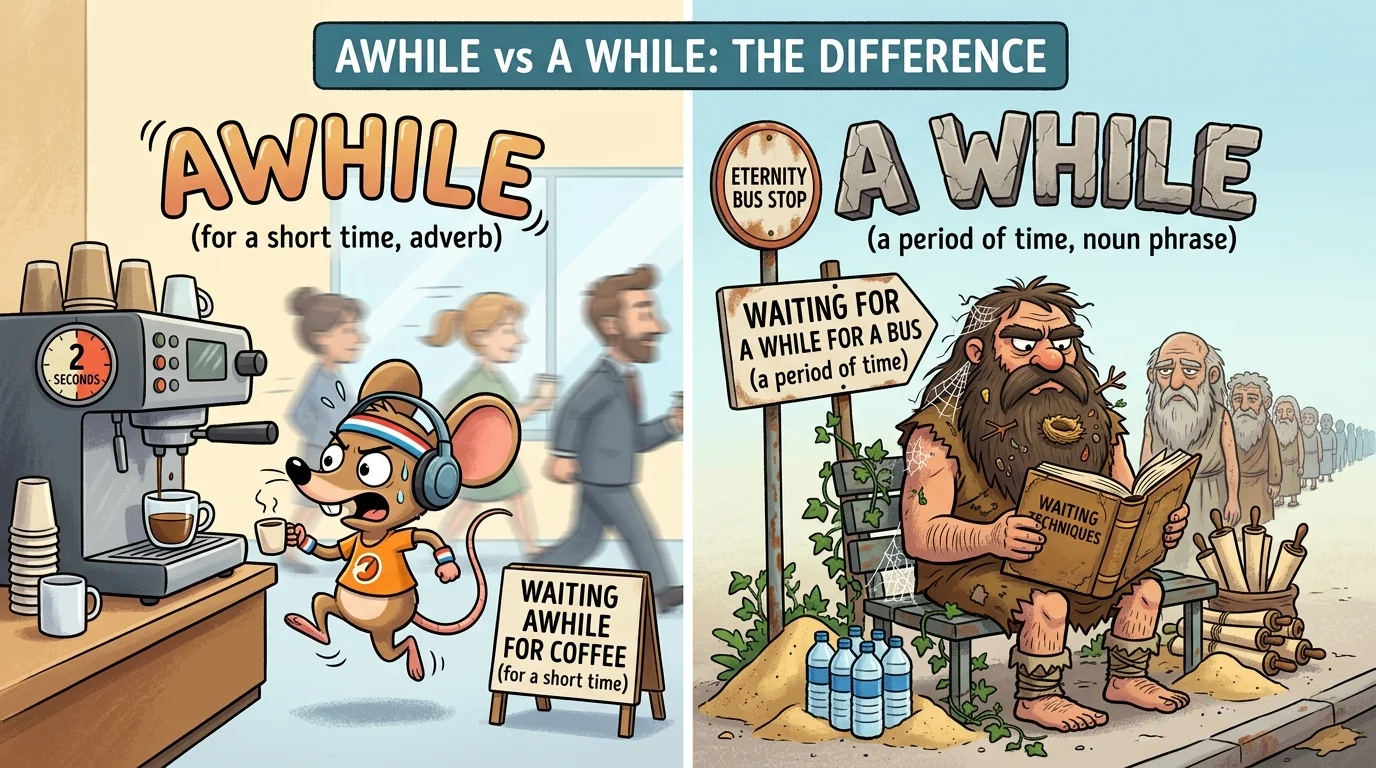
- Awhile is one word and functions as an adverb.
- A while is two words and functions as a noun phrase.
- Awhile usually appears directly after verbs.
- A while often follows prepositions.
| Feature | Awhile | A While |
|---|---|---|
| Number of Words | One | Two |
| Part of Speech | Adverb | Noun phrase |
| Meaning | For a short time | A period of time |
| Usually Follows | Verbs | Prepositions |
| Example | Stay awhile. | Wait for a while. |
Real-World Usage Examples
Example 1
Incorrect: Please stay a while.
Correct: Please stay awhile.
🎯 Lesson: No preposition is needed, so use the adverb awhile.
Example 2
Incorrect: We waited for awhile.
Correct: We waited for a while.
🎯 Lesson: The preposition for requires the noun phrase a while.
Example 3
Friend: Are you leaving already?
You: No, I’ll stay awhile.
🎯 Lesson: Use awhile directly after the verb.
Example 4
Friend: How long has it been since you visited?
You: It’s been a while.
🎯 Lesson: Here, a while means a period of time.
Common Mistakes
Mistake 1: Writing “For Awhile”
Incorrect:
- We talked for awhile.
Correct:
- We talked for a while.
Why it happens: People assume both expressions are interchangeable.
Mistake 2: Writing “Stay A While”
Incorrect:
- Stay a while.
Correct:
- Stay awhile.
Why it happens: Writers do not recognize that awhile functions as an adverb.
Mistake 3: Ignoring the Grammar Function
Many people focus on meaning rather than grammatical structure.
Correction: Determine whether the expression acts as an adverb or a noun phrase.
Memory Tricks
Trick 1
Awhile = Already Includes “For a Short Time”
Since awhile already means “for a short time,” don’t add another preposition before it.
Trick 2
A While = A + Noun
If you see a preposition like for, think of a while as a noun phrase.
Trick 3
Remember this sentence:
Stay awhile, but wait for a while.
The first expression follows a verb directly, while the second follows a preposition.
Expert Insights
Historically, awhile developed from the phrase a while and gradually became accepted as a single-word adverb.
Modern English preserves both forms because they serve different grammatical purposes:
- Awhile operates as an adverb meaning “for a short time.”
- A while remains a noun phrase referring to a period of time.
Many grammar mistakes occur because speakers hear both expressions pronounced similarly and assume they can always be substituted for one another. In formal writing, however, maintaining the distinction improves clarity and grammatical precision.