
Quick Answer
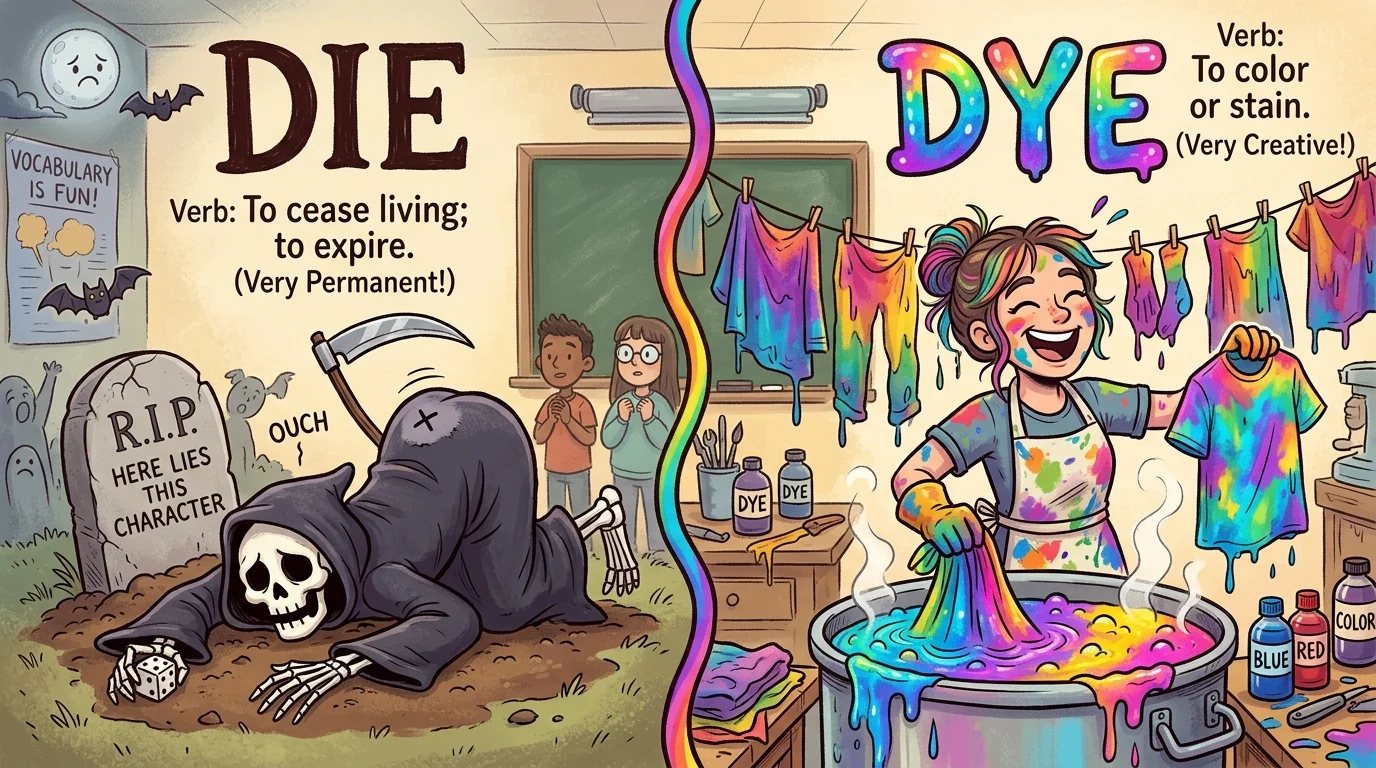
Die is a verb that usually means to stop living or to cease functioning.
Dye can be a verb meaning to color something or a noun referring to the coloring substance itself.
Examples:
- Plants can die without water.
- She wants to dye her hair blue.
Both words sound the same but have entirely different meanings.
What Does Die Mean?
Die is primarily a verb that means to stop living or to cease existing.
Definition
Die means:
- To stop living
- To cease functioning
- To gradually disappear or end
Usage Rules
Use die when referring to:
- The death of people, animals, or plants
- Machines or devices stopping work
- Activities, trends, or emotions ending
Examples of Die
- The flowers will die without sunlight.
- His phone suddenly died during the meeting.
- Old traditions sometimes die over time.
- Fish can die in polluted water.
Key Insight
The word die is often used both literally and figuratively.
Literal: The tree died during the winter.
Figurative: The conversation quickly died.
What Does Dye Mean?
Dye can function as both a verb and a noun.
Definition
As a verb, dye means:
- To change the color of something
As a noun, dye means:
- A substance used for coloring materials
Usage Rules
Use dye when discussing:
- Coloring hair
- Changing the color of clothes
- Applying pigments or coloring substances
Examples of Dye
- She plans to dye her hair red.
- They dyed the fabric green.
- The company uses natural dyes in its products.
- I accidentally spilled fabric dye on my shirt.
Key Insight
Whenever the sentence involves adding or changing color, dye is usually the correct choice.
Die vs Dye: Key Differences
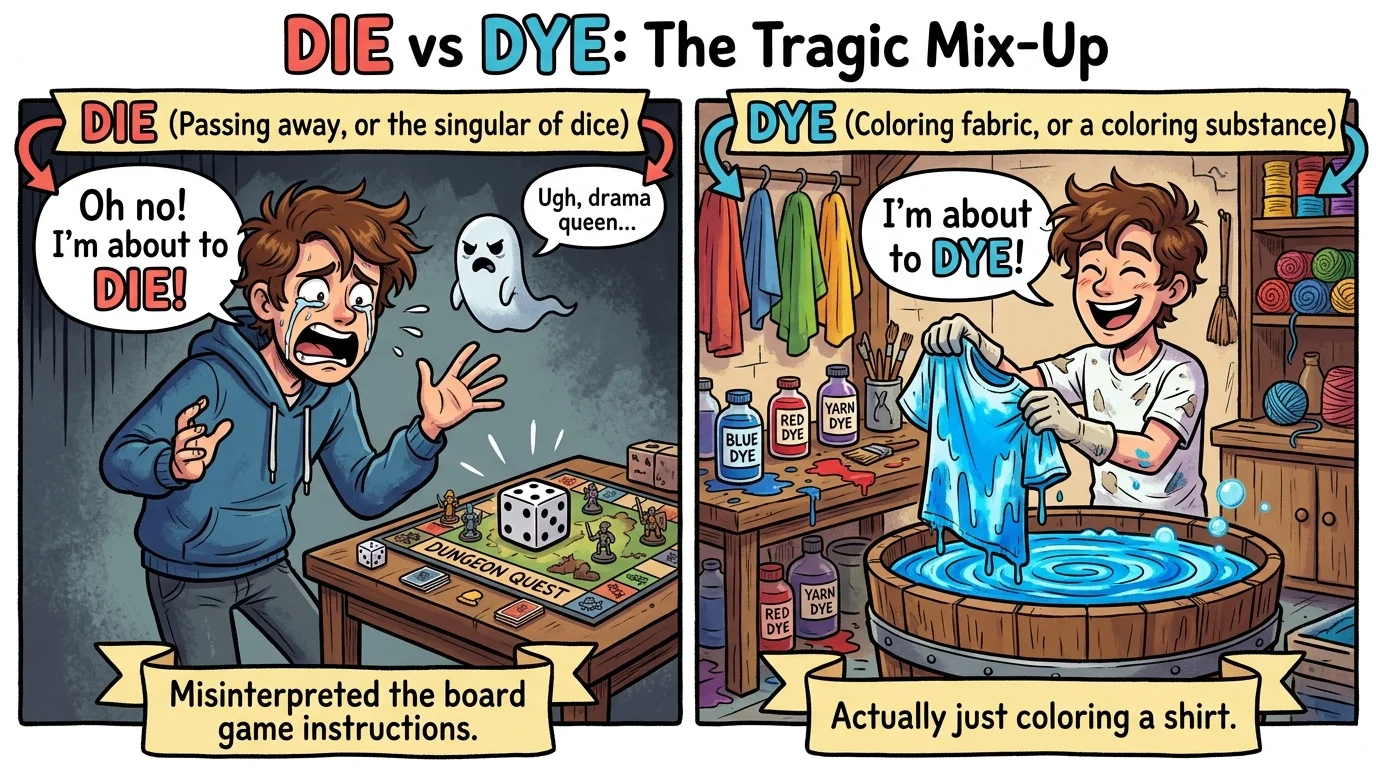
Although die and dye are pronounced the same, their meanings are completely different.
Quick Differences
- Die relates to death, endings, or stopping function.
- Dye relates to coloring something.
- Die is mainly a verb.
- Dye can be both a verb and a noun.
| Feature | Die | Dye |
|---|---|---|
| Meaning | To stop living or functioning | To color something |
| Part of Speech | Mainly a verb | Verb and noun |
| Related Topics | Death, endings, malfunction | Hair, fabric, pigments |
| Example | The battery died. | She dyed her hair blonde. |
Real-World Usage Examples
Example 1
Incorrect: I want to die my hair purple.
Correct: I want to dye my hair purple.
🎯 Lesson: Changing color requires dye, not die.
Example 2
Incorrect: My phone dyed during the movie.
Correct: My phone died during the movie.
🎯 Lesson: Devices stop functioning—they don’t change color.
Example 3
Friend: Why are you buying fabric paint?
You: I need to dye these curtains.
🎯 Lesson: Coloring fabric requires dye.
Example 4
Friend: Why is your laptop off?
You: The battery died.
🎯 Lesson: When something stops functioning, use die.
Common Mistakes
Mistake 1: Writing “Die My Hair”
Incorrect:
- I want to die my hair black.
Correct:
- I want to dye my hair black.
Why it happens: Both words are pronounced the same.
Mistake 2: Writing “My Phone Dyed”
Incorrect:
- My phone dyed yesterday.
Correct:
- My phone died yesterday.
Why it happens: People confuse the spellings because they are homophones.
Mistake 3: Assuming They Have Similar Meanings
Some learners think the words are related because they sound identical.
Correction: Their meanings are entirely unrelated.
Memory Tricks
Trick 1
Dye has a “Y,” and colors often remind us of yellow.
Yellow starts with Y, just like dye.
Trick 2
Die ends with “ie,” which can remind you of “life ends.”
Use die when something stops living or functioning.
Trick 3
Remember this sentence:
You dye your hair, but your phone can die.
Expert Insights
Die comes from ancient Germanic roots associated with ending life or ceasing to exist. Over centuries, its meaning expanded to include things that stop functioning, such as batteries, engines, and electronic devices.
Dye comes from older words connected to coloring and pigments. It has long been associated with changing the appearance of fabrics, clothing, hair, and materials through color.
Because the words evolved from different origins but ended up with the same pronunciation, they became classic examples of English homophones—words that sound alike but have different meanings and spellings.