
Quick Answer
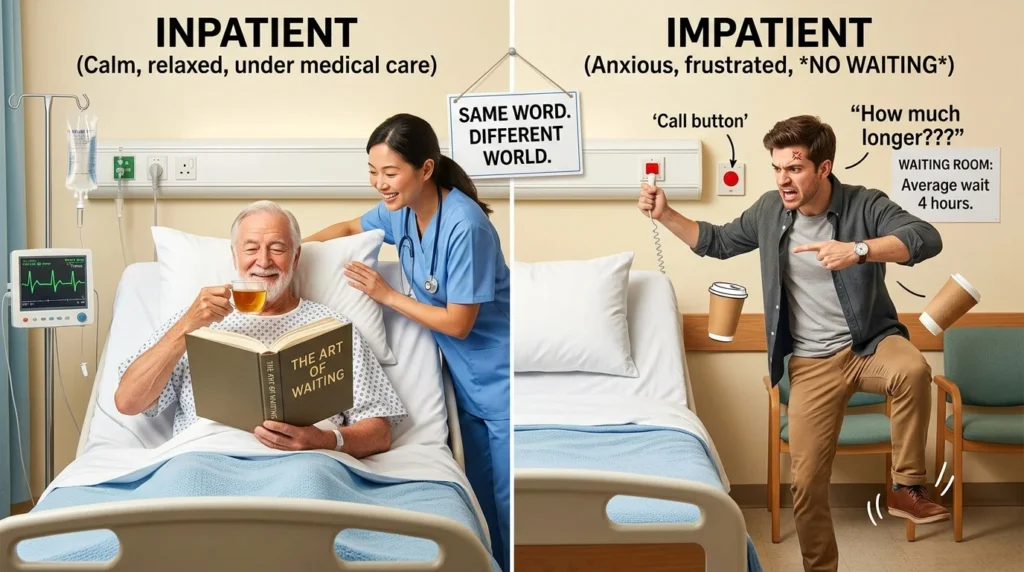
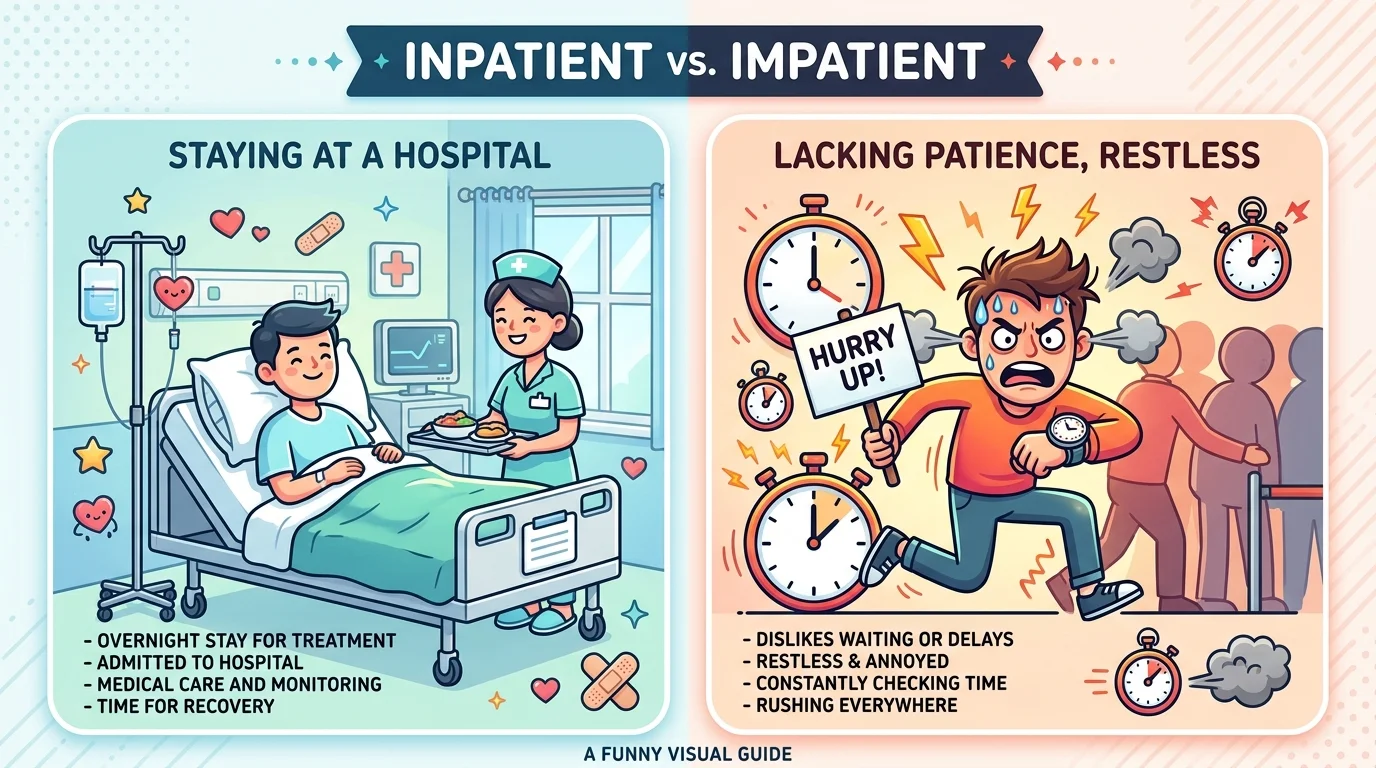
Inpatient means a person who stays in a hospital or medical facility for treatment.
Impatient means unable to wait calmly or becoming irritated by delays.
Examples:
- The doctor checked on the inpatient after surgery.
- She became impatient while waiting in line.
A simple rule is:
- Inpatient = In the hospital
- Impatient = Not patient
What Does Inpatient Mean?
Inpatient is a noun and adjective used in healthcare to refer to someone who stays in a hospital or medical facility while receiving treatment.
Definition
Inpatient means:
- A hospital patient who remains overnight
- A person admitted to a medical facility
- Someone receiving treatment while staying in the hospital
Usage Rules
Use inpatient when discussing:
- Hospitals and healthcare facilities
- Medical treatment requiring admission
- Overnight stays in hospitals
- Healthcare services and patient care
Examples of Inpatient
- The hospital admitted the inpatient for observation.
- She remained an inpatient for three days after surgery.
- The doctor specializes in inpatient care.
- The hospital expanded its inpatient services.
Key Insight
An inpatient stays in a medical facility for treatment. This word is commonly used in hospitals, clinics, and healthcare settings.
What Does Impatient Mean?
Impatient is an adjective describing someone who becomes annoyed, restless, or unable to wait calmly.
Definition
Impatient means:
- Lacking patience
- Easily irritated by delays
- Unable to wait calmly
- Restless and eager for something to happen
Usage Rules
Use impatient when discussing:
- Waiting situations
- Frustration and annoyance
- Delays and interruptions
- Eagerness or restlessness
Examples of Impatient
- The children became impatient while waiting for dinner.
- She grew impatient during the long meeting.
- He was impatient to hear the exam results.
- Customers became impatient because of the delay.
Key Insight
Impatient describes a person’s feelings or behavior when they dislike waiting or want something to happen quickly.
Inpatient vs Impatient: Key Differences
Although these words differ by only one letter, their meanings are entirely unrelated.
Quick Differences
- Inpatient refers to a hospital patient.
- Impatient describes a lack of patience.
- Inpatient is mainly used in medical contexts.
- Impatient describes emotions and behavior.
| Feature | Inpatient | Impatient |
|---|---|---|
| Main Meaning | Hospital patient | Unable to wait calmly |
| Context | Healthcare and medicine | Emotions and behavior |
| Part of Speech | Noun and adjective | Adjective |
| Related Idea | Medical treatment | Frustration and restlessness |
| Example | The inpatient recovered quickly. | The customer became impatient. |
Real-World Usage Examples
Example 1
Incorrect: The doctor examined the impatient after surgery.
Correct: The doctor examined the inpatient after surgery.
🎯 Lesson: Hospital patients are called inpatients.
Example 2
Incorrect: The children became inpatient while waiting.
Correct: The children became impatient while waiting.
🎯 Lesson: Feeling annoyed by delays requires impatient.
Example 3
Friend: Why is your uncle still in the hospital?
You: He’s an inpatient recovering from surgery.
🎯 Lesson: Someone admitted to a hospital is an inpatient.
Example 4
Friend: Why does she keep checking the clock?
You: She’s becoming impatient because the bus is late.
🎯 Lesson: Someone who dislikes waiting is impatient.
Common Mistakes
Mistake 1: Using Impatient for Hospital Patients
Incorrect:
- The impatient was discharged yesterday.
Correct:
- The inpatient was discharged yesterday.
Why it happens: The words look nearly identical.
Mistake 2: Using Inpatient for Frustration
Incorrect:
- I became inpatient after waiting for an hour.
Correct:
- I became impatient after waiting for an hour.
Why it happens: Writers accidentally omit the letter m.
Mistake 3: Assuming the Words Are Related
Incorrect assumption:
- Inpatient and impatient have similar meanings.
Correct:
- They have completely different meanings and are used in entirely different situations.
Why it happens: The spellings and pronunciations are very similar.
Memory Tricks
Trick 1
Inpatient = In the Hospital
Think:
Inpatient = In + Patient = In a medical facility.
Trick 2
Impatient = Impossible to Wait
Think:
Impatient = I can’t wait anymore.
Trick 3
Remember this sentence:
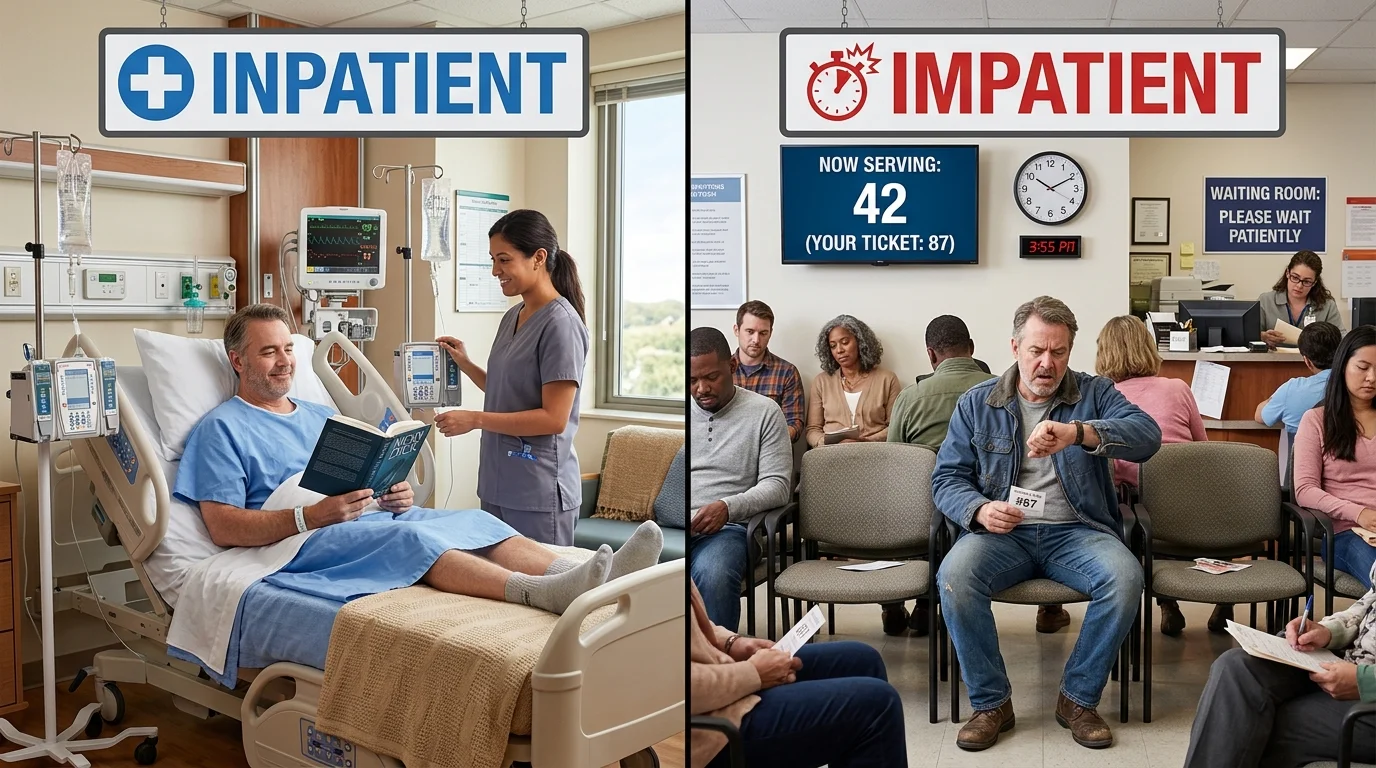
The inpatient stayed in the hospital, while his impatient family waited outside.
Expert Insights
Although inpatient and impatient look nearly identical, they come from different concepts.
- Inpatient developed as a medical term describing patients admitted to healthcare facilities.
- Impatient comes from the adjective patient, with the negative prefix im-, meaning not patient.
Because both words are common and differ by only one letter, they frequently appear in spelling mistakes. However, remembering their contexts makes the distinction easy:
- Inpatient belongs to healthcare and medicine.
- Impatient belongs to emotions and behavior.
Keeping these meanings separate improves clarity and prevents misunderstandings.