
Quick Answer
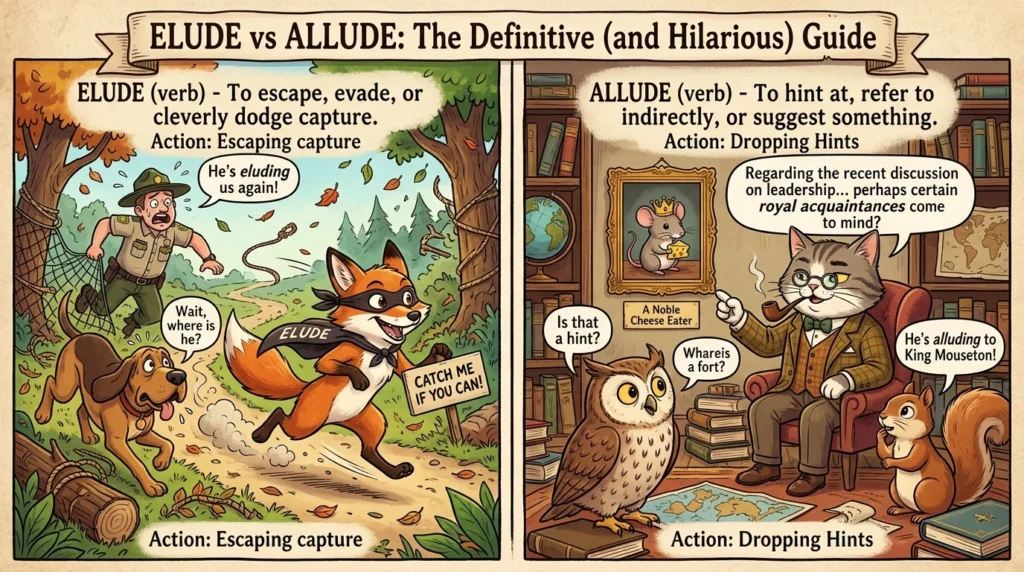
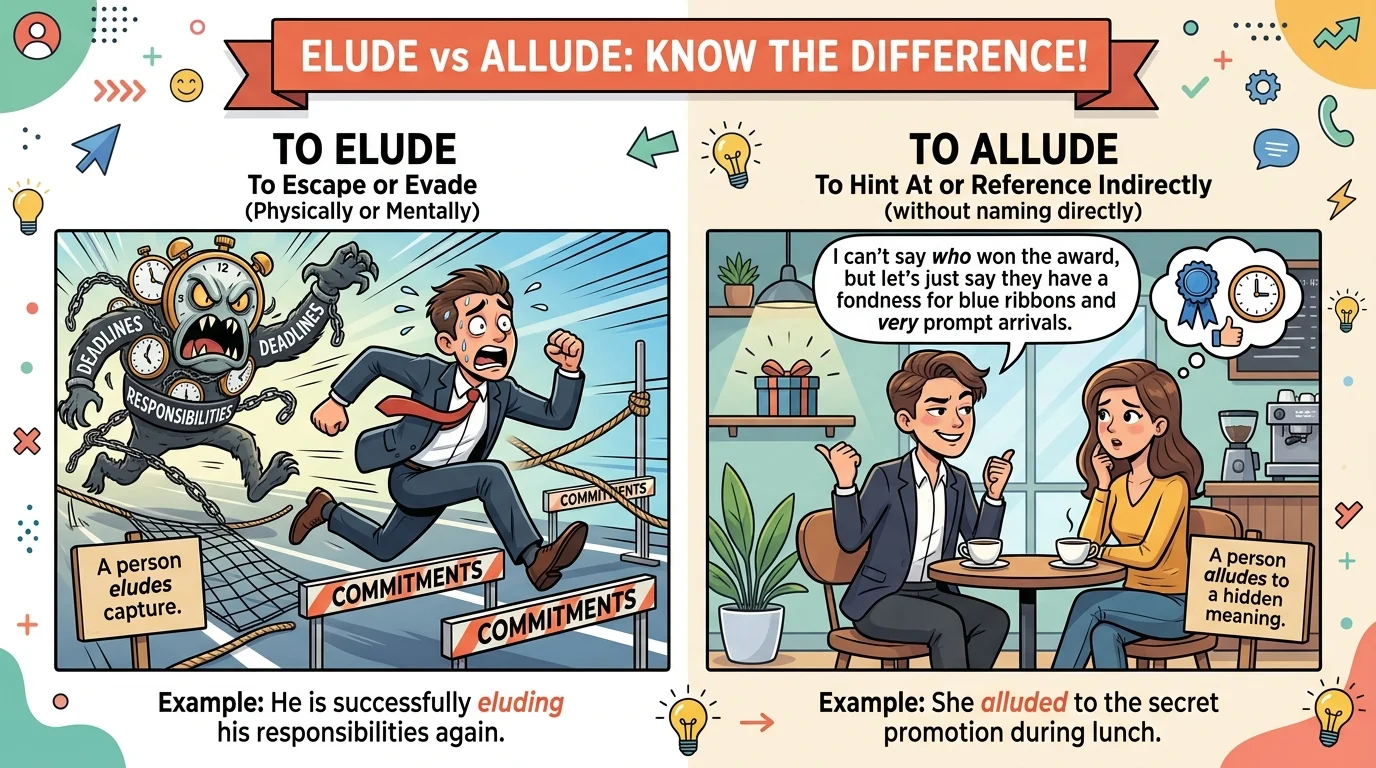
Elude means to escape, avoid, or remain beyond someone’s understanding or reach.
Allude means to refer to something indirectly without mentioning it directly.
Examples:
- The thief managed to elude the police.
- The speaker alluded to recent events without naming them.
A simple rule is:
- Elude = Escape
- Allude = Indirectly Refer
What Does Elude Mean?
Elude is a verb that means to avoid, escape, or evade someone or something.
Definition
Elude means:
- To escape capture
- To avoid being found
- To evade understanding
- To remain difficult to achieve
Usage Rules
Use elude when discussing:
- Escaping from people or authorities
- Avoiding detection
- Ideas that are difficult to understand
- Goals that remain unattainable
Examples of Elude
- The suspect managed to elude the police.
- Sleep continued to elude him.
- The answer eluded the students.
- Success seemed to elude the struggling company.
Key Insight
Elude often suggests something that is difficult to catch, reach, achieve, or understand.
What Does Allude Mean?
Allude is a verb that means to refer to something indirectly.
Definition
Allude means:
- To hint at something
- To mention something indirectly
- To suggest an idea without stating it explicitly
- To make an indirect reference
Usage Rules
Use allude when:
- Hinting at a person or event
- Referring indirectly to literature, history, or current events
- Suggesting an idea without explaining it fully
- Using subtle references in speech or writing
Examples of Allude
- The author alluded to ancient mythology.
- She alluded to problems in the company without giving details.
- The comedian alluded to recent political events.
- His comments seemed to allude to an earlier disagreement.
Key Insight
Allude does not directly state something. Instead, it hints at it or refers to it indirectly.
Elude vs Allude: Key Differences
Although these verbs look and sound similar, they have entirely different meanings.
Quick Differences
- Elude means escape or avoid.
- Allude means indirectly refer to something.
- Elude often involves avoidance or difficulty.
- Allude involves hints and indirect references.
| Feature | Elude | Allude |
|---|---|---|
| Main Meaning | Escape or evade | Refer indirectly |
| Common Context | Police, goals, understanding | Speech, writing, references |
| Action | Avoiding or escaping | Hinting or mentioning |
| Related Idea | Evasion | Suggestion |
| Example | The answer eluded me. | The speaker alluded to the scandal. |
Real-World Usage Examples
Example 1
Incorrect: The criminal managed to allude the police.
Correct: The criminal managed to elude the police.
🎯 Lesson: Escaping authorities requires elude.
Example 2
Incorrect: The writer eluded to Shakespeare.
Correct: The writer alluded to Shakespeare.
🎯 Lesson: Indirect references require allude.
Example 3
Friend: Did the detective catch the suspect?
You: No, the suspect eluded the authorities.
🎯 Lesson: Elude means escape or evade.
Example 4
Friend: Did the manager mention layoffs?
You: Not directly. He alluded to them.
🎯 Lesson: Allude means to hint at something indirectly.
Common Mistakes
Mistake 1: Using Allude for Escaping
Incorrect:
- The runner alluded his opponents.
Correct:
- The runner eluded his opponents.
Why it happens: The words look and sound similar.
Mistake 2: Using Elude for Indirect References
Incorrect:
- The article eluded to economic problems.
Correct:
- The article alluded to economic problems.
Why it happens: Writers confuse the meanings because of the similar spellings.
Mistake 3: Forgetting the Preposition with Allude
Incorrect:
- She alluded the incident.
Correct:
- She alluded to the incident.
Why it happens: Many learners forget that allude is typically followed by to.
Memory Tricks
Trick 1
Elude = Escape
Both words start with E.
Think:
Elude = Escape.
Trick 2
Allude = A Hint About Something
Think:
Allude = An indirect reference.
Trick 3
Remember this sentence:
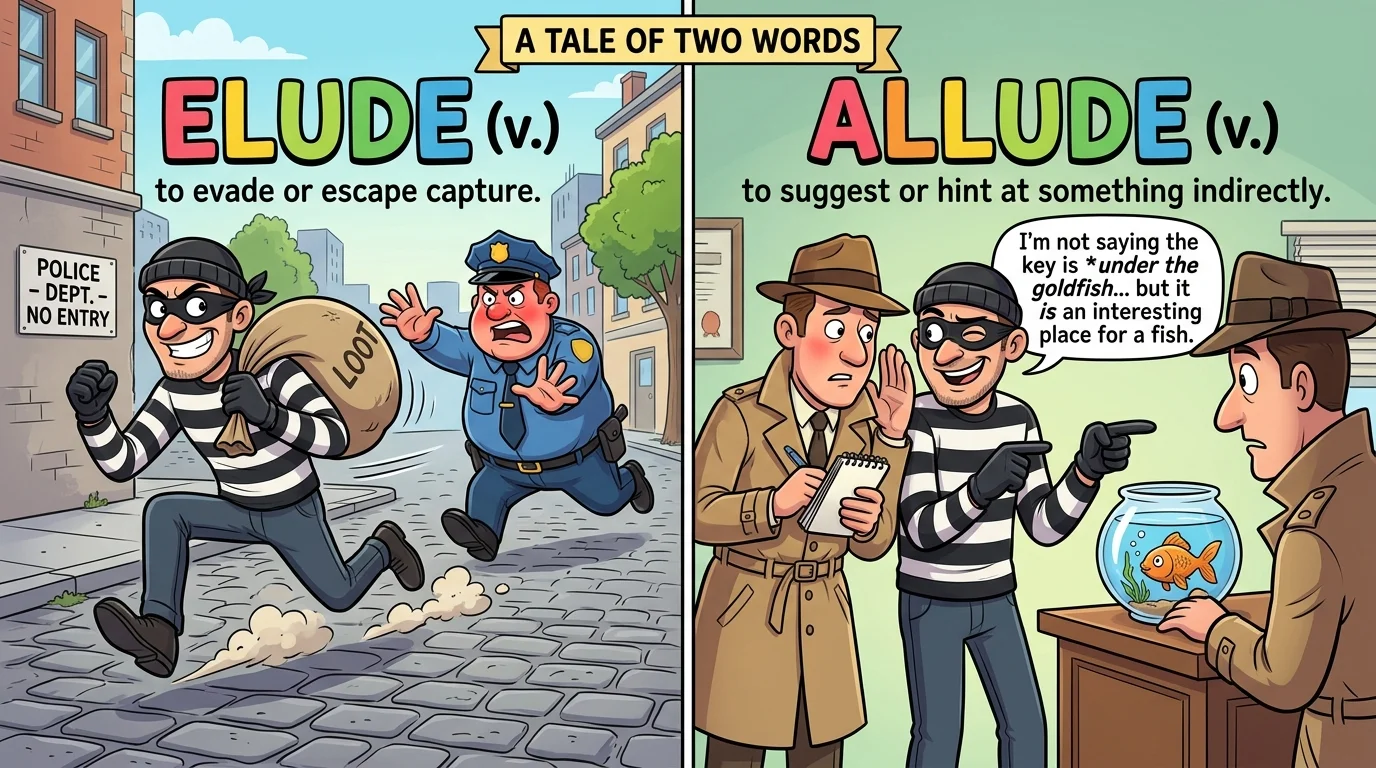
The thief eluded the police, while the journalist alluded to the crime.
Expert Insights
The verbs elude and allude come from different Latin roots.
- Elude developed from a root meaning to escape or evade through play or trickery.
- Allude developed from a root meaning to refer to or hint at something indirectly.
Although their pronunciations and spellings are similar, they belong to entirely different semantic categories:
- Elude involves avoidance, escape, or something beyond reach.
- Allude involves communication, hints, and indirect references.
Maintaining this distinction makes your writing clearer and more precise.