

Quick Answer
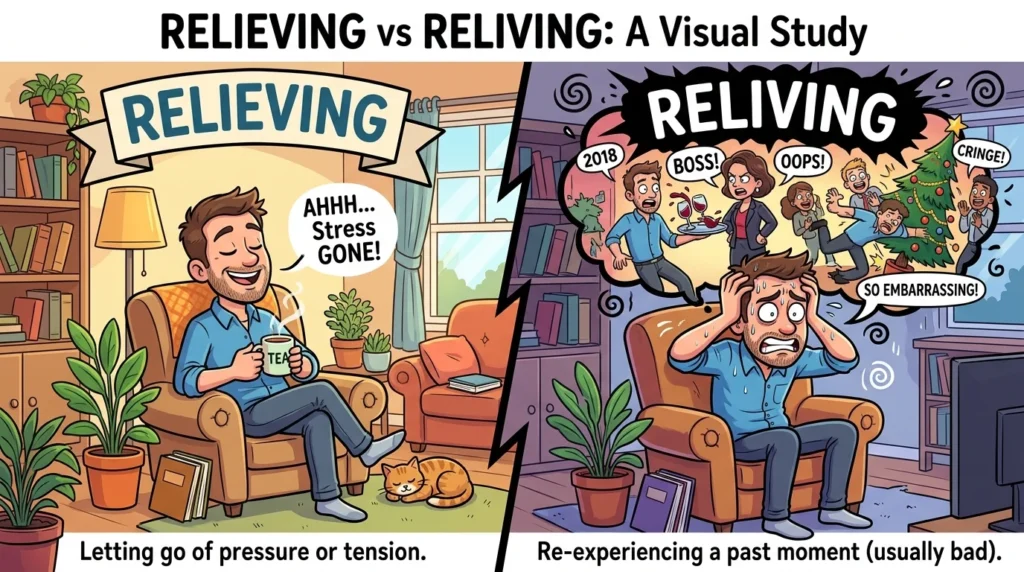
Relieving means reducing pain, stress, worry, or discomfort.
Reliving means experiencing a past event again in your thoughts or memories.
Examples:
- Taking a short break was relieving after a stressful day.
- She spent the evening reliving her childhood memories.
A simple rule is:
- Relieving = bringing relief
- Reliving = living something again
What Does Relieving Mean?
Relieving is the present participle of the verb relieve, which means to reduce or remove something unpleasant.
Definition
Relieving means:
- Easing pain or stress
- Reducing discomfort
- Removing worry or pressure
- Bringing comfort or relief
Usage Rules
Use relieving when discussing:
- Physical pain
- Stress and anxiety
- Emotional burdens
- Comfort and reassurance
Examples of Relieving
- The medicine is relieving her headache.
- Talking to a friend was incredibly relieving.
- The cool breeze was relieving on a hot day.
- Sharing the responsibility was relieving.
Key Insight
Whenever something makes you feel better or reduces a burden, relieving is usually the correct word.
What Does Reliving Mean?
Reliving is the present participle of the verb relive, which means to experience something again mentally or emotionally.
Definition
Reliving means:
- Remembering and mentally experiencing something again
- Going through past experiences in your mind
- Revisiting memories and emotions
Usage Rules
Use reliving when discussing:
- Memories
- Past experiences
- Childhood moments
- Emotional events
- Flashbacks and recollections
Examples of Reliving
- He enjoys reliving his college memories.
- She was reliving the excitement of her wedding day.
- The photo album had him reliving old adventures.
- Watching the video felt like reliving the entire trip.
Key Insight
If the sentence involves remembering or mentally experiencing something from the past again, reliving is the correct choice.
Relieving vs Reliving: Key Differences
Although the words differ by only one letter, their meanings are entirely different.
Quick Differences
- Relieving means reducing discomfort or bringing comfort.
- Reliving means experiencing the past again in your mind.
- Relieving focuses on easing problems.
- Reliving focuses on memories and past experiences.
| Feature | Relieving | Reliving |
|---|---|---|
| Main Meaning | Bringing relief | Experiencing something again |
| Context | Pain, stress, comfort | Memories and past events |
| Focus | Making things easier | Revisiting the past |
| Emotional Effect | Relief and comfort | Nostalgia or recollection |
| Example | The massage was relieving. | He was reliving his childhood. |
Real-World Usage Examples
Example 1
Incorrect: Looking at old photographs was relieving my childhood.
Correct: Looking at old photographs was reliving my childhood.
🎯 Lesson: Revisiting memories requires reliving.
Example 2
Incorrect: The medicine was reliving my back pain.
Correct: The medicine was relieving my back pain.
🎯 Lesson: Reducing pain requires relieving.
Example 3
Friend: Why are you smiling at those old pictures?
You: I’m reliving some wonderful memories.
🎯 Lesson: Remembering past experiences uses reliving.
Example 4
Friend: Did the vacation help you relax?
You: Yes, it was incredibly relieving after a stressful month.
🎯 Lesson: Feeling comfort or reduced stress uses relieving.
Common Mistakes
Mistake 1: Using Relieving for Memories
Incorrect:
- I spent the evening relieving my school days.
Correct:
- I spent the evening reliving my school days.
Why it happens: Both words involve emotions and experiences.
Mistake 2: Using Reliving for Pain Reduction
Incorrect:
- The medication is reliving my headache.
Correct:
- The medication is relieving my headache.
Why it happens: Writers confuse the similar spellings.
Mistake 3: Ignoring the Meaning of the Root Words
Incorrect assumption:
- The words can be used interchangeably.
Correct:
- They have completely different meanings and contexts.
Why it happens: Only one letter separates them, making them easy to mix up.
Memory Tricks
Trick 1
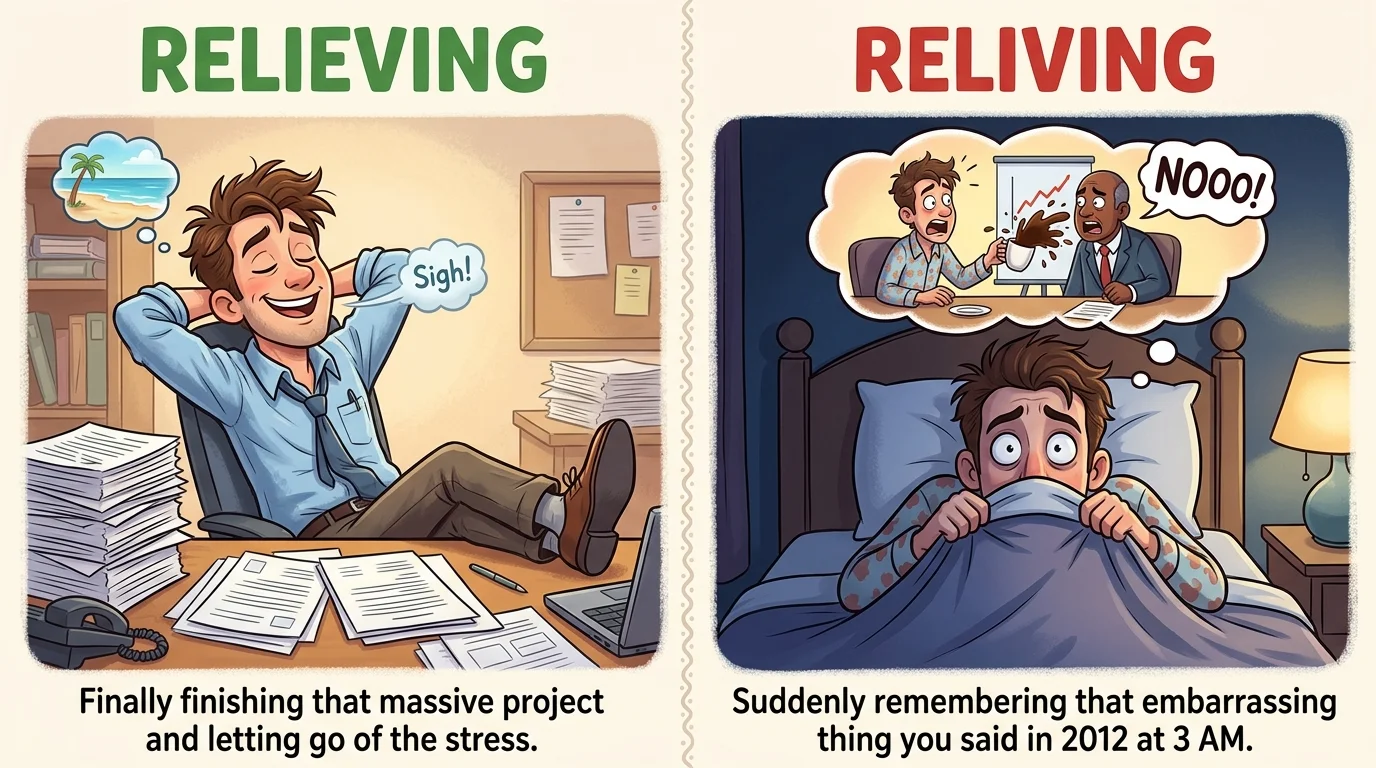
Relieving = Relief
Both words begin with reli- and relate to feeling better.
Think:
Relieving = relief from pain or stress.
Trick 2
Reliving = Living Again
The word contains living.
Think:
Reliving = living an experience again in your mind.
Trick 3
Remember this sentence:
The vacation was relieving, and later I enjoyed reliving it through photos.
Expert Insights
The verbs relieve and relive come from different linguistic developments in English.
- Relieve evolved from words associated with helping, easing burdens, and bringing comfort.
- Relive developed from the idea of living through an experience again.
Because the present participles differ by only one letter, writers frequently confuse them. However, the distinction is clear:
- Relieving is about reducing something unpleasant.
- Reliving is about mentally revisiting the past.
Maintaining this distinction improves clarity and prevents awkward or misleading sentences.