

Quick Answer
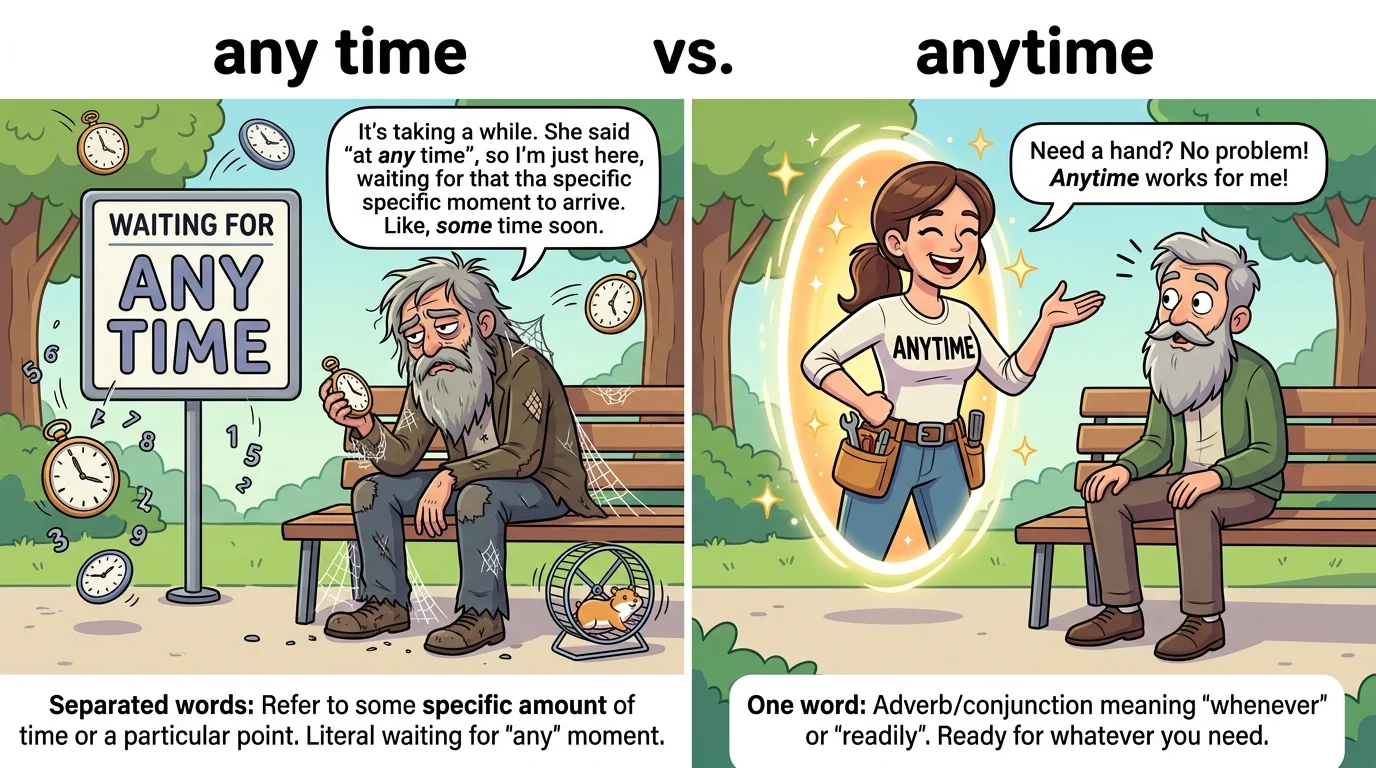
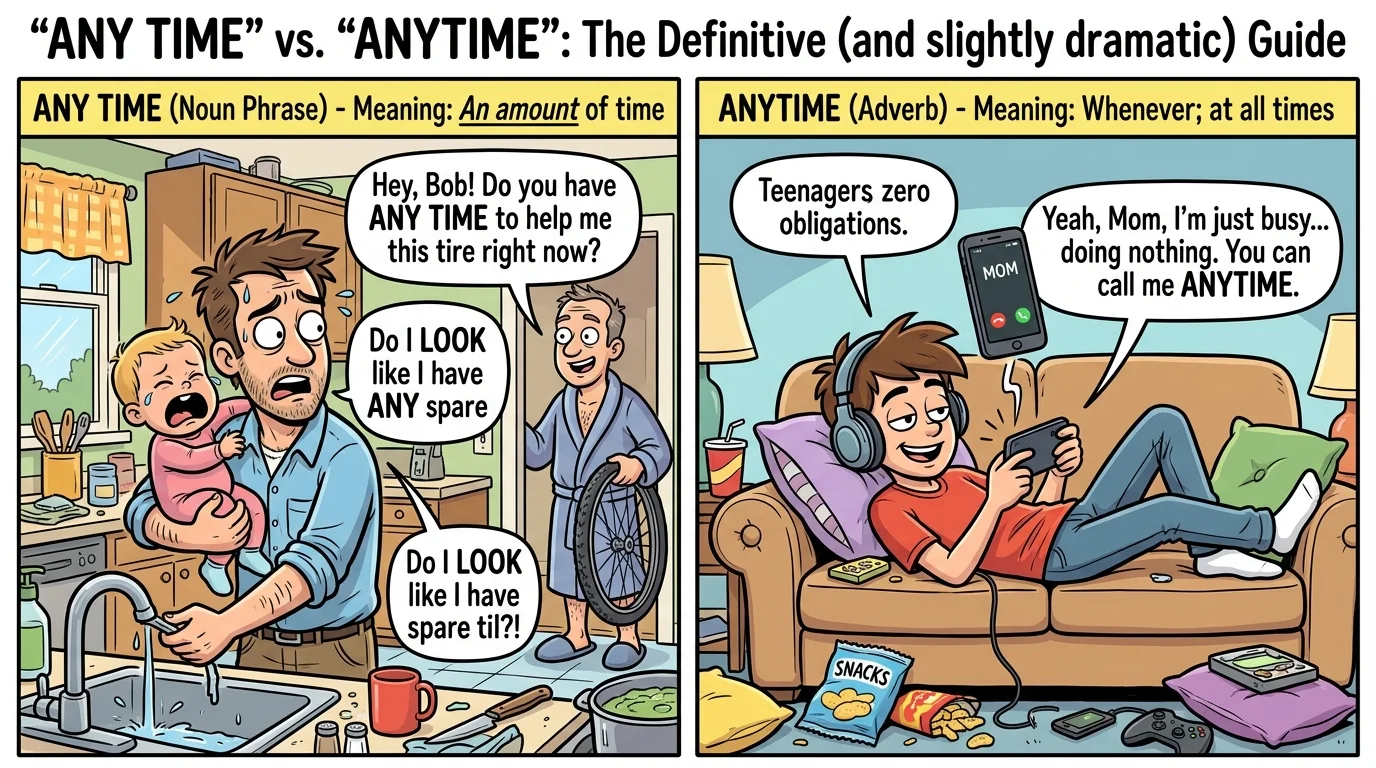
Any time is a two-word noun phrase that means any amount of time or any particular time.
Anytime is a one-word adverb that means whenever or at any time.
Examples:
- Do you have any time to talk today?
- You can call me anytime.
A simple rule is:
- Any time = noun phrase
- Anytime = adverb meaning whenever
What Does Any Time Mean?
Any time is a noun phrase consisting of the determiner any and the noun time.
Definition
Any time means:
- Any amount of time
- Any particular moment
- An unspecified period of time
Usage Rules
Use any time when:
- Referring to an amount of time
- Using a preposition before the phrase
- Asking about availability
- Talking about a specific period or duration
Examples of Any Time
- Do you have any time to help me?
- I don’t have any time for hobbies lately.
- Is there any time available tomorrow?
- She barely had any time to prepare.
Key Insight
Any time usually works as a noun phrase and can often be replaced with any amount of time.
Example:
- I don’t have any time to spare.
- I don’t have any amount of time to spare.
Both sentences have essentially the same meaning.
What Does Anytime Mean?
Anytime is an adverb meaning whenever or at any time.
Definition
Anytime means:
- Whenever
- At any moment
- At an unspecified time
Usage Rules
Use anytime when:
- Inviting someone to do something whenever they want
- Referring to an unspecified moment
- Using it as an adverb modifying a verb
Examples of Anytime
- You can visit us anytime.
- Feel free to call me anytime.
- Come back anytime you need help.
- I can meet anytime this weekend.
Key Insight
If you can replace the word with whenever, anytime is usually correct.
Example:
- Call me anytime.
- Call me whenever.
Both sentences work perfectly.
Any Time vs Anytime: Key Differences
Although they have related meanings, their grammatical functions are different.
Quick Differences
- Any time is a two-word noun phrase.
- Anytime is a one-word adverb.
- Any time refers to an amount or period of time.
- Anytime means whenever or at any moment.
| Feature | Any Time | Anytime |
|---|---|---|
| Number of Words | Two | One |
| Part of Speech | Noun phrase | Adverb |
| Main Meaning | Any amount of time | Whenever |
| Common Usage | Availability and duration | Invitations and unspecified moments |
| Example | I don’t have any time today. | You can call anytime. |
Real-World Usage Examples
Example 1
Incorrect: I don’t have anytime to finish this project.
Correct: I don’t have any time to finish this project.
🎯 Lesson: Amounts of time require the noun phrase any time.
Example 2
Incorrect: You can visit us any time.
Correct: You can visit us anytime.
🎯 Lesson: When you mean whenever, use anytime.
Example 3
Friend: Can I call you later?
You: Yes, call me anytime.
🎯 Lesson: The meaning here is whenever you want.
Example 4
Friend: Do you have free time today?
You: I barely have any time.
🎯 Lesson: Here, the phrase refers to an amount of time.
Common Mistakes
Mistake 1: Using Anytime as a Noun
Incorrect:
- I don’t have anytime today.
Correct:
- I don’t have any time today.
Why it happens: People assume the one-word form works everywhere.
Mistake 2: Using Any Time Instead of Whenever
Incorrect:
- Stop by any time you want.
Preferred:
- Stop by anytime you want.
Why it happens: Writers overlook the adverbial function of anytime.
Mistake 3: Ignoring Prepositions
Incorrect:
- At anytime, you may contact us.
Preferred:
- At any time, you may contact us.
Why it happens: Prepositions often require the two-word noun phrase.
Memory Tricks
Trick 1
Anytime = Whenever
If you can replace it with whenever, use anytime.
Trick 2
Any Time = Any Amount of Time
If you’re discussing a period or amount of time, use any time.
Trick 3
Remember this sentence:
I don’t have any time today, but you can call me anytime tomorrow.
The first refers to an amount of time, while the second means whenever.
Expert Insights
Historically, any time appeared first as a noun phrase. Over time, English speakers began using anytime as a single-word adverb meaning whenever.
Modern style guides generally follow this distinction:
- Any time for periods or amounts of time.
- Anytime as an adverb meaning whenever.
However, informal writing sometimes uses the forms interchangeably. Maintaining the distinction improves clarity and makes your writing appear more polished and professional.