
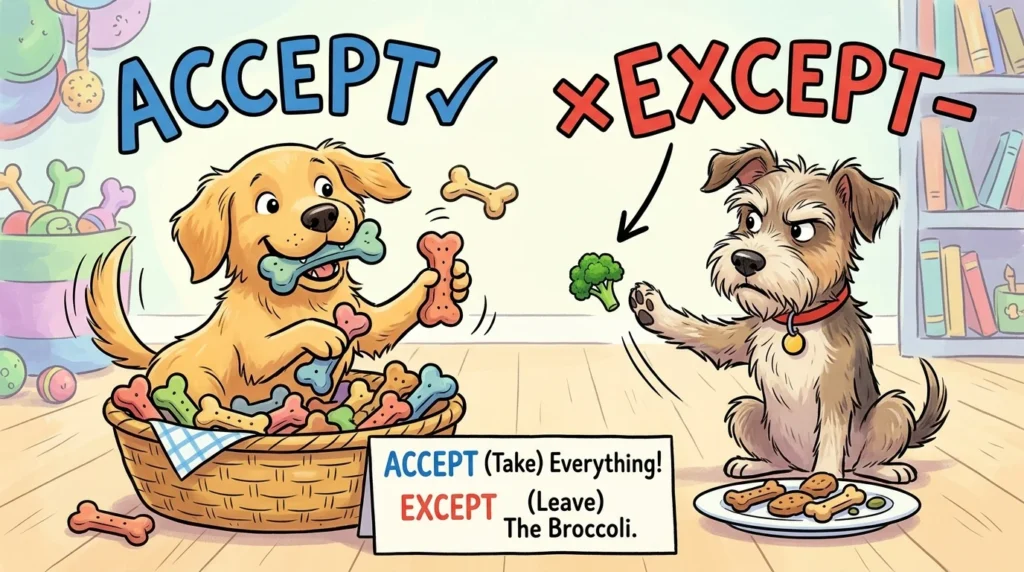

Quick Answer
Accept means to receive, agree to, or approve something.
Except means excluding, leaving out, or not including someone or something.
Simple rule: If you’re taking something in, use accept. If you’re leaving something out, use except.
What Does Accept Mean?
Definition
Accept is a verb that means to willingly receive, agree to, approve, or believe something.
Usage Rules
Use accept when talking about:
- Receiving gifts or offers
- Agreeing to terms or invitations
- Admitting facts or responsibility
- Approving requests or applications
- Believing something to be true
Real Examples
- She decided to accept the job offer.
- I gladly accepted his invitation to dinner.
- The company did not accept the proposal.
- He finally accepted that he had made a mistake.
- The school accepted her application.
Key Insights
The word accept commonly appears in:
- Business and professional communication
- Job offers and applications
- Invitations and requests
- Academic settings
- Legal agreements
- Personal relationships
Key idea: To accept something means to take it in or agree to it.
What Does Except Mean?
Definition
Except is usually a preposition or conjunction that means excluding, other than, or not including.
Usage Rules
Use except when:
- Excluding someone from a group
- Mentioning an exception
- Leaving something out
- Stating that one item does not follow the same rule
Real Examples
- Everyone attended the meeting except Sarah.
- I eat all vegetables except spinach.
- The store is open every day except Sunday.
- All students passed the exam except one.
- He likes every sport except cricket.
Key Insights
The word except commonly appears in:
- Rules and policies
- Lists and comparisons
- Instructions and directions
- Academic writing
- Everyday conversations
Key idea: Except means something is being left out or excluded.
Accept vs Except: Key Differences
Comparison Table
| Feature | Accept | Except |
|---|---|---|
| Meaning | To receive, agree, or approve | To exclude or leave out |
| Part of Speech | Mainly a verb | Mainly a preposition or conjunction |
| Function | Takes something in | Leaves something out |
| Context | Offers, invitations, applications, facts | Lists, rules, exceptions |
| Example | I accept your apology. | Everyone came except John. |
Quick Differences
- Accept = receive or agree.
- Except = exclude or leave out.
- Accept is an action.
- Except creates an exception.
- The words are never interchangeable.
Real-World Usage Scenarios
Example 1
Incorrect:
“I except your apology.”
Correct:
“I accept your apology.”
🎯 Lesson: If you’re receiving something, use accept.
Example 2
Incorrect:
“Everyone accept James attended the meeting.”
Correct:
“Everyone except James attended the meeting.”
🎯 Lesson: If someone is left out, use except.
Example 3
Manager:
“We’re pleased to offer you the position.”
Employee:
“I happily accept the offer.”
🎯 Lesson: Job offers are accepted, not excepted.
Example 4
Teacher:
“All students may leave early except those who have detention.”
🎯 Lesson: Except introduces an exception.
Example 5
Friend:
“Will you accept my invitation to dinner?”
🎯 Lesson: Invitations are accepted.
Common Mistakes People Make
Mistake 1: Using Except Instead of Accept
Incorrect:
“I except your invitation.”
Correct:
“I accept your invitation.”
Why It Happens
Both words sound similar and differ by only one letter, causing confusion in writing.
Mistake 2: Using Accept Instead of Except
Incorrect:
“Everyone accept Emma completed the assignment.”
Correct:
“Everyone except Emma completed the assignment.”
Why It Happens
Writers sometimes focus on pronunciation instead of meaning and accidentally choose the wrong word.
Mistake 3: Assuming They Are Synonyms
Incorrect:
“I can use either word.”
Correct:
The words have entirely different meanings and are not interchangeable.
Why It Happens
Their similar spelling leads people to assume they have related meanings.
Memory Tricks to Remember the Difference
Trick 1
Accept = Acquire
Both start with A.
Think:
Accept = Acquire or receive something.
Trick 2
Except = Exclude
Both start with Ex.
Think:
Except = Exclude something.
Trick 3
Remember this phrase:
Accept takes things in. Except keeps things out.

Expert Insight: Why These Words Are Commonly Confused
The confusion between accept and except comes from their similar pronunciation and nearly identical spelling. In spoken English, the difference can be subtle, especially in fast conversations.
However, their functions are completely different. Accept is an action that involves receiving, agreeing, or approving. Except signals exclusion and introduces an exception to a rule or statement.
Understanding whether something is being taken in or left out is the fastest way to choose the correct word.