

Quick Answer
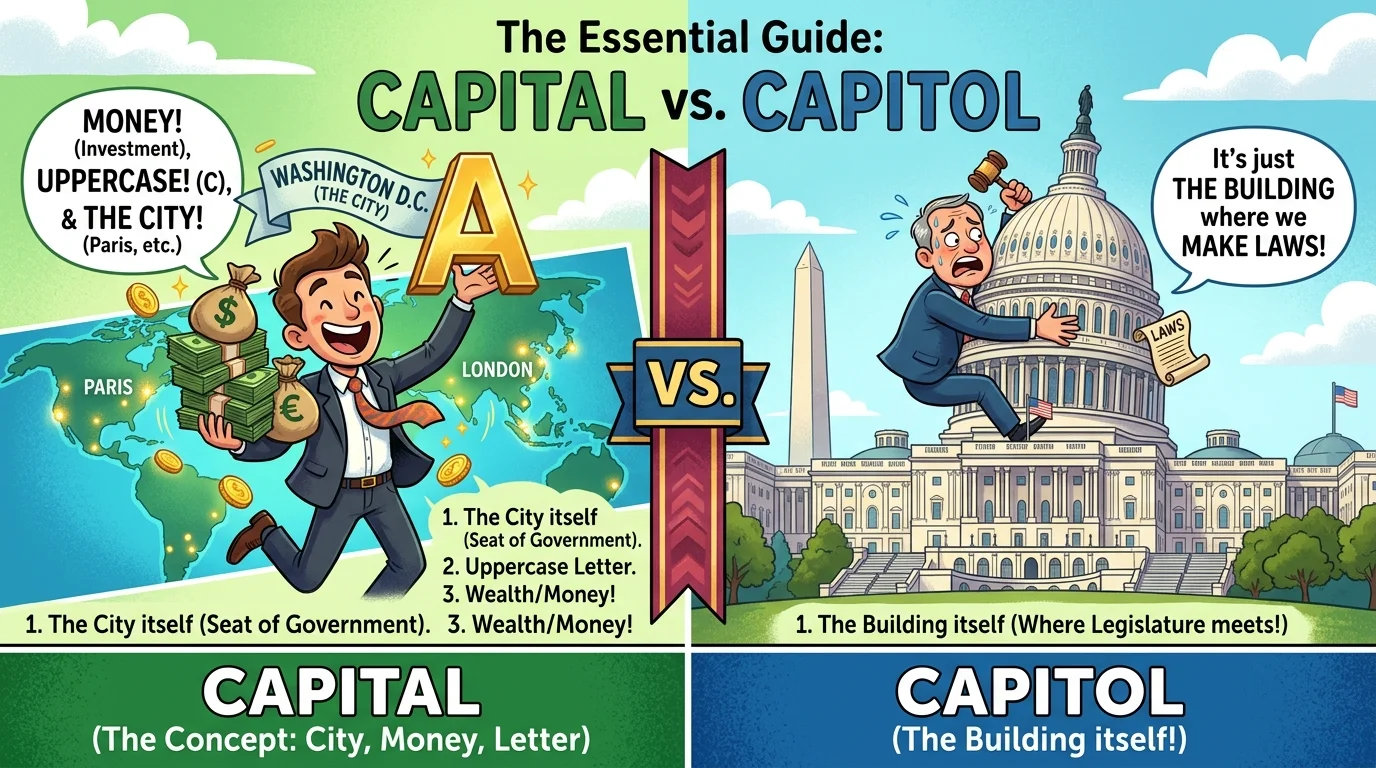
Capital has several meanings. It can refer to:
- A city that serves as the center of government
- Money or financial assets
- An uppercase letter
- Something of great importance
Capitol refers specifically to a government building where lawmakers meet.
Examples:
- Correct: Islamabad is the capital of Pakistan.
- Correct: The lawmakers met at the capitol.
Deep Explanation: Capital
Capital is a versatile word with several meanings in English.
Meaning 1: A Government City
A capital is the city where a country’s or state’s government is based.
Examples:
- Islamabad is the capital of Pakistan.
- Paris is the capital of France.
- Tokyo is the capital of Japan.
Meaning 2: Money or Financial Resources
In business and economics, capital refers to money or assets used to invest or operate a business.
Examples:
- The company raised additional capital.
- Small businesses often need startup capital.
- Investors provided the necessary capital.
Meaning 3: An Uppercase Letter
Capital can also mean a large letter of the alphabet.
Examples:
- Write your name using capital letters.
- The sentence begins with a capital “A.”
- Please use a capital “P” in Pakistan.
Meaning 4: Something Extremely Important
The word can also describe something significant.
Examples:
- Education is of capital importance.
- This is a capital opportunity for growth.
Key Insight
Capital has multiple meanings and is used much more frequently than capitol.
Deep Explanation: Capitol
Capitol has one primary meaning.
It refers to a building where a legislative body meets.
Common Uses of Capitol
Capitol usually refers to:
- National legislative buildings
- State legislative buildings
- Government assembly buildings
Correct Examples
✅ The senators met inside the capitol.
✅ Tourists visited the state capitol.
✅ Protesters gathered near the capitol building.
Key Insight
Capitol refers to a building, not a city or money.
Capital vs Capitol: Key Differences
Quick Differences
- Capital has several meanings.
- Capitol refers only to a legislative building.
- Capital can mean a city, money, uppercase letters, or importance.
- Capitol is a specific type of government building.
| Feature | Capital | Capitol |
|---|---|---|
| Meaning | Government city, money, uppercase letters, importance | Legislative building |
| Part of Speech | Noun and adjective | Noun |
| Usage | Geography, finance, grammar, general English | Government and politics |
| Number of Meanings | Multiple | One primary meaning |
| Example | Islamabad is the capital of Pakistan. ✅ | The lawmakers met in the capitol. ✅ |
Real-World Usage Scenarios
Example 1
Teacher:
What is the capital of Pakistan?
Student:
Islamabad.
🎯 Lesson: Use capital for government cities.
Example 2
Investor:
The startup needs more capital.
🎯 Lesson: Use capital for money and financial resources.
Example 3
Editor:
Please use a capital letter at the beginning of the sentence.
🎯 Lesson: Use capital for uppercase letters.
Example 4
Tour Guide:
This capitol building was constructed over one hundred years ago.
🎯 Lesson: Use capitol for legislative buildings.
Common Mistakes
Mistake 1: Using Capitol for a City
❌ Islamabad is the capitol of Pakistan.
✅ Islamabad is the capital of Pakistan.
Why it happens: The words sound exactly alike.
Mistake 2: Using Capital for a Legislative Building
❌ The lawmakers gathered inside the capital.
✅ The lawmakers gathered inside the capitol.
Why it happens: People assume both spellings mean government-related places.
Mistake 3: Assuming the Words Are Interchangeable
❌ Capital and capitol always mean the same thing.
✅ They have completely different meanings.
Why it happens: They are perfect homophones.
Memory Tricks
Remember this simple phrase:
CapitOl has an O because it refers to a dOmed building.
Think:
- CapitOl → DOme → Building
- Capital → Everything else
Another easy trick:
If you’re talking about:
- A city → Capital
- Money → Capital
- Uppercase letters → Capital
- A legislature’s building → Capitol
Expert Insight
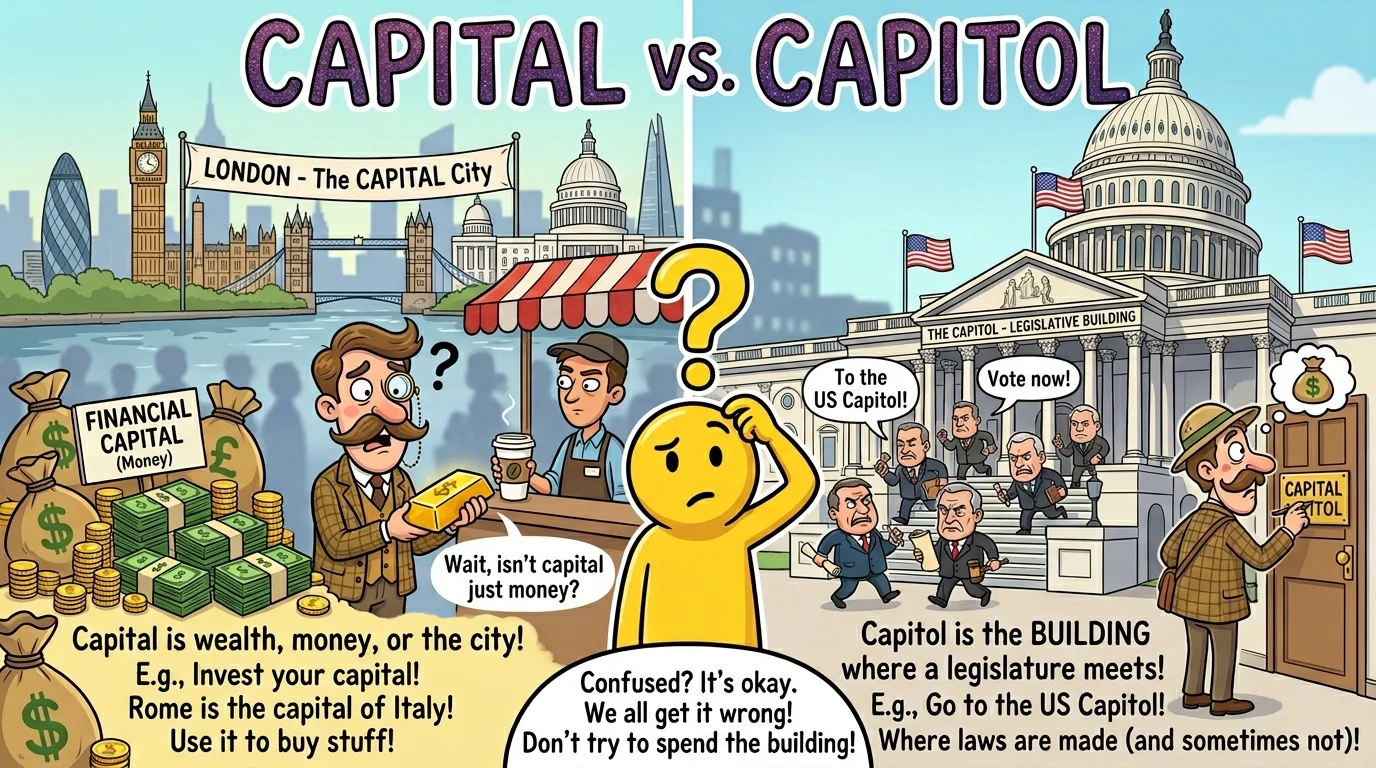
The word capital comes from Latin roots associated with the head or chief part of something. This historical development explains why it can refer to chief cities, principal resources, or major importance.
The word capitol, however, originated from the ancient hill in Rome known as the Capitoline Hill, where important government buildings stood. Over time, the term came to refer specifically to legislative buildings.
Because both words share similar origins and identical pronunciations, confusion between them remains extremely common in modern English.
Professional writers, educators, and style guides consistently emphasize that capitol should only be used when referring to legislative buildings.