
Quick Answer
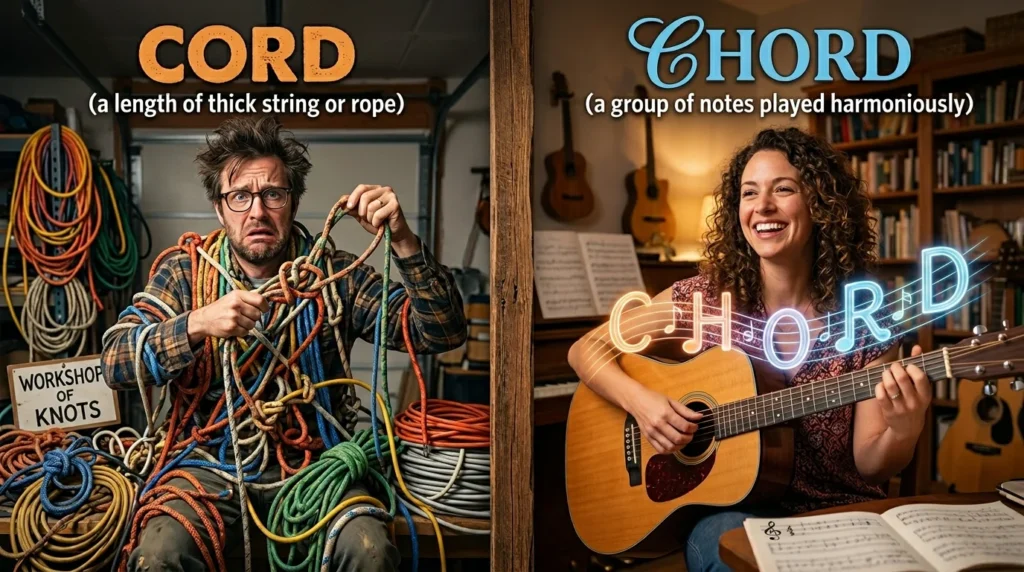
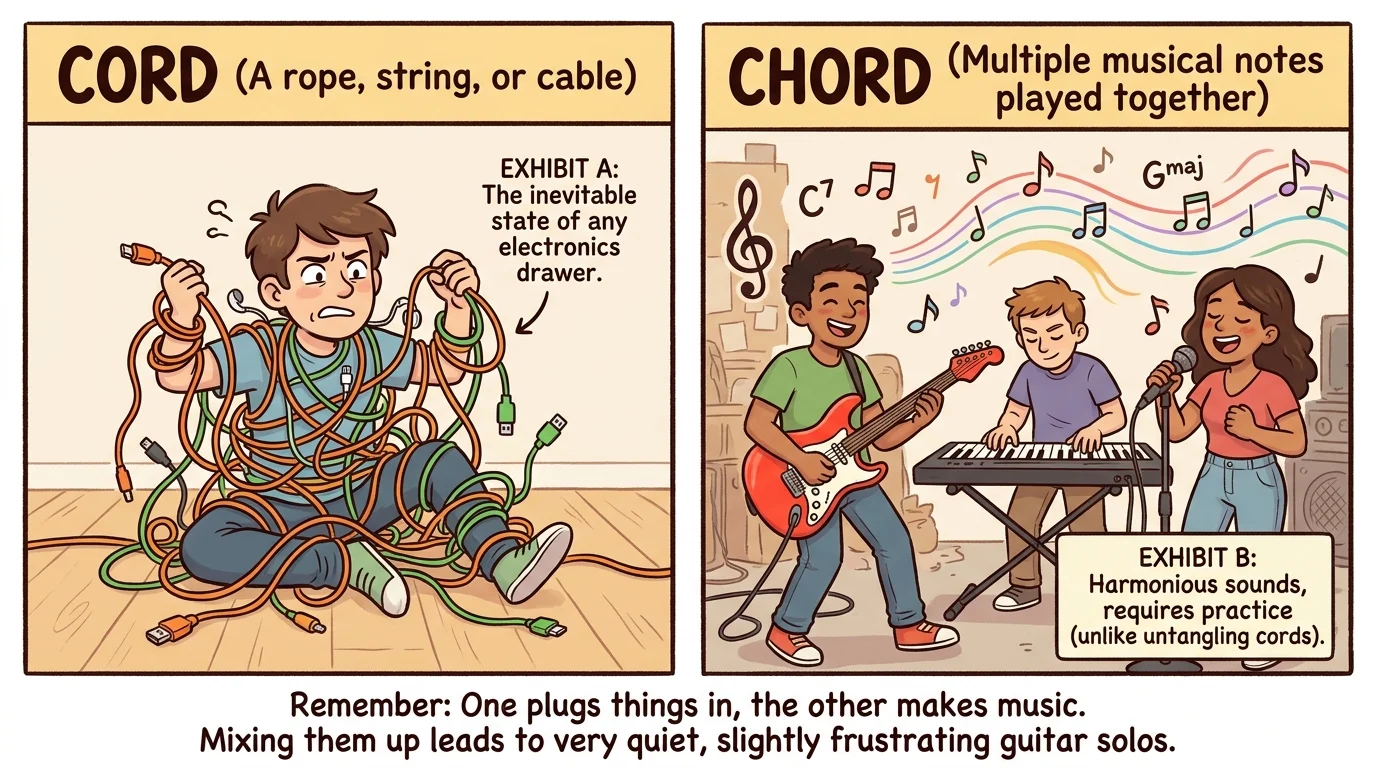
Cord means a rope, string, wire, cable, or connecting strand.
Chord means a combination of musical notes played simultaneously or something that creates a strong emotional response.
Simply put, cord is a physical string or cable, while chord is related to music or emotions.
What Does “Cord” Mean?
Cord refers to a rope-like object, wire, cable, or any long, flexible strand used for tying, connecting, or transmitting electricity.
Usage Rules
Use cord when referring to:
- Electrical cables and wires
- Ropes and strings
- Flexible connecting materials
- Physical strands or bindings
Examples
- Please unplug the power cord.
- She tied the package with a red cord.
- The phone’s charging cord is damaged.
Key Insight: If you can touch it, plug it in, tie with it, or use it as a cable, you probably need cord.
What Does “Chord” Mean?
Chord primarily refers to a group of musical notes played together. It can also be used figuratively to describe something that creates an emotional connection or resonates with someone.
Usage Rules
Use chord when referring to:
- Musical notes played simultaneously
- Music theory and instruments
- Emotional reactions and connections
- Ideas that deeply affect people
Examples
- The guitarist played a beautiful chord.
- Learning basic piano chords takes practice.
- Her speech struck a chord with the audience.
Key Insight: If the sentence involves music or emotional resonance, use chord.
Cord vs Chord: Key Differences
Bullet Differences
- Meaning: Cord means a cable, rope, or wire; chord means musical notes played together or an emotional connection.
- Context: Cord is used for physical objects; chord is used in music and figurative expressions.
- Usage: Cord refers to something tangible; chord often refers to sounds or feelings.
- Function: Cord connects physically; chord connects musically or emotionally.
- Common Mistake: Writers sometimes use cord when referring to music because both words are pronounced the same.
| Feature | Cord | Chord |
|---|---|---|
| Meaning | Rope, cable, wire, or string | Musical notes played together |
| Context | Physical objects | Music and emotions |
| Function | Connects or binds physically | Creates harmony or emotional impact |
| Example | The extension cord is too short. | The pianist played a major chord. |
| Related To | Cables and strings | Music and resonance |
Real-World Usage Scenarios
Scenario 1
Incorrect: “I need a new charging chord.”
Correct: “I need a new charging cord.”
🎯 Lesson: Charging cables are physical objects, so use cord.
Scenario 2
Incorrect: “The guitarist played a beautiful cord.”
Correct: “The guitarist played a beautiful chord.”
🎯 Lesson: Musical note combinations are called chords.
Scenario 3
Incorrect: “Her story struck a cord with me.”
Correct: “Her story struck a chord with me.”
🎯 Lesson: The expression is strike a chord, meaning to create an emotional connection.
Scenario 4
Incorrect: “The curtain hangs from a decorative chord.”
Correct: “The curtain hangs from a decorative cord.”
🎯 Lesson: A physical string or rope is a cord.
Scenario 5
Incorrect: “The piano student learned several major cords.”
Correct: “The piano student learned several major chords.”
🎯 Lesson: In music, combinations of notes are called chords.
Common Mistakes
Mistake 1: Writing “Chord” for Cables
Why it happens: Both words are pronounced the same.
Correction: If it is a wire, rope, or cable, use cord.
Mistake 2: Writing “Cord” for Music
Why it happens: People spell the word based on pronunciation.
Correction: Musical note combinations are always chords.
Mistake 3: Misspelling the Expression “Strike a Chord”
Why it happens: The phrase is often heard more than it is read.
Correction: The correct expression is strike a chord.
Memory Tricks to Remember the Difference
Trick 1
Cord = Cable
Both words begin with the letter C and refer to physical objects.
Think:
Cord = Cable or Cord.
Trick 2
Chord = Harmony
The extra h can remind you of harmony, which is related to music.
Think:
Chord = Harmony.
Trick 3
Ask yourself:
Can I touch it, or can I hear it?
- Physical object → Cord
- Music or emotion → Chord
Trick 4
Remember this simple rule:
Cord connects physically. Chord connects musically or emotionally.

Expert Insight
The confusion between cord and chord exists because they are perfect homophones. Despite sounding identical, they have entirely different origins and meanings.
Cord comes from older words relating to rope and string and has maintained its association with physical strands and cables.
Chord originates from terms associated with musical harmony. Over time, English also developed figurative expressions like strike a chord, which refers to creating a strong emotional response similar to the resonance produced by harmonious music.
Professional editors often use a simple test: if the sentence involves a tangible object, they choose cord. If it involves music or emotions, they choose chord.