
Quick Answer
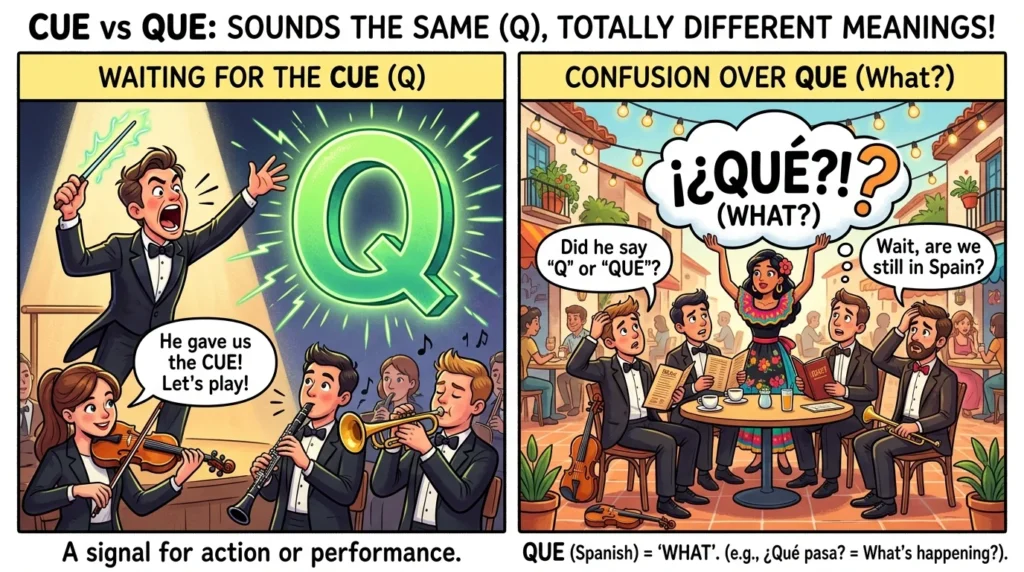
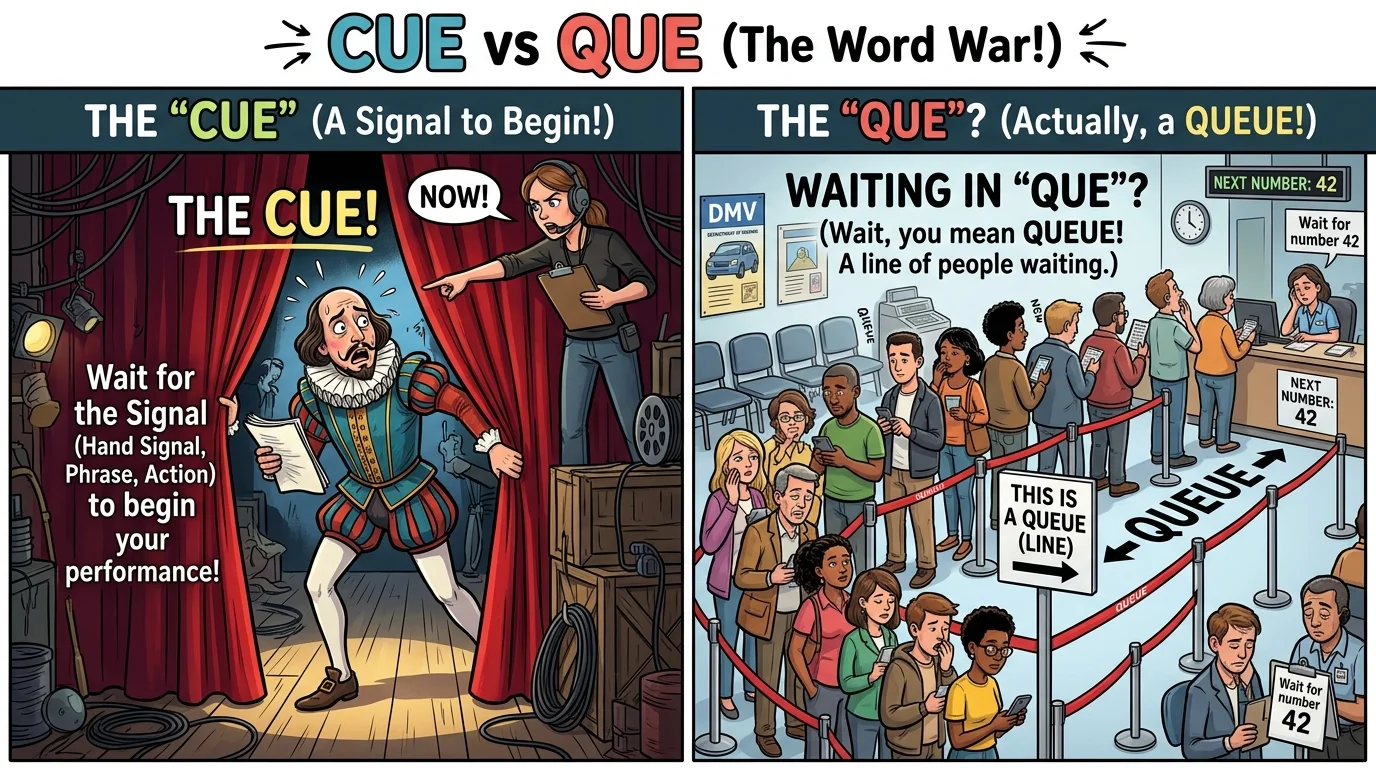
Cue is an English word that means a signal, prompt, or indication to do something. It can also refer to a line or action in performances.
Que is generally not a standard English word. It usually comes from other languages and can mean “that,” “what,” or “who” depending on the language and context.
What Does Cue Mean?
Definition
Cue is an English noun and verb that refers to a signal, prompt, reminder, or indication that tells someone to act or respond.
Usage Rules
Use cue when referring to:
- A signal to start something
- A reminder or prompt
- An actor’s line or action in a performance
- An indication that something is about to happen
Real Examples
- The teacher gave me a cue to begin my presentation.
- When the music started, that was our cue to walk onto the stage.
- His smile was my cue that everything was fine.
- The director forgot to give the actors their cue.
Key Insights
The word cue is common in:
- Everyday conversations
- Public speaking
- Theater and acting
- Psychology and behavior studies
- Business presentations
- Sports and coaching
Key idea: A cue tells you that it is time to do something.
What Does Que Mean?
Definition
Que is usually a foreign-language word rather than a standard English word.
In different languages, que can have different meanings:
- In Spanish: “that,” “what,” or “which”
- In Portuguese: often means “that”
- In French: can function similarly to “that” or “which”
Usage Rules
Use que only when:
- Writing in another language
- Quoting foreign phrases
- Referring to names, titles, or expressions that contain the word
Real Examples
Spanish:
- ¿Que quieres? (What do you want?)
- Creo que tienes razón. (I think that you are right.)
Portuguese:
- Eu acho que ele está certo. (I think that he is right.)
Key Insights
Que is not typically interchangeable with cue in English writing.
If you are writing entirely in English and need a word meaning signal or prompt, you almost certainly need cue, not que.
Cue vs Que: Key Differences
Comparison Table
| Feature | Cue | Que |
|---|---|---|
| Meaning | Signal, prompt, indication | Foreign-language word meaning “that,” “what,” or similar terms |
| Function | Noun or verb in English | Word used mainly in Spanish, Portuguese, or French |
| Usage | Gives instructions or signals | Used in non-English sentences |
| Context | Theater, presentations, conversations, behavior | Foreign languages and quotations |
| Example | That was my cue to leave. | Creo que está bien. |
Quick Differences
- Cue = signal or prompt.
- Que = foreign-language word.
- Cue is standard English.
- Que usually belongs to another language.
- They are not interchangeable.
Real-World Usage Scenarios
Example 1
Incorrect:
“That was my que to start speaking.”
Correct:
“That was my cue to start speaking.”
🎯 Lesson: Use cue when talking about signals or prompts.
Example 2
Incorrect:
“The director forgot my que.”
Correct:
“The director forgot my cue.”
🎯 Lesson: Theater and performance situations use cue.
Example 3
Spanish Sentence:
“Espero que vengas mañana.”
Translation:
“I hope that you come tomorrow.”
🎯 Lesson: Use que only within the language where it belongs.
Example 4
Correct:
“When the traffic light turned green, that was our cue to drive.”
🎯 Lesson: A cue often signals action.
Common Mistakes People Make
Mistake 1: Writing “que” Instead of “cue”
Incorrect:
“That was my que.”
Correct:
“That was my cue.”
Why It Happens
The two words have similar pronunciations, and many people have seen que online or in multilingual environments.
Mistake 2: Assuming Que Is an English Synonym of Cue
Incorrect:
“I used que because it means signal.”
Correct:
Use cue.
Why It Happens
Writers often assume that similar-looking words share the same meaning.
Mistake 3: Using Cue in Spanish Sentences
Incorrect:
“Creo cue es verdad.”
Correct:
“Creo que es verdad.”
Why It Happens
People learning multiple languages sometimes mix vocabulary from different languages.
Memory Tricks to Remember the Difference
Trick 1
Cue = Clue
Both words rhyme and are related to signals and hints.
Cue gives you a clue.
Trick 2
Cue starts with C.
Think:
C = Command or signal to act.
Trick 3
Que belongs to another language.
Think:
Q = Quoting another language.

Expert Insight: Why These Words Are Commonly Confused
The confusion between cue and que has increased because people frequently encounter multiple languages online. Search engines and social media expose users to Spanish, Portuguese, and French vocabulary more than ever before.
In modern English, cue remains the only standard choice when referring to prompts, reminders, and signals. Meanwhile, que generally appears in multilingual contexts and should not replace cue in normal English writing.
Understanding the language context immediately removes the confusion.