
Quick Answer
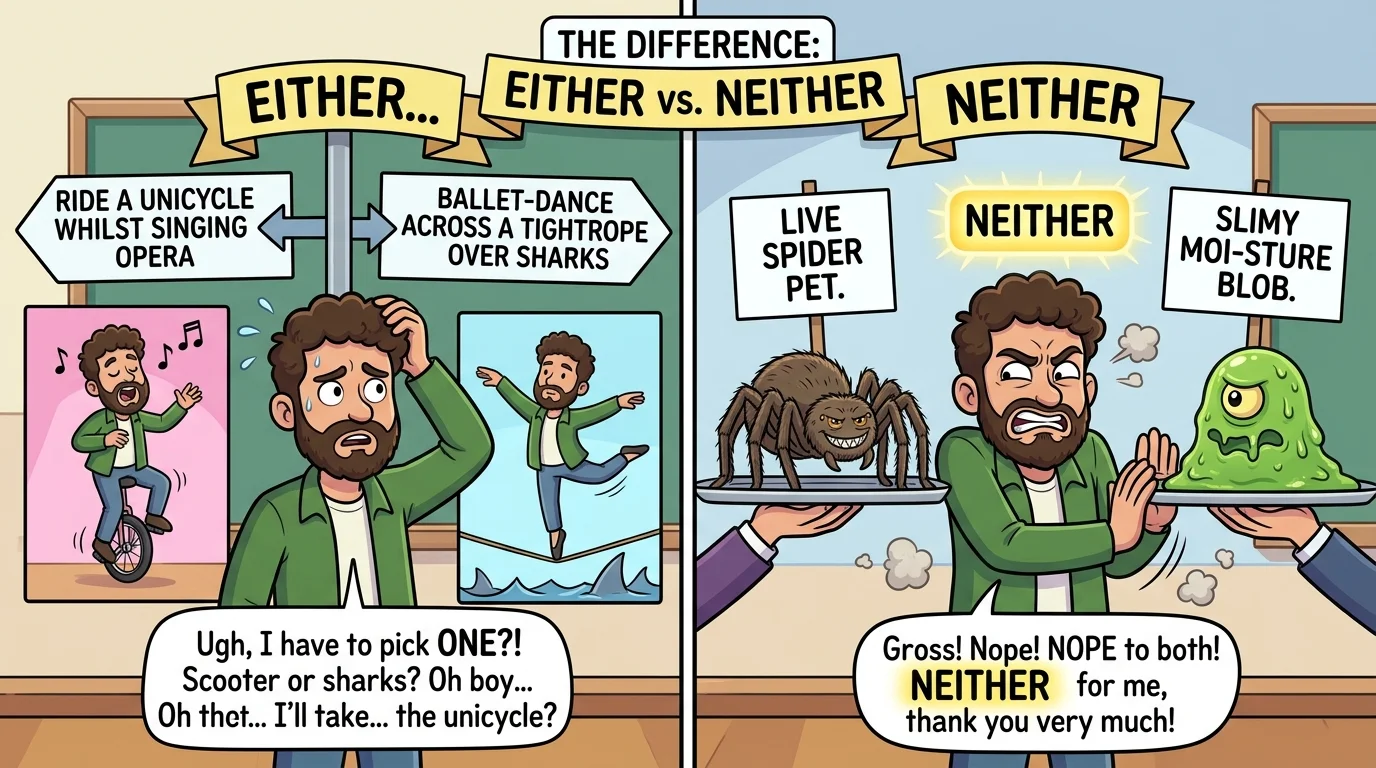
Either means one or the other of two choices.
Neither means not one and not the other of two choices.
Examples:
- You can choose either tea or coffee.
- Neither answer is correct.
A simple rule is:
- Either = one of the two
- Neither = none of the two
What Does Either Mean?
Either refers to one of two possibilities, choices, people, or things.
Definition
Either means:
- One or the other of two
- Any one of two options
- One of two alternatives
Usage Rules
Use either when:
- Offering two choices
- Referring to one of two possibilities
- Indicating that both options are acceptable
Examples of Either
- You may sit on either side of the table.
- We can travel on either Friday or Saturday.
- Either answer would work.
- You can choose either dress.
Key Insight
Either usually carries a positive meaning because it presents options or possibilities.
Pattern:
- Either A or B
Examples:
- Either you call me, or I will call you.
- You can have either pizza or pasta.
What Does Neither Mean?
Neither means not one and not the other.
Definition
Neither means:
- Not either of two
- Not one and not the other
- None of the two choices
Usage Rules
Use neither when:
- Rejecting both options
- Referring to none of two people or things
- Indicating that both choices are untrue or unavailable
Examples of Neither
- Neither answer is correct.
- Neither candidate won the election.
- I like neither movie.
- Neither option seems practical.
Key Insight
Neither has a negative meaning because it excludes both choices.
Pattern:
- Neither A nor B
Examples:
- Neither Sarah nor Emma attended the meeting.
- He speaks neither French nor Spanish.
Either vs Neither: Key Differences
Although these words are closely related, they have opposite meanings.
Quick Differences
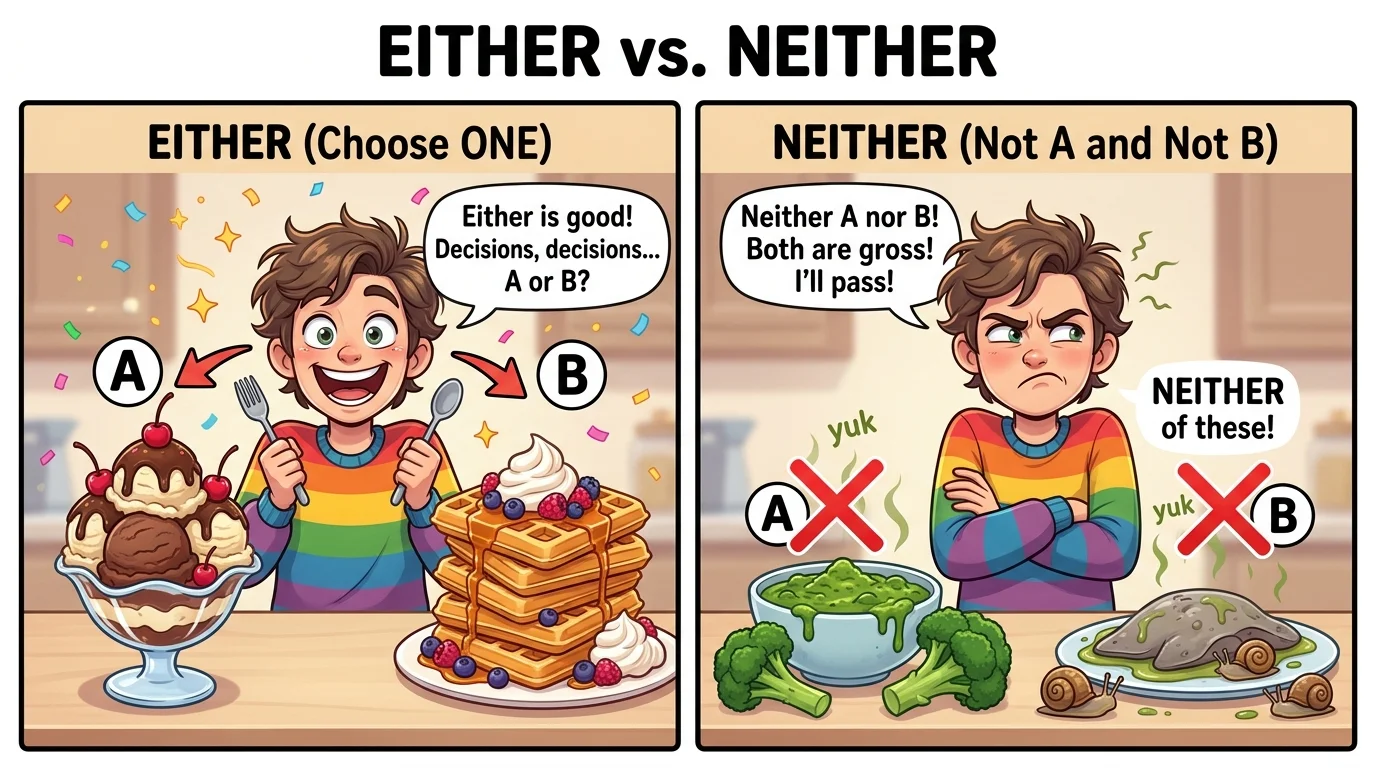
- Either means one of two options.
- Neither means none of the two options.
- Either usually expresses possibility or choice.
- Neither expresses rejection or absence.
| Feature | Either | Neither |
|---|---|---|
| Main Meaning | One of two | None of two |
| Usage | Choices and possibilities | Rejection of both choices |
| Common Pair | Either…or | Neither…nor |
| Meaning Type | Positive or neutral | Negative |
| Example | Either road leads home. | Neither road is safe. |
Real-World Usage Examples
Example 1
Incorrect: You can choose neither blue or red.
Correct: You can choose either blue or red.
🎯 Lesson: When offering options, use either.
Example 2
Incorrect: Either of the answers is correct because both are wrong.
Correct: Neither of the answers is correct.
🎯 Lesson: When both choices are rejected, use neither.
Example 3
Friend: Which movie do you want to watch?
You: Either movie is fine with me.
🎯 Lesson: Either means one of the two choices is acceptable.
Example 4
Friend: Did you like the restaurants?
You: No, I liked neither of them.
🎯 Lesson: Neither means not one and not the other.
Common Mistakes
Mistake 1: Using Either Instead of Neither
Incorrect:
- Either answer is wrong.
Correct:
- Neither answer is correct.
Why it happens: Writers forget that either expresses a choice, not rejection.
Mistake 2: Using Neither with Or
Incorrect:
- Neither tea or coffee sounds good.
Correct:
- Neither tea nor coffee sounds good.
Why it happens: People mix up the expressions either…or and neither…nor.
Mistake 3: Double Negatives
Incorrect:
- I don’t want neither option.
Correct:
- I want neither option.
Or:
- I don’t want either option.
Why it happens: Many speakers accidentally add unnecessary negatives.
Memory Tricks
Trick 1
Either = E for Either one.
Think:
Either = one of the two choices.
Trick 2
Neither = N for None.
Think:
Neither = none of the two choices.
Trick 3
Remember this sentence:
Either means one. Neither means none.
Expert Insights
The words either and neither come from Old English and have been paired for centuries to express choices and negation.
In modern English:
- Either generally introduces alternatives and possibilities.
- Neither functions as a negative determiner, pronoun, conjunction, or adverb.
Grammar experts recommend remembering their fixed pairings:
- Either…or
- Neither…nor
Maintaining these pairings improves grammatical accuracy and makes your writing clearer and more natural.