

Quick Answer
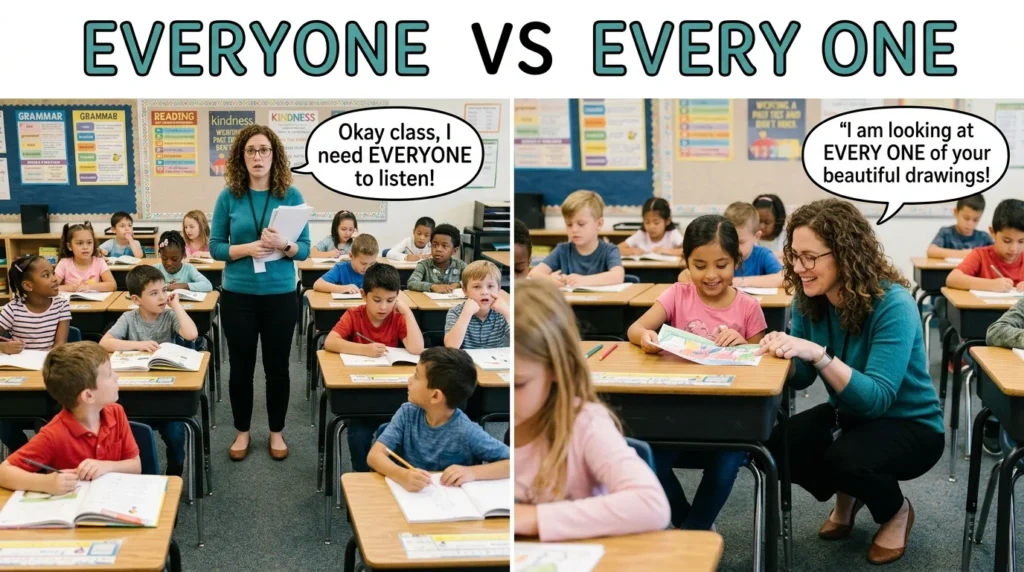
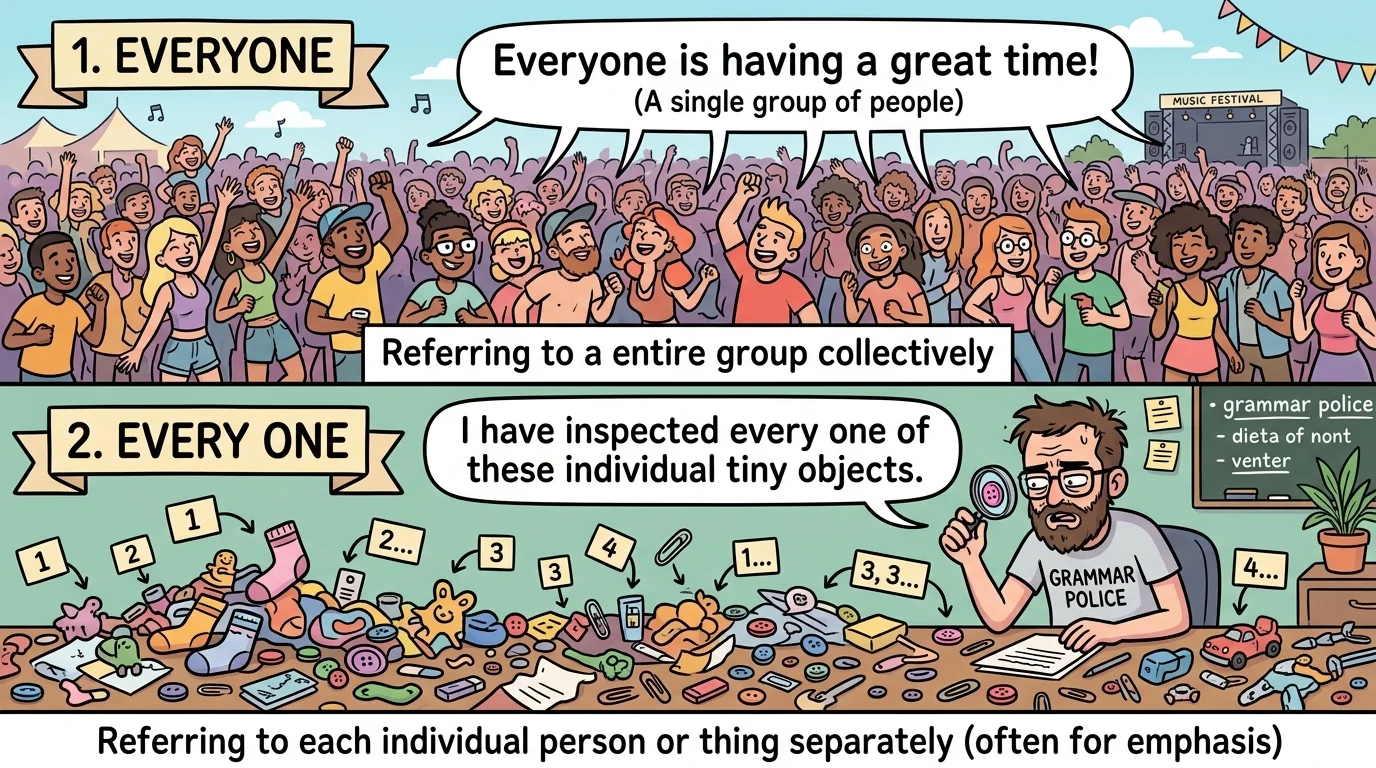
Everyone means all the people in a group and functions as an indefinite pronoun.
Every one means each individual person or thing in a specific group and is usually followed by of.
Simply put, everyone = all people together, while every one = each individual member of a group.
What Does “Everyone” Mean?
Everyone is an indefinite pronoun that means all the people in a particular group. It refers only to people, not objects or things.
Usage Rules
Use everyone when:
- Referring to all people in a group
- Addressing an entire audience
- Making general statements about people
- Talking about every person collectively
Examples
- Everyone enjoyed the concert.
- Everyone needs encouragement sometimes.
- The teacher asked everyone to submit their assignments.
Key Insight: If you could replace the word with everybody, then everyone is usually the correct choice.
What Does “Every One” Mean?
Every one means each individual member of a particular group. Unlike everyone, it can refer to both people and things.
It is commonly followed by of.
Usage Rules
Use every one when:
- Referring to each item in a group
- Emphasizing individuals separately
- Talking about people or objects one by one
- Using the phrase every one of
Examples
- I checked every one of the documents.
- She thanked every one of her supporters.
- Every one of the cookies was delicious.
Key Insight: If you can add the phrase of them, you usually need every one.
Everyone vs Every One: Key Differences
Bullet Differences
- Meaning: Everyone means all people together; every one means each individual member of a group.
- Part of Speech: Everyone is an indefinite pronoun; every one is a determiner plus a pronoun.
- Usage: Everyone refers only to people; every one can refer to people or things.
- Structure: Every one often appears before of.
- Common Mistake: Writers frequently use everyone when they should write every one of.
| Feature | Everyone | Every One |
|---|---|---|
| Meaning | All people in a group | Each individual member of a group |
| Refers To | People only | People or things |
| Usage | Collective meaning | Individual emphasis |
| Often Followed By “Of”? | No | Yes |
| Example | Everyone laughed. | Every one of the books is new. |
Real-World Usage Scenarios
Scenario 1
Incorrect: “Every one enjoyed the party.”
Correct: “Everyone enjoyed the party.”
🎯 Lesson: Since all the guests are being discussed collectively, use everyone.
Scenario 2
Incorrect: “Everyone of the students passed.”
Correct: “Every one of the students passed.”
🎯 Lesson: The phrase of the students requires every one.
Scenario 3
Incorrect: “Everyone of the cookies was eaten.”
Correct: “Every one of the cookies was eaten.”
🎯 Lesson: Since cookies are things, use every one, not everyone.
Scenario 4
Incorrect: “Every one was excited about the announcement.”
Correct: “Everyone was excited about the announcement.”
🎯 Lesson: When referring to all people collectively, choose everyone.
Scenario 5
Incorrect: “I inspected everyone of the boxes.”
Correct: “I inspected every one of the boxes.”
🎯 Lesson: Individual items require every one of.
Common Mistakes
Mistake 1: Writing “Everyone of”
Why it happens: The expressions sound identical when spoken.
Correction: The correct phrase is every one of, not everyone of.
Mistake 2: Using “Every One” for Groups of People
Why it happens: Writers assume the separated form is always correct.
Correction: If you mean all people together, use everyone.
Mistake 3: Forgetting That “Everyone” Refers Only to People
Why it happens: The word sounds broad and universal.
Correction: Use every one when referring to objects or individual items.
Memory Tricks to Remember the Difference
Trick 1
Everyone = Everybody
If you can replace the word with everybody, use everyone.
Example:
- Everyone enjoyed the movie.
- Everybody enjoyed the movie.
Both sentences work.
Trick 2
Every One = Every Single One
Think:
Every one = each individual member.
Trick 3
If the phrase is followed by of, choose:
Every one of
Examples:
- Every one of the books
- Every one of the students
- Every one of the cookies
Trick 4
Remember this simple rule:
Everyone means all people together. Every one means each one individually.
Expert Insight
The confusion between everyone and every one comes from pronunciation. In speech, both expressions sound exactly the same, so many writers rely on instinct rather than grammar.
Grammatically, everyone functions as an indefinite pronoun representing a collective group of people. Every one, however, places emphasis on individual members of a group and frequently appears with the preposition of.
Professional editors often use a simple test. If the sentence means everybody, they choose everyone. If the sentence means each individual one, they choose every one.