

Quick Answer: Flys vs Flies
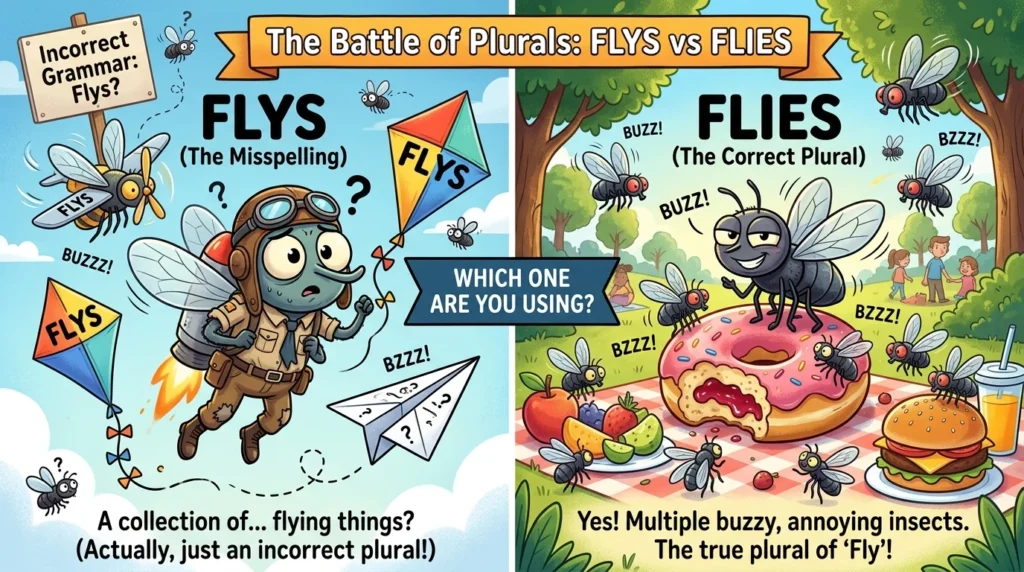
Flies is usually the correct spelling. It is the plural form of the noun fly and the third-person singular form of the verb fly.
Flys is a rare spelling that appears mainly as a proper noun, surname, or in specialized uses such as the plural of fly meaning a part of clothing (the fly of pants) in some style guides.
Examples
✔ The flies were buzzing around the window.
✔ She flies to London every month.
✘ The flys were buzzing around the window.
📌 In standard English, flies is almost always the correct choice.
What Does Flies Mean?
Definition
Flies can function as either:
- The plural of the noun fly (the insect)
- The third-person singular form of the verb fly
Usage
The word commonly appears in:
- Everyday conversation
- Academic writing
- News articles
- Travel discussions
- Biology and science
Examples
As a Noun
- Flies are attracted to food waste.
- Several flies entered the room.
As a Verb
- He flies to New York every week.
- The bird flies over the lake.
Key Insight
Flies is the standard spelling recognized by dictionaries and grammar rules.
What Does Flys Mean?
Definition
Flys is not the standard plural of fly.
However, it may appear in specific contexts such as:
- Proper names and surnames
- Brand names
- Certain specialized references to clothing flies
- Historical or nonstandard usage
Usage
You might encounter flys in:
- Company names
- Family names
- Product branding
- Rare technical references
Examples
- Flys Inc. launched a new product.
- The tailor repaired the flys on several garments. (Rare usage)
Key Insight
For normal writing involving insects or the act of flying, use flies.
Flys vs Flies: Key Differences
✔️ Quick Comparison
- ✔️ Flies = Standard spelling
- ❌ Flys = Rare or specialized spelling
- ✔️ Flies = Plural of fly (insect)
- ✔️ Flies = Third-person form of fly (verb)
- ❌ Flys = Not standard in everyday English
- ✔️ Flies = Accepted by all major dictionaries
Comparison Table
| Feature | Flys | Flies |
|---|---|---|
| Standard English | ❌ Rare | ✔️ Yes |
| Plural of Fly (Insect) | ❌ No | ✔️ Yes |
| Verb Form of Fly | ❌ No | ✔️ Yes |
| Formal Writing | ❌ Avoid | ✔️ Correct |
| Dictionary Preference | ❌ Rare | ✔️ Preferred |
| Example | Flys around the room | Flies around the room |
Why Is It “Flies” and Not “Flys”?
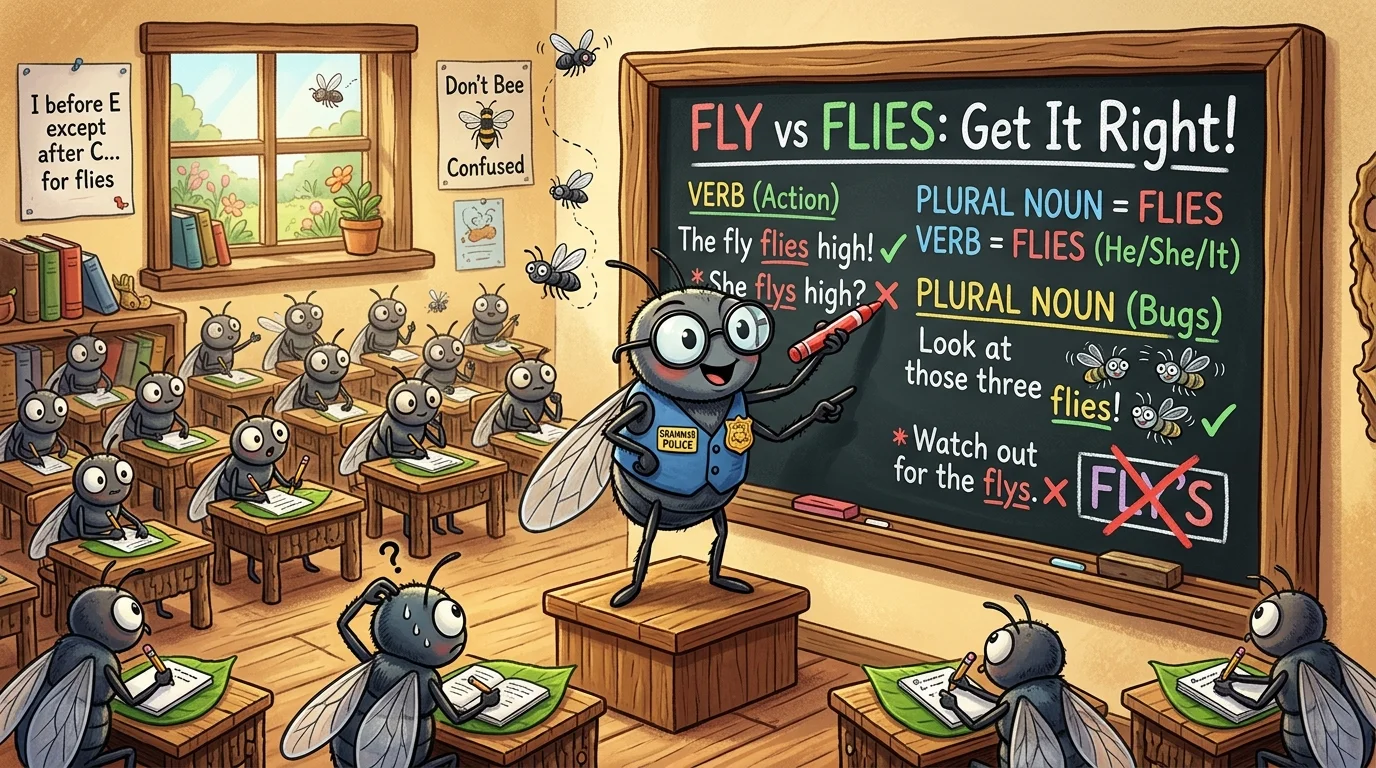
English spelling rules require many nouns ending in a consonant + y to change the y to i before adding -es.
Examples include:
- fly → flies
- baby → babies
- city → cities
- lady → ladies
- story → stories
Because fly ends in a consonant (l) followed by y, the correct plural becomes flies.
📌 The same rule applies to the verb form:
- He flies.
- She flies.
- It flies.
Real-World Usage Scenarios
Scenario 1: Talking About Insects
Incorrect:
“There are many flys in the kitchen.”
Correct:
“There are many flies in the kitchen.”
🎯 Lesson: The plural of the insect fly is flies.
Scenario 2: Air Travel
“She flies to Dubai every month.”
🎯 Lesson: The third-person singular verb form is flies.
Scenario 3: Nature Observation
“The eagle flies high above the mountains.”
🎯 Lesson: Use flies for birds, insects, and aircraft.
Scenario 4: School Writing
Incorrect:
“The bird flys south for winter.”
Correct:
“The bird flies south for winter.”
🎯 Lesson: Grammar rules require flies.
Scenario 5: Scientific Writing
“Fruit flies are commonly used in genetic research.”
🎯 Lesson: Scientific publications use flies.
Common Mistakes
Mistake 1: Simply Adding “S”
Many writers assume fly becomes flys.
✔ Correction:
- fly → flies
Mistake 2: Ignoring the Y-to-I Rule
Words ending in consonant + y usually change y to i before adding es.
✔ Correction:
- city → cities
- lady → ladies
- fly → flies
Mistake 3: Using Flys in Formal Writing
This can appear as a spelling error.
✔ Correction: Use flies unless referring to a specific proper noun or specialized context.
Why This Happens
People often apply the simple plural rule (+s) instead of the correct spelling rule for words ending in consonant + y.
Easy Memory Tricks
Trick 1: Think of Cities
- city → cities
- fly → flies
Same spelling rule.
Trick 2: Change Y to I
Remember:
Consonant + Y = Change Y to I + ES
Trick 3: Think of Fruit Flies
The common scientific term is:
✔ Fruit flies
Not:
❌ Fruit flys
Expert Insight: The Grammar Behind Flies
The spelling flies follows one of the most common noun and verb formation rules in English. When a word ends in a consonant followed by y, the y changes to i before adding -es.
This rule has been part of English grammar for centuries and applies consistently across thousands of words. Because of this established convention, dictionaries, publishers, educators, and style guides universally recognize flies as the standard form.