


Quick Answer
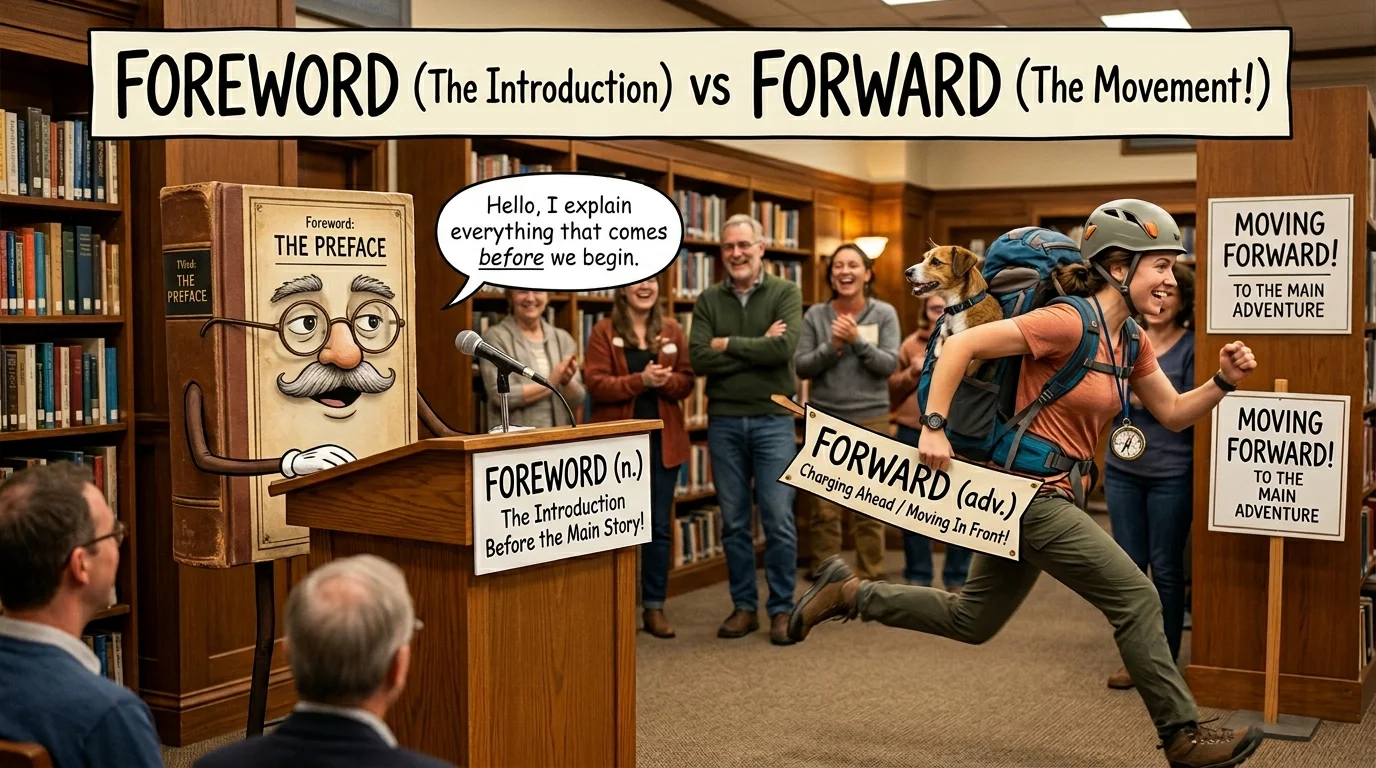
Foreword is a noun that means an introductory section written at the beginning of a book, usually by someone other than the author.
Forward generally refers to movement, progress, direction, or sending something onward.
Simply put, a foreword appears at the front of a book, while forward relates to moving ahead.
What Does “Foreword” Mean?
Foreword is a noun that refers to a short introduction placed at the beginning of a book. It is often written by an expert, a notable figure, or someone connected to the author or subject.
Usage Rules
Use foreword when referring to:
- The introductory pages of a book
- A preface written by another person
- An endorsement or introduction to a publication
Examples
- The famous historian wrote the foreword to the biography.
- I read the foreword before starting the novel.
- The book’s foreword explains why the topic remains important today.
Key Insight: A foreword is always related to books or publications and usually appears before the main content.
What Does “Forward” Mean?
Forward generally relates to movement, progress, or direction. It can function as several parts of speech.
Usage Rules
Use forward when:
- Moving ahead physically
- Describing progress
- Sending something to another person
- Indicating an onward direction
- Encouraging advancement
Examples
- She stepped forward to answer the question.
- We need to move forward with the project.
- Please forward the email to your manager.
- The team is looking forward to the event.
Key Insight: If the sentence involves movement, progress, or sending something onward, use forward.
Foreword vs Forward: Key Differences
Bullet Differences
- Meaning: Foreword is a book introduction; forward relates to movement or progress.
- Part of Speech: Foreword is always a noun; forward can function as multiple parts of speech.
- Usage: Foreword appears in books; forward is used in everyday communication and action.
- Context: Foreword belongs to publishing; forward belongs to movement, direction, and advancement.
- Common Mistake: People often write “book forward” when they mean “book foreword.”
| Feature | Foreword | Forward |
|---|---|---|
| Meaning | Introduction at the beginning of a book | Movement, progress, or sending onward |
| Part of Speech | Noun | Noun, adjective, adverb, or verb |
| Context | Publishing and books | Everyday actions and directions |
| Function | Introduces a publication | Describes or causes movement |
| Example | The author thanked the person who wrote the foreword. | Please forward the message to me. |
Real-World Usage Scenarios
Scenario 1
Incorrect: “The professor wrote the forward to my textbook.”
Correct: “The professor wrote the foreword to my textbook.”
🎯 Lesson: Introductions to books are called forewords.
Scenario 2
Incorrect: “Please foreword this email.”
Correct: “Please forward this email.”
🎯 Lesson: Sending an email onward requires the verb forward.
Scenario 3
Incorrect: “The company is moving foreword with the project.”
Correct: “The company is moving forward with the project.”
🎯 Lesson: Progress and advancement require forward.
Scenario 4
Incorrect: “I enjoyed reading the forward at the beginning of the novel.”
Correct: “I enjoyed reading the foreword at the beginning of the novel.”
🎯 Lesson: The introductory section of a book is a foreword.
Common Mistakes
Mistake 1: Writing “Forward” Instead of “Foreword”
Why it happens: Both words are pronounced the same.
Correction: If you are referring to a book introduction, use foreword.
Mistake 2: Writing “Foreword” for Movement
Why it happens: Writers confuse the spellings because they sound identical.
Correction: If the sentence involves progress, movement, or sending something, use forward.
Mistake 3: Assuming Both Words Are Interchangeable
Why it happens: Homophones often create spelling confusion.
Correction: Remember that the words belong to entirely different contexts.
Memory Tricks to Remember the Difference
Trick 1
Foreword = Before the Words
Think:
Foreword = “fore” + “word.”
It comes before the main words of the book.
Trick 2
Forward = Ahead
Think:
Forward = Move forward.
The word relates to progress and direction.
Trick 3
Ask yourself:
Am I talking about a book introduction or movement?
- Book introduction → Foreword
- Movement or progress → Forward
Trick 4
Remember this simple rule:
A foreword comes before a book, while forward means ahead.
Expert Insight
The confusion between foreword and forward exists because they are perfect homophones. Despite sounding identical, they have completely different origins and functions.
The word foreword literally means “a word beforehand” and developed in publishing to describe introductory remarks placed before the main text.
The word forward, however, evolved from terms relating to movement and direction. Today, it is widely used in expressions involving progress, advancement, and sending information onward.
Professional editors often use a simple test: if the sentence could involve moving ahead or sending something, they choose forward. If the sentence refers to an introductory section of a publication, they choose foreword.