
Quick Answer
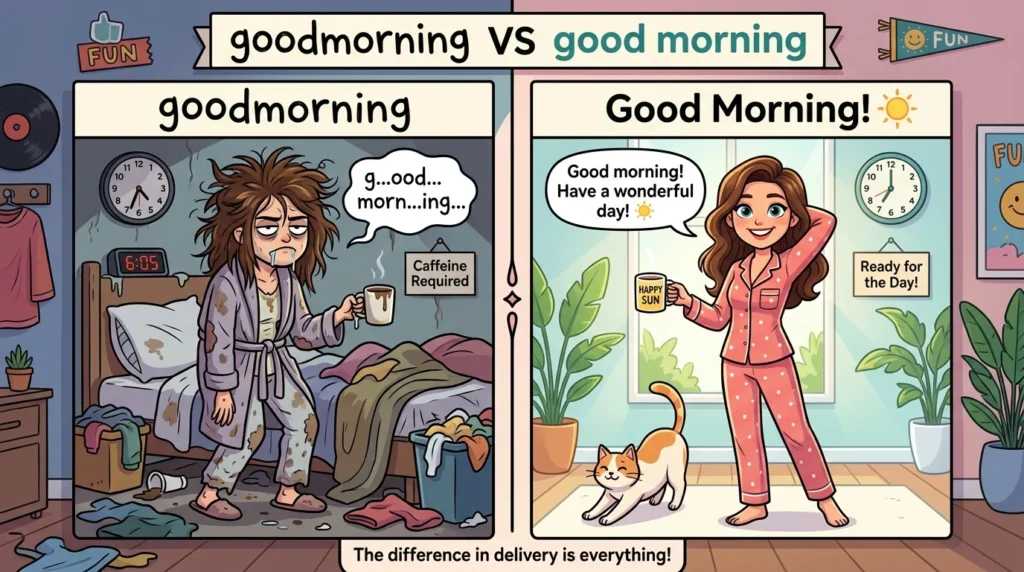
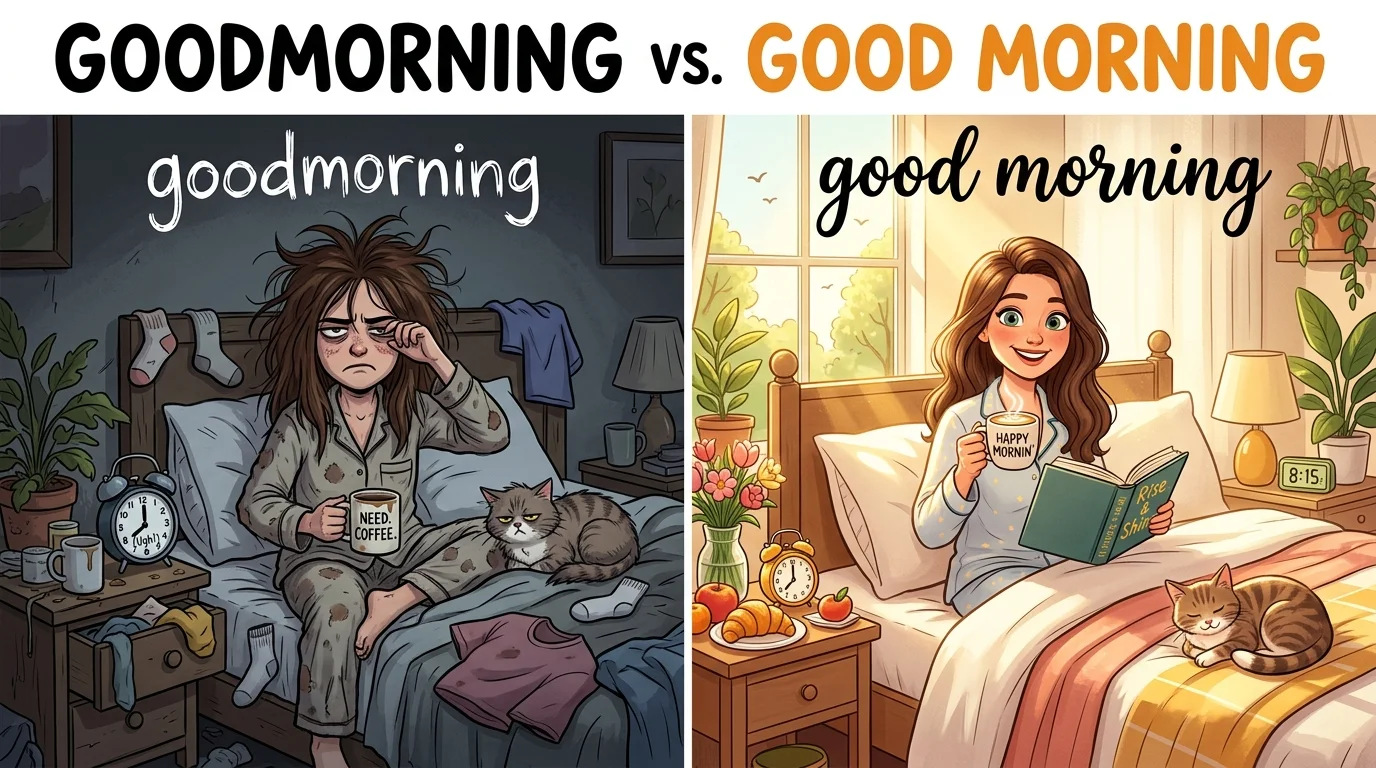
Good morning is the correct spelling.
Goodmorning is generally incorrect and should not be used in standard English writing.
Use good morning as two separate words when greeting someone in the morning.
Examples:
- Correct: Good morning, everyone.
- Correct: I wanted to say good morning before the meeting.
- Incorrect: Goodmorning, everyone.
Deep Explanation: Goodmorning
Definition
Goodmorning is a nonstandard spelling of good morning.
Most dictionaries and style guides do not recognize it as the correct form of the greeting.
Usage Rules
Avoid using goodmorning in:
- Business emails
- Professional messages
- Academic writing
- Formal letters
- Reports
- Customer communications
Context
People often write goodmorning because:
- They assume it is a compound word
- They frequently see greetings written informally online
- They confuse it with words like goodbye
Examples
Incorrect:
- Goodmorning, team.
- Goodmorning, Professor.
- Wishing you a goodmorning.
Correct:
- Good morning, team.
- Good morning, Professor.
- Wishing you a good morning.
Key Insight
In standard English, the greeting is written as two separate words.
Deep Explanation: Good Morning
Definition
Good morning is a standard English greeting used when meeting or addressing someone during the morning hours.
Usage Rules
Use good morning when:
- Greeting someone early in the day
- Beginning an email
- Starting a meeting
- Opening a speech
- Welcoming guests
Common Contexts
- Good morning, everyone.
- Good morning, sir.
- Good morning, class.
- Good morning, team.
- Good morning, ladies and gentlemen.
Real Examples
- Good morning, how are you today?
- The manager began with, “Good morning, everyone.”
- She sent a good morning message to her friend.
- Good morning, and welcome to our conference.
Key Insight
Good morning is the accepted spelling in professional, academic, and everyday English.
Goodmorning vs Good Morning
Key Differences
- Good morning is correct.
- Goodmorning is incorrect.
- Good morning consists of two separate words.
- Professional writing uses good morning.
- Dictionaries recognize good morning, not goodmorning.
Comparison Table
| Feature | Goodmorning | Good Morning |
|---|---|---|
| Correct Spelling | No | Yes |
| Dictionary Recognition | No | Yes |
| Standard English | No | Yes |
| Professional Writing | Incorrect | Correct |
| Greeting Usage | Incorrect | Correct |
| Example | Goodmorning, John ❌ | Good morning, John ✔ |
Real-World Usage Scenarios
Scenario 1
Employee: “Good morning, everyone.”
Manager: “Good morning.”
🎯 Lesson: Workplace greetings use good morning.
Scenario 2
Student: “Good morning, teacher.”
Teacher: “Good morning, class.”
🎯 Lesson: Schools and universities use the two-word form.
Scenario 3
Email Opening:
Good morning, Sarah,
I hope you’re doing well.
🎯 Lesson: Professional emails should use good morning.
Scenario 4
Conference Host: “Good morning, ladies and gentlemen.”
Audience: “Good morning.”
🎯 Lesson: Public speaking follows the standard spelling.
Scenario 5
Friend: “Good morning! Ready for the trip?”
Friend: “Absolutely.”
🎯 Lesson: Everyday conversations also use good morning.
Common Mistakes
Mistake 1: Combining the Words
Incorrect:
- Goodmorning everyone.
- Goodmorning sir.
- Goodmorning team.
Correct:
- Good morning everyone.
- Good morning, sir.
- Good morning, team.
Why It Happens
Many people assume all common greetings become compound words.
Mistake 2: Copying Informal Social Media Usage
Some social media users write goodmorning for convenience or style.
However, this does not make it standard English.
Mistake 3: Using Goodmorning in Professional Emails
Using goodmorning in formal communication can appear careless.
Always use good morning.
Memory Tricks
Trick 1: Think of Other Greetings
Notice these greetings use two words:
- Good afternoon
- Good evening
- Good night
Similarly:
- Good morning
Trick 2: Remember the Pattern
All common time-based greetings begin with:
Good + Time of Day
Written separately.
Trick 3: Use the Email Test
Ask yourself:
“Would I write ‘Goodafternoon’ or ‘Goodevening’?”
Probably not.
The same rule applies to good morning.

Expert Insight
The phrase good morning developed as a greeting rather than a true compound noun. Unlike words such as goodbye, which evolved into a single lexical unit over time, good morning remains a phrase consisting of an adjective (good) and a noun (morning).
Because of this grammatical structure, dictionaries, style guides, editors, and educational institutions continue to treat good morning as two separate words.
While informal online writing occasionally combines the phrase into goodmorning, standard English usage overwhelmingly favors the two-word form.