
Quick Answer: Hernia or Appendicitis?
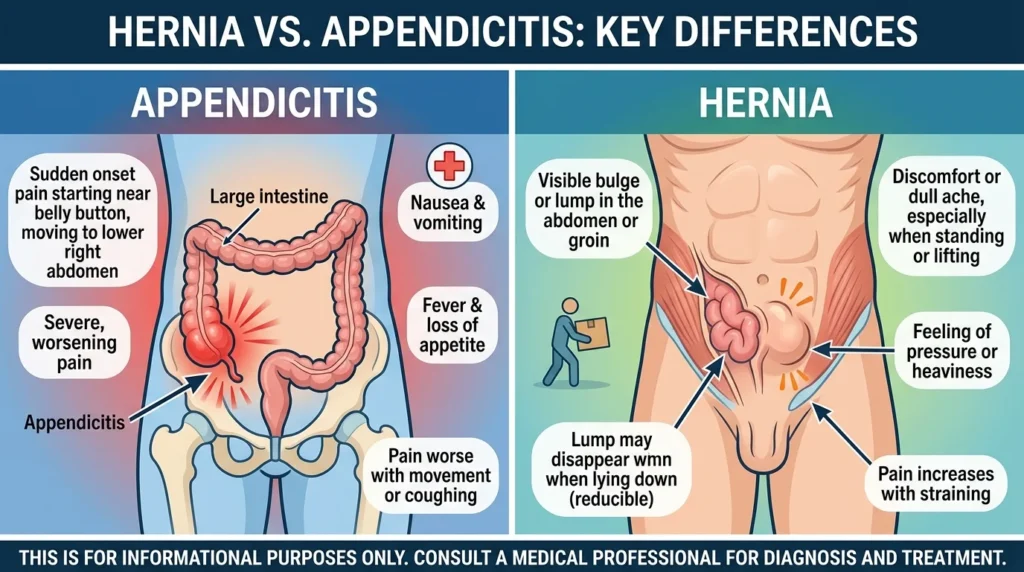
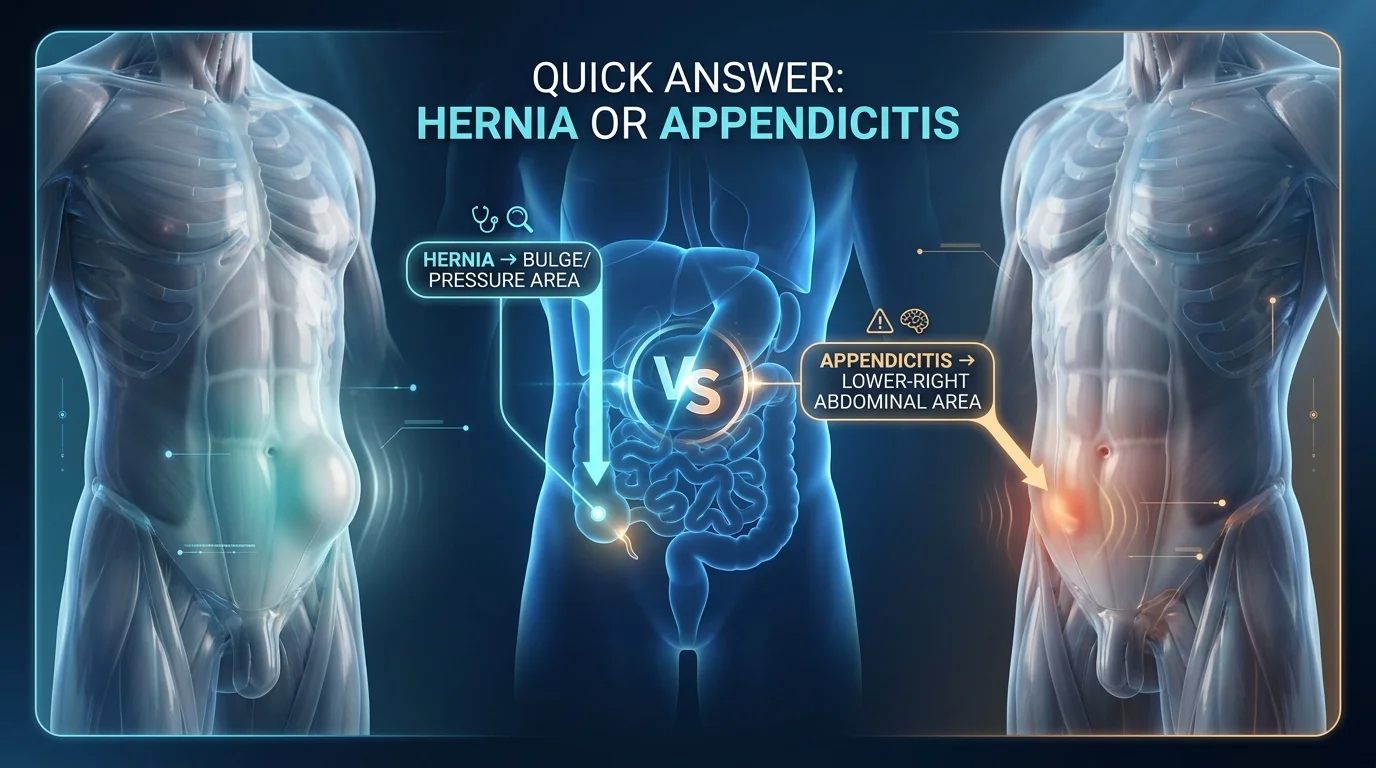
A hernia often causes a noticeable lump or bulge that may become more prominent with coughing, standing, or straining.
Appendicitis typically causes abdominal pain that becomes progressively worse, often moving toward the lower-right abdomen, and may occur with nausea, vomiting, loss of appetite, or fever.
Hernia = tissue pushes through a weak spot.
Appendicitis = inflamed appendix.
What Is a Hernia?
A hernia develops when internal tissue pushes through a weakened area of muscle or connective tissue.
Common types include:
- Inguinal hernia — occurs in the groin
- Umbilical hernia — occurs around the belly button
- Femoral hernia — occurs near the upper thigh/groin
- Incisional hernia — occurs at or near a previous surgical incision
- Hiatal hernia — occurs when part of the stomach moves through the diaphragm
Common Symptoms of a Hernia
Symptoms vary depending on the type and severity, but may include:
- A visible or palpable bulge
- Aching or discomfort
- Pressure or heaviness
- Burning or pulling
- Pain when lifting
- Discomfort when coughing or straining
A hernia may become more noticeable when you’re standing or increasing pressure inside the abdomen.
Example
He noticed a small lump in his groin that became more prominent when he coughed.
🎯 Lesson: A changeable lump or bulge is an important clue that may point toward a hernia.
What Is Appendicitis?
Appendicitis is inflammation of the appendix, a small pouch connected to the large intestine.
One common pattern is pain that:
- Begins around the belly button
- Gradually becomes more severe
- Moves toward or becomes concentrated in the lower-right abdomen
Other possible symptoms include:
- Loss of appetite
- Nausea
- Vomiting
- Fever
- Abdominal tenderness
- Bloating
- Constipation or diarrhea
Not everyone experiences the classic symptoms.
Example
She developed worsening abdominal pain that eventually became concentrated in the lower-right side, along with nausea and loss of appetite.
🎯 Lesson: Progressive abdominal pain with gastrointestinal symptoms can be a warning sign of appendicitis.
Hernia vs. Appendicitis: Main Difference
| Feature | Hernia | Appendicitis |
|---|---|---|
| Cause | Tissue pushes through a weak area | Appendix becomes inflamed |
| Typical clue | Bulge or lump | Progressively worsening abdominal pain |
| Common pain location | Groin, belly button, or abdominal wall | Often lower-right abdomen |
| Visible lump | Often possible | Not typical |
| Pain with coughing/straining | Common | Movement/coughing may worsen pain |
| Fever | Not typical unless complicated | May occur |
| Nausea/vomiting | Not typical, but possible | Common |
| Treatment | Monitoring or surgical repair depending on circumstances | Prompt medical evaluation; often appendectomy and/or antibiotics |
| Emergency potential | Strangulation/incarceration | Rupture/perforation |
Hernia vs. Appendicitis: Pain Location
Where Does a Hernia Hurt?
Hernia pain often occurs near the location of the hernia.
For example:
Inguinal hernia → groin
Umbilical hernia → belly button
Incisional hernia → previous surgical area
The pain may increase with lifting, coughing, sneezing, or straining.
Where Does Appendicitis Hurt?
Appendicitis often begins with pain around the belly button before becoming more localized to the lower-right abdomen.
However, appendix position varies, so appendicitis does not always produce the classic pain pattern.
🎯 Key Insight: Pain location provides useful clues, but it cannot confirm the diagnosis.
Hernia vs. Appendicitis: How the Pain Feels
Hernia Pain
A hernia may cause:
- Aching
- Pressure
- Burning
- Pulling
- Pinching
It may become worse with physical strain.
Appendicitis Pain
Appendicitis pain often:
- Progressively worsens
- Becomes more localized
- Gets worse with movement or coughing
- Occurs with nausea or appetite loss
🎯 Lesson: Progressively worsening abdominal pain deserves prompt medical attention, particularly when accompanied by other concerning symptoms.
Hernia vs. Appendicitis: Real-World Scenarios
Scenario 1: A Groin Bulge
A person notices a lump in the groin that becomes more visible when standing or coughing.
More suggestive of: Hernia ✅
🎯 Lesson: A bulge that changes with pressure or position is a classic hernia clue.
Scenario 2: Lower-Right Abdominal Pain
Someone develops abdominal pain that becomes increasingly severe and settles in the lower-right abdomen.
Possible: Appendicitis 🚨
🎯 Lesson: Progressive lower-right abdominal pain should be medically assessed.
Scenario 3: Pain After Lifting
A person develops groin discomfort after heavy lifting and notices a bulge.
More suggestive of: Hernia ✅
🎯 Lesson: Activities that increase abdominal pressure can make a hernia more noticeable.
Scenario 4: Pain With Nausea and Fever
Someone develops worsening abdominal pain together with nausea, vomiting, and fever.
Possible: Appendicitis or another urgent abdominal condition 🚨
🎯 Lesson: Don’t assume the symptoms are caused by a hernia or appendicitis without medical evaluation.
Scenario 5: A Suddenly Painful Hernia
A previously noticeable hernia suddenly becomes very painful, firm, and cannot be pushed back in.
Possible strangulated or incarcerated hernia 🚨
🎯 Lesson: This can be an emergency requiring immediate medical attention.
Common Mistakes About Hernia and Appendicitis
Mistake 1: Assuming Lower-Right Pain Always Means Appendicitis
❌ Not necessarily.
Lower-right abdominal pain can have many causes, including hernias, kidney stones, gastrointestinal conditions, and other problems.
Mistake 2: Assuming Every Hernia Has a Visible Lump
❌ Not always.
Some hernias can be difficult to see, especially when small or depending on their location.
Mistake 3: Assuming Appendicitis Always Starts on the Right Side
❌ Not necessarily.
Classic appendicitis may begin around the belly button and later move toward the lower right, but symptoms can vary.
Mistake 4: Waiting for a Fever
❌ Don’t wait for fever before seeking care.
A person can have appendicitis without every classic symptom being present.
Mistake 5: Trying to Diagnose Yourself From Pain Location Alone
Pain location is only one piece of the puzzle.
Doctors may need:
- Physical examination
- Medical history
- Blood or urine tests
- Ultrasound
- CT imaging
- Other testing
to determine the cause.
Hernia vs. Appendicitis: When Is It an Emergency?
🚨 Warning Signs of Possible Appendicitis
Seek prompt medical attention for:
- Severe or worsening abdominal pain
- Increasing lower-right abdominal pain
- Persistent vomiting
- Fever with abdominal pain
- Significant abdominal tenderness
- Pain that makes movement difficult
Untreated appendicitis can lead to perforation or rupture, which can cause serious infection.
🚨 Warning Signs of a Complicated Hernia
Seek emergency medical care if a hernia becomes:
- Suddenly very painful
- Hard or extremely tender
- Impossible to push back when it previously could be
- Red, purple, or unusually discolored
- Associated with vomiting
- Associated with severe abdominal pain
These symptoms can indicate incarceration or strangulation, where trapped tissue may lose its blood supply.
Hernia vs. Appendicitis: Diagnosis
How Is a Hernia Diagnosed?
A healthcare professional may use:
- Physical examination
- Medical history
- Examination while standing or coughing
- Ultrasound
- CT scan when appropriate
Many external hernias can be identified through physical examination.
How Is Appendicitis Diagnosed?
Doctors may use:
- Physical examination
- Medical history
- Blood tests
- Urine tests
- Ultrasound
- CT scan
- Other imaging when appropriate
The choice of testing depends on the individual and circumstances.
🎯 Key Insight: There isn’t one symptom or test that proves every case.
Hernia vs. Appendicitis: Treatment
Hernia Treatment
Treatment depends on the type and severity.
Some hernias may initially be monitored if they cause few symptoms, while others require surgical repair.
A strangulated or incarcerated hernia may require emergency surgery.
Appendicitis Treatment
Appendicitis requires prompt medical evaluation.
Treatment may involve:
- Antibiotics
- Surgical removal of the appendix (appendectomy)
- Drainage in selected complicated cases
The appropriate treatment depends on the individual case.
Memory Tricks: Hernia vs. Appendicitis
💪 Hernia = Weak Spot
Think:
Hernia → weak wall → tissue pushes through
🩺 Appendicitis = Appendix
Think:
Appendicitis → inflammation of the appendix
⭐ One-Line Memory Trick
Hernia creates a bulge; appendicitis creates inflammation and worsening abdominal pain.
Expert Insight: Why Hernia and Appendicitis Can Be Confused
The abdomen contains many organs, muscles, nerves, and tissues packed into a relatively small area.
As a result, different conditions can produce pain in similar locations.
A hernia can cause localized abdominal or groin pain, while appendicitis can sometimes produce unusual pain depending on the appendix’s position.
That’s why clinicians consider the pattern of pain, physical findings, associated symptoms, medical history, and test results together.
The goal isn’t simply to determine whether pain is “on the right” or “on the left.” The goal is to identify why the pain is occurring.
Quick Test: Hernia or Appendicitis?
1. A groin lump becomes larger when coughing.
More suggestive of: Hernia ✅
2. Pain progressively worsens and becomes concentrated in the lower-right abdomen.
Possible: Appendicitis 🚨
3. A hernia suddenly becomes painful and cannot be pushed back.
Possible emergency: Complicated hernia 🚨
4. Abdominal pain occurs with nausea, vomiting, and fever.
Possible appendicitis or another urgent condition 🚨
5. Groin pain appears with lifting and a noticeable bulge.
More suggestive of: Hernia ✅