
Quick Answer
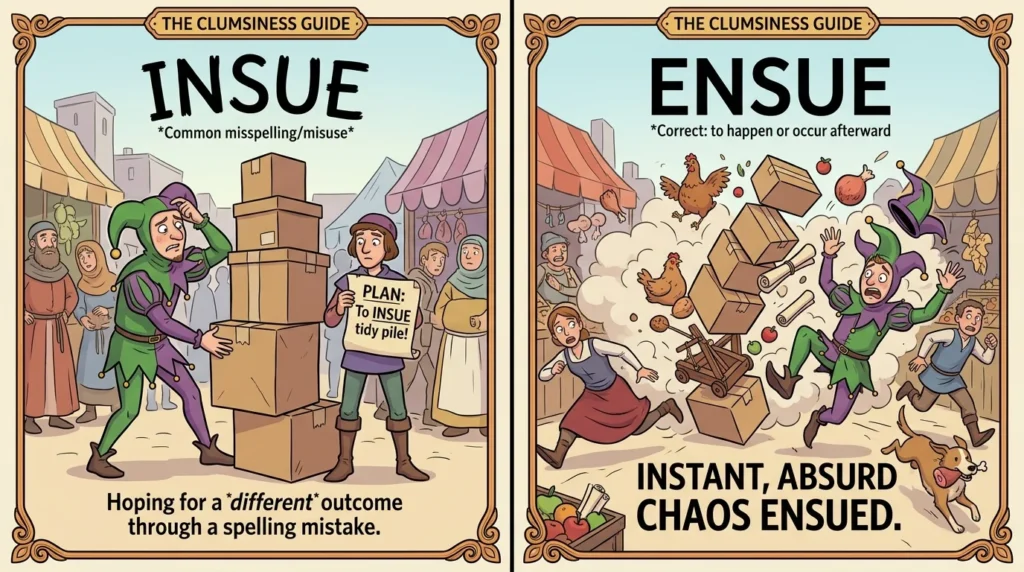
Ensue is the correct English word and means “to happen afterward” or “to occur as a result.”
Insue is not recognized as a standard English word and is considered a spelling mistake.
If you are writing in modern English, always use ensue.
What Does “Insue” Mean?
Definition
The word insue is not recognized as a standard English word in modern dictionaries.
In nearly all cases, it appears because someone accidentally misspells ensue.
Usage Rules
There are no accepted grammar rules for using insue because it is not considered a valid English word.
Examples
Incorrect examples:
- ❌ Chaos began to insue after the announcement.
- ❌ Several problems may insue if the policy changes.
- ❌ A heated debate insued among the participants.
Correct versions:
- ✅ Chaos began to ensue after the announcement.
- ✅ Several problems may ensue if the policy changes.
- ✅ A heated debate ensued among the participants.
Key Insight
If you write insue, most grammar checkers and editors will flag it as an error.
What Does “Ensue” Mean?
Definition
Ensue is a verb that means:
- To happen afterward
- To occur as a consequence
- To follow as a result of something
Usage Rules
Use ensue when describing events that happen because of a previous action or situation.
Examples
- Confusion ensued after the announcement.
- A lengthy discussion ensued.
- Several complications may ensue if the issue remains unresolved.
- Laughter ensued when the joke was told.
- Legal action could ensue from the dispute.
Key Insight
Ensue is often used in formal writing, journalism, business communication, legal documents, and academic texts.
Insue vs Ensue: Key Differences
Bullet Point Differences
- Ensue is a valid English word.
- Insue is a misspelling.
- Ensue means “to happen afterward.”
- Insue has no recognized meaning.
- Ensue appears in dictionaries and style guides.
- Insue should be avoided in all professional writing.
Comparison Table
| Feature | Insue | Ensue |
|---|---|---|
| Valid English Word | No | Yes |
| Dictionary Recognition | No | Yes |
| Meaning | None | To happen afterward |
| Professional Usage | Incorrect | Correct |
| Academic Writing | Incorrect | Correct |
| Example | Insue confusion | Ensue confusion |
Real-World Usage Scenarios
Scenario 1
❌ Confusion will insue if the instructions are unclear.
✅ Confusion will ensue if the instructions are unclear.
🎯 Lesson: Use ensue when something happens as a consequence.
Scenario 2
❌ Several arguments insued after the meeting.
✅ Several arguments ensued after the meeting.
🎯 Lesson: The past tense of ensue is ensued.
Scenario 3
❌ Chaos may insue during the transition.
✅ Chaos may ensue during the transition.
🎯 Lesson: Ensue commonly describes resulting events.
Scenario 4
❌ A discussion insued among the committee members.
✅ A discussion ensued among the committee members.
🎯 Lesson: Formal writing almost always uses ensued in this context.
Scenario 5
❌ Legal consequences could insue.
✅ Legal consequences could ensue.
🎯 Lesson: Ensue is frequently used in legal and professional language.
Common Mistakes
Mistake 1: Replacing “En” with “In”
Many people write insue because they assume the word begins with “in.”
Why It Happens
The pronunciation does not strongly emphasize the opening syllable.
Correction
Remember that the correct spelling begins with en-, not in-.
Mistake 2: Confusing Ensue with Pursue
Some writers mix up the spelling because both words end with “-sue.”
Why It Happens
The words share similar letter patterns.
Correction
Remember that ensue means “to follow as a result,” while pursue means “to follow or chase.”
Mistake 3: Avoiding the Word Entirely
Some writers avoid using ensue because they are unsure of its spelling.
Why It Happens
The word is more common in formal writing than in everyday conversation.
Correction
Learn its meaning and use it confidently when discussing consequences or resulting events.
Memory Tricks
Trick 1
Think:
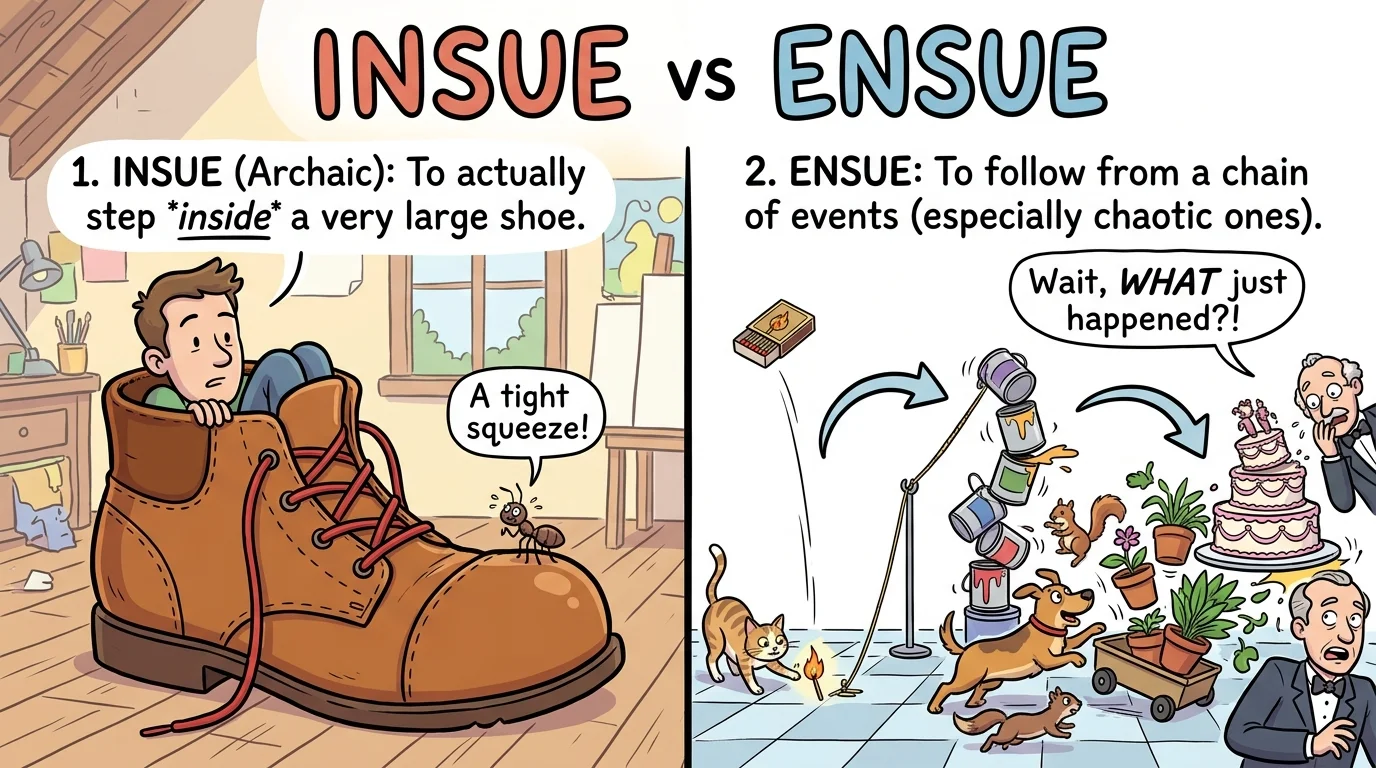
ENsue = Event Next
The letters EN can remind you that an event happens next.
Trick 2
Remember the phrase:
“What follows will ensue.”
This connects the word with the idea of something happening afterward.
Trick 3
If the sentence means “happen as a result,” the correct word is usually ensue.
Expert Insight
The word ensue originates from Old French and ultimately traces back to Latin roots associated with following or coming afterward. Over centuries, it became established in English as a formal verb used to describe events that occur as a consequence of something else.
Because the word appears frequently in news reports, legal documents, academic writing, and professional communication, maintaining the correct spelling is important. While insue occasionally appears online, it is simply a spelling error rather than an accepted variation.
For clear and professional writing, editors and style guides consistently recommend ensue.