

Quick Answer: Layed vs Laid
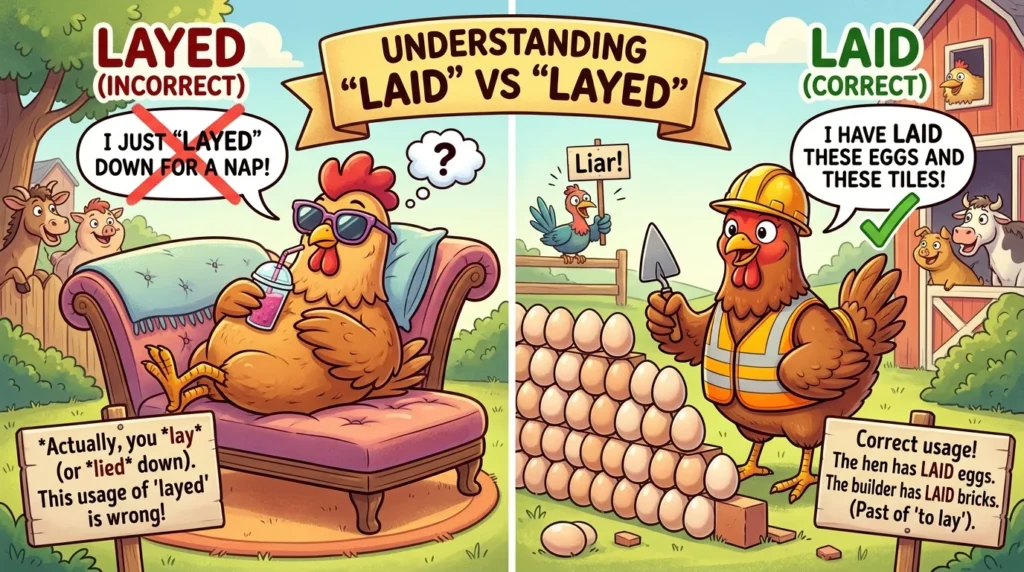
Laid is the correct past tense and past participle of the verb lay, which means to put or place something down.
Layed is generally considered a misspelling in modern English.
In short, use laid, not layed, when referring to the past form of lay.
Deep Explanation: Layed
Definition
Layed is a nonstandard spelling that people sometimes use when trying to form the past tense of lay.
Usage Rules
Many English verbs create their past tense by adding -ed:
- Play → Played
- Stay → Stayed
- Display → Displayed
Because of this pattern, some writers incorrectly assume:
Lay + ed = Layed
However, this assumption is incorrect.
Context
In modern English, dictionaries and style guides generally treat layed as a misspelling.
Examples
Incorrect:
- She layed the book on the desk.
- The chicken layed an egg.
- He layed his keys on the table.
Key Insight: Although layed looks logical, it is not the standard past form of lay.
Deep Explanation: Laid
Definition
Laid is the correct past tense and past participle of the verb lay.
The verb lay means to put, place, or set something down.
Usage Rules
Use laid whenever you are talking about something that was placed somewhere in the past.
Context
The word can be used literally and figuratively.
Literal meaning:
- Laid a book on the desk
- Laid bricks for a wall
- Laid an egg
Figurative meaning:
- Laid plans for the future
- Laid the foundation for success
- Laid blame on someone
Examples
- She laid the book on the table.
- The workers laid new flooring yesterday.
- The hen laid three eggs.
- They laid the groundwork for the project.
Key Insight: Whenever you mean “put” or “placed” in the past, laid is the correct word.
Layed vs Laid: Key Differences
Main Differences
- Meaning: Both attempt to express the past form of lay.
- Correctness: Only laid is standard English.
- Usage: Laid is used in both formal and informal writing.
- Grammar: Layed is generally considered incorrect.
- Common Mistake: Writers apply regular -ed spelling rules.
Comparison Table
| Feature | Layed | Laid |
|---|---|---|
| Meaning | Intended past form of lay | Correct past tense of lay |
| Standard English | No | Yes |
| Usage | Avoid | Use in all situations |
| Context | Nonstandard spelling | Formal and informal writing |
| Example | She layed the book down. ❌ | She laid the book down. ✅ |
Real-World Usage Scenarios
Scenario 1
Student: “I wrote, ‘I layed my notebook on the desk.'”
Teacher: “The correct word is ‘laid.'”
🎯 Lesson: The past tense of lay is laid, not layed.
Scenario 2
Employee: “I layed the files on your desk.”
Manager: “You should write ‘laid the files on your desk.'”
🎯 Lesson: Professional writing also requires laid.
Scenario 3
Friend: “Why isn’t it spelled layed?”
Friend: “Because lay is an irregular verb.”
🎯 Lesson: Not all English verbs form the past tense by adding -ed.
Common Mistakes
Mistake 1: Adding -ed Automatically
Incorrect thinking:
Lay + ed = Layed
Why it happens: Most verbs form the past tense by adding -ed.
Correction: The correct past form is laid.
Mistake 2: Confusing Lay and Lie
Many people mix up:
- Lay – to put something down
- Lie – to recline or rest
Why it happens: The verbs have similar forms.
Correction: Remember that laid comes from lay, meaning to place something.
Mistake 3: Assuming Both Spellings Are Acceptable
Why it happens: Both spellings appear logical.
Correction: Standard English recognizes only laid.
Memory Tricks
Trick 1: Remember the Phrase
You lay something down, and yesterday you laid it down.
Trick 2: Think of Common Expressions
- Laid the foundation
- Laid an egg
- Laid the book on the table
You will almost always see laid, never layed.
Trick 3: Remember Irregular Verbs
English contains many irregular verbs:
- Say → Said
- Pay → Paid
- Lay → Laid
The spelling changes instead of simply adding -ed.
Expert Insight
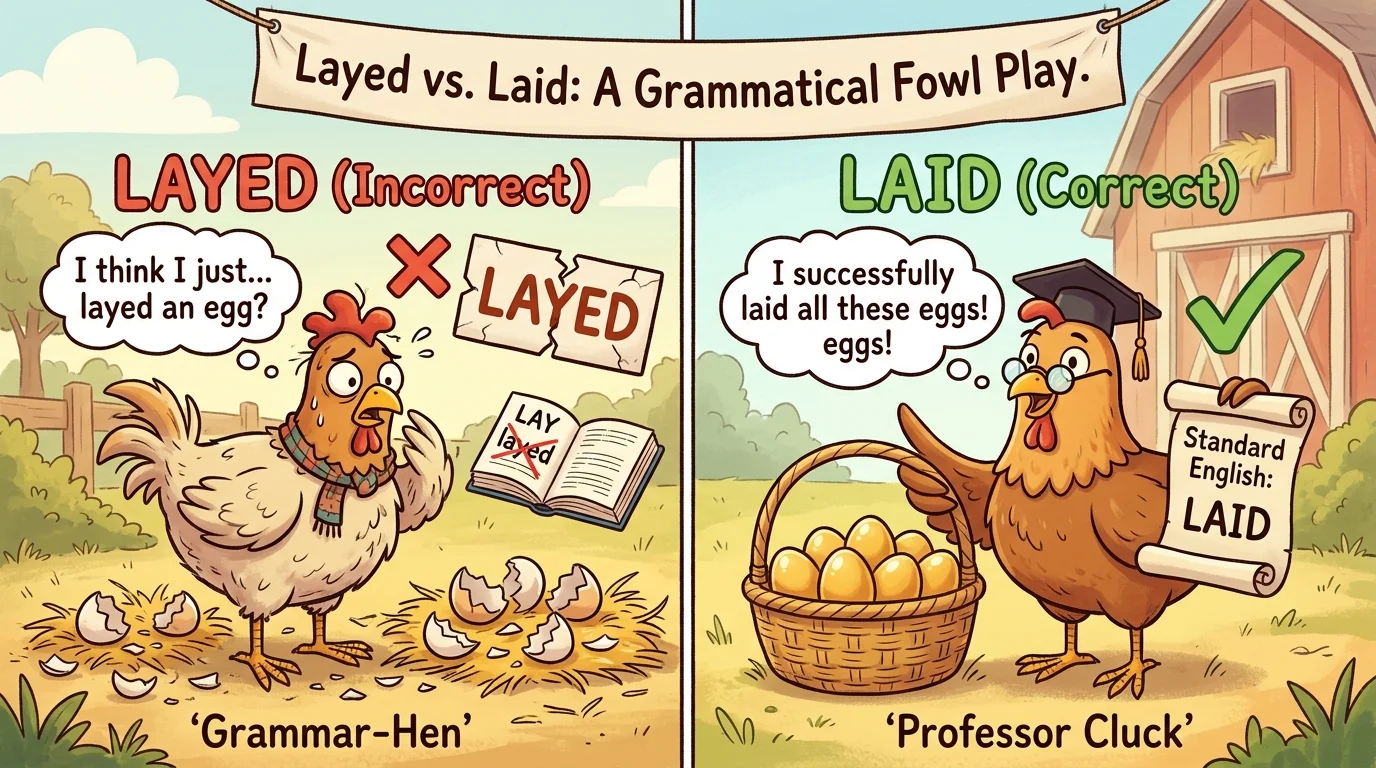
The verb lay comes from an older Germanic verb pattern that forms its past tense irregularly. Over time, English retained the form laid, much like pay became paid and say became said.
Because English preserves many historical spellings, laid remains the accepted past tense and past participle of lay, while layed is generally regarded as an error.