
Quick Answer
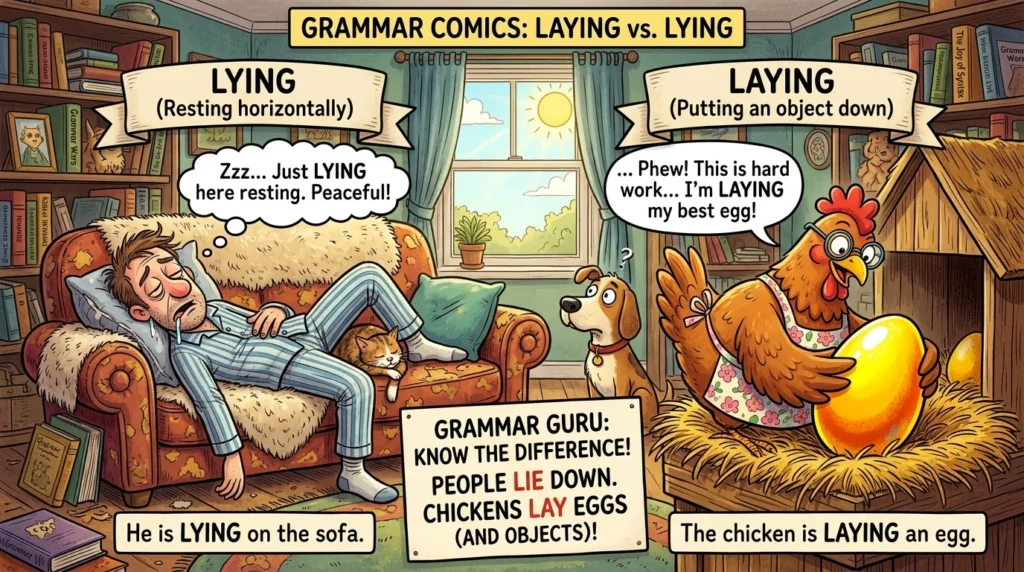
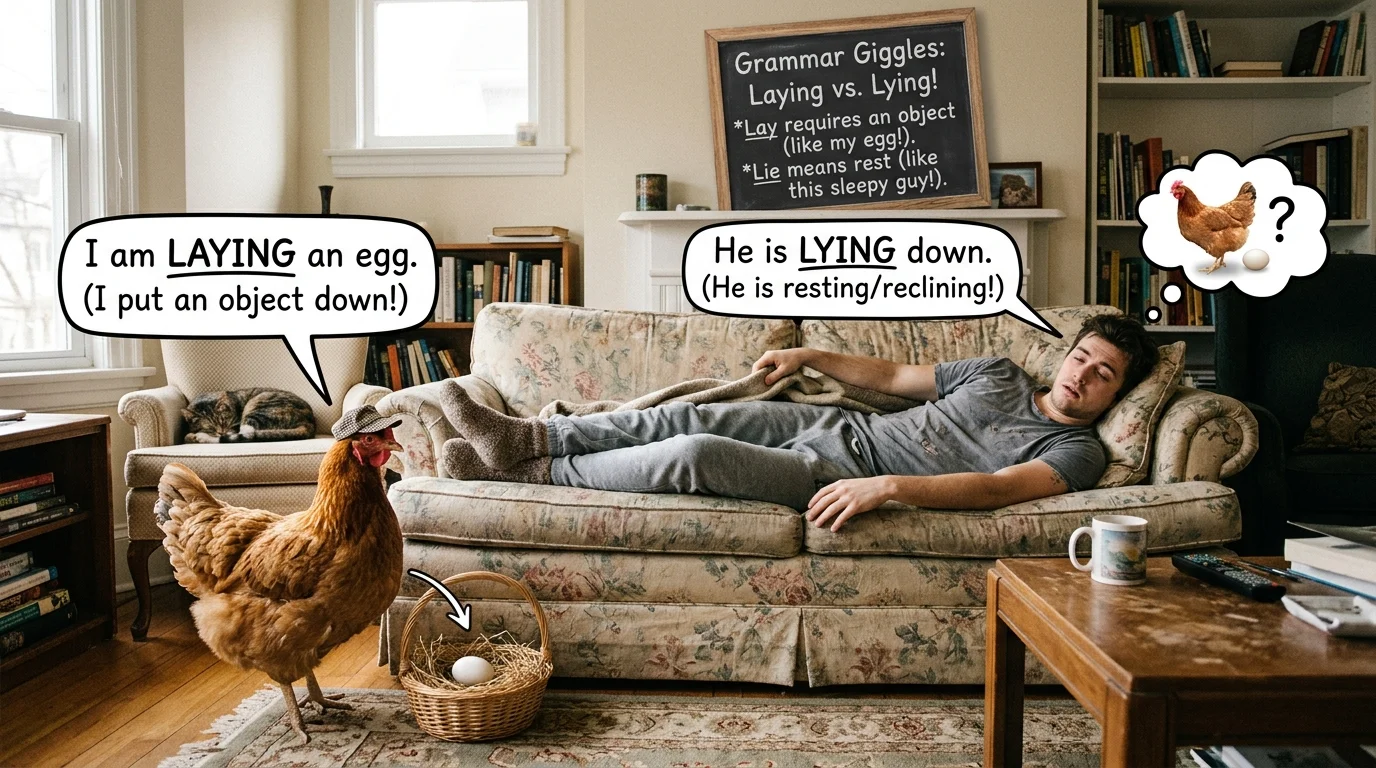
Laying is the present participle of lay, which means to put or place something somewhere. It usually requires a direct object.
Lying is the present participle of lie, which means to recline, rest, or be in a horizontal position. It does not take a direct object.
Simply put, you lay something down, but you lie down yourself.
What Does “Laying” Mean?
Laying means placing or putting an object somewhere. Since it comes from the verb lay, it normally requires something to receive the action.
Usage Rules
Use laying when:
- Putting an object down
- Placing something in a specific location
- Describing an action being done to something
Examples
- She is laying the books on the table.
- He is laying new tiles in the kitchen.
- The farmer is laying straw in the barn.
Key Insight: If you can ask, “What is being placed?”, then laying is probably the correct choice.
What Does “Lying” Mean?
Lying means resting, reclining, or being in a horizontal position. The person or thing is simply in that position and is not placing another object somewhere.
Usage Rules
Use lying when:
- Reclining on a bed or couch
- Resting in a horizontal position
- Describing where someone or something is resting
Examples
- She is lying on the sofa.
- The cat is lying under the tree.
- I spent the afternoon lying in bed.
Key Insight: If nobody is placing something, and someone is simply resting, use lying.
Laying vs Lying: Key Differences
Bullet Differences
- Meaning: Laying means putting something down; lying means resting or reclining.
- Function: Laying requires an object; lying does not.
- Action: Laying transfers an action to something else; lying describes one’s own position.
- Grammar: Laying is transitive, while lying is intransitive.
- Common Mistake: People often say “I am laying down” when they mean “I am lying down.”
| Feature | Laying | Lying |
|---|---|---|
| Meaning | Putting something down | Resting or reclining |
| Verb Base | Lay | Lie |
| Requires an Object? | Yes | No |
| Function | Action toward an object | Position or state |
| Example | She is laying the blanket on the bed. | She is lying on the bed. |
Real-World Usage Scenarios
Scenario 1
Incorrect: “I am laying on the couch.”
Correct: “I am lying on the couch.”
🎯 Lesson: If you are simply resting, use lying.
Scenario 2
Incorrect: “She is lying the plates on the table.”
Correct: “She is laying the plates on the table.”
🎯 Lesson: Since plates are being placed somewhere, use laying.
Scenario 3
Incorrect: “The dog is laying under the tree.”
Correct: “The dog is lying under the tree.”
🎯 Lesson: The dog is resting, not placing an object.
Scenario 4
Incorrect: “He is lying the baby in the crib.”
Correct: “He is laying the baby in the crib.”
🎯 Lesson: The baby is receiving the action, so use laying.
Scenario 5
Incorrect: “I spent the day laying in bed.”
Correct: “I spent the day lying in bed.”
🎯 Lesson: If you are resting in bed, the correct word is lying.
Common Mistakes
Mistake 1: Saying “I Am Laying Down”
Why it happens: Many native speakers use this phrase informally.
Correction: If you are resting, say I am lying down.
Mistake 2: Forgetting the Object Rule
Why it happens: The verbs have similar meanings and forms.
Correction: Ask yourself whether something is being placed.
Mistake 3: Confusing Verb Forms
Why it happens: The past forms of lay and lie are also irregular.
Correction: Focus first on the meaning: placing versus resting.
Memory Tricks to Remember the Difference
Trick 1
Laying = Putting.
Both words contain the letter P sound at the beginning.
Think:
Laying = Placing something.
Trick 2
Lying = Reclining.
Both words involve resting.
Think:
Lying = Lounging.
Trick 3
Ask yourself this question:
Is there an object?
- Yes → Use laying
- No → Use lying
Trick 4
Remember this simple rule:
You lay a book on the table, but you lie on the sofa.
Expert Insight
The confusion between laying and lying comes from the irregular nature of the verbs lay and lie. In modern English, even native speakers frequently mix them up in everyday conversation.
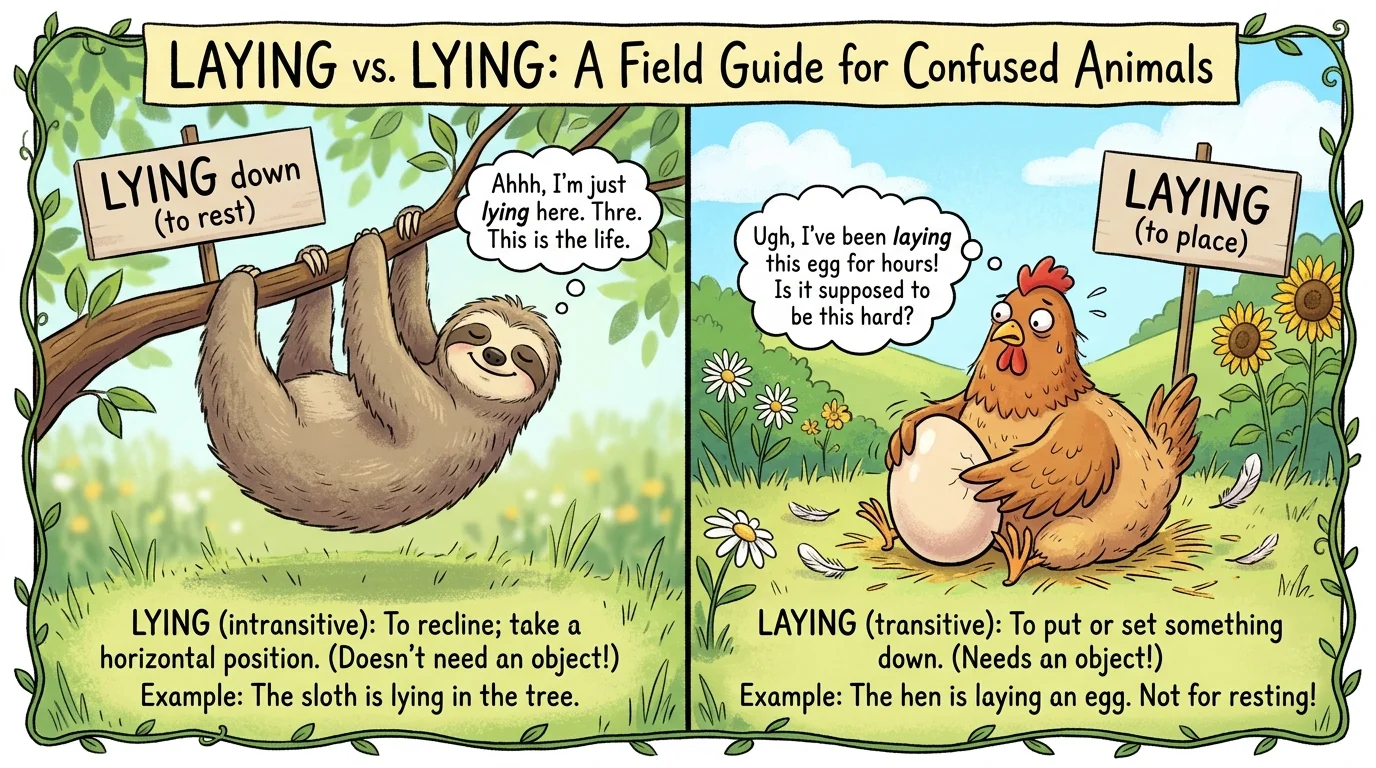
Grammatically, lay is a transitive verb because it requires an object. Lie is an intransitive verb because it does not act upon an object.
Professional writers and editors often rely on the object test. If something is receiving the action, they choose laying. If someone is simply resting or reclining, they use lying.