
Quick Answer
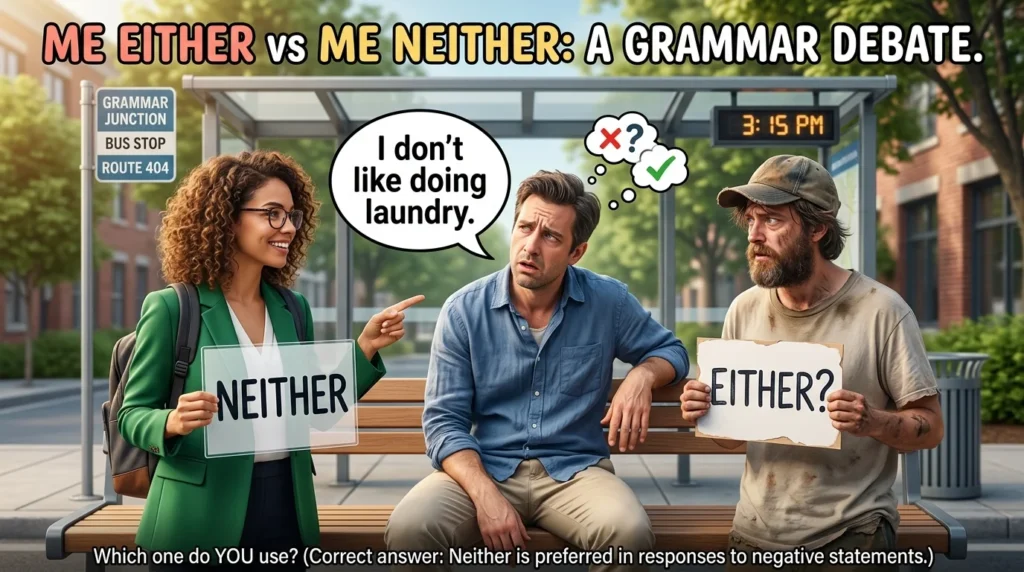
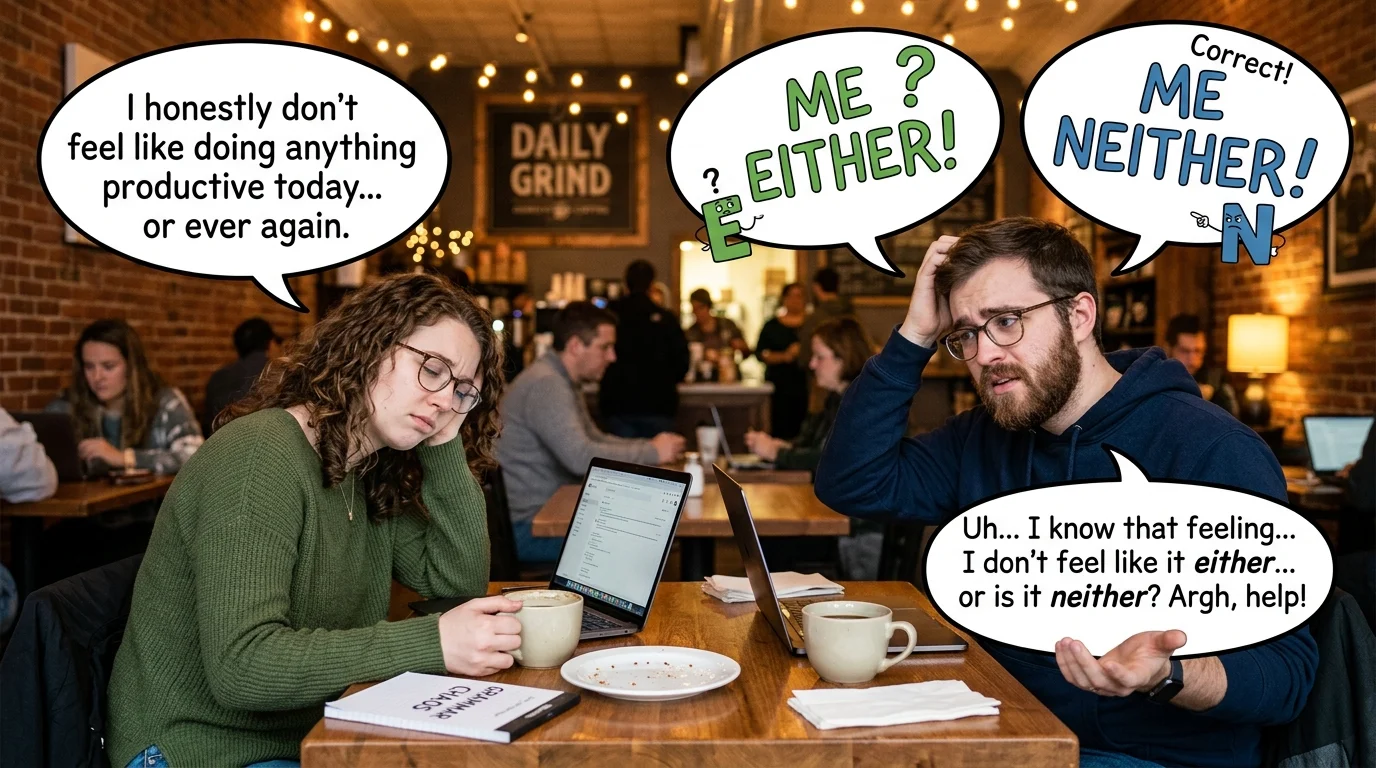
Me neither is the traditional and grammatically standard way to agree with a negative statement.
Me either is an informal expression commonly used in conversational English, especially in American English.
Examples:
Person A: I don’t like coffee.
Person B: Me neither.
Person A: I can’t swim.
Person B: Me either.
Both expressions are widely understood, but me neither is generally preferred in formal writing.
What Does Me Neither Mean?
Me neither is an expression used to agree with someone who has made a negative statement.
Definition
Me neither means:
- Neither do I.
- I also do not.
- The same negative statement applies to me.
Usage Rules
Use me neither when:
- Agreeing with a negative sentence
- Writing formally
- Speaking in standard English
Examples of Me Neither
- I don’t watch horror movies. — Me neither.
- I can’t drive. — Me neither.
- I haven’t seen that film. — Me neither.
- I don’t understand the question. — Me neither.
Key Insight
Me neither is essentially a shortened form of:
- Neither do I.
- Neither can I.
- Neither have I.
What Does Me Either Mean?
Me either is an informal expression that also agrees with a negative statement.
Definition
Me either means:
- I don’t either.
- I also do not.
- The same negative statement applies to me.
Usage Rules
Use me either when:
- Speaking casually
- Using conversational English
- Communicating informally with friends or family
Examples of Me Either
- I don’t eat spicy food. — Me either.
- I can’t stay late. — Me either.
- I haven’t been there before. — Me either.
- I don’t remember his name. — Me either.
Key Insight
Although me either is extremely common in spoken English, it is generally considered less formal than me neither.
Me Either vs Me Neither: Key Differences
Although both expressions agree with negative statements, they differ in formality and traditional grammar.
Quick Differences
- Me neither is traditionally and grammatically preferred.
- Me either is informal and conversational.
- Both express agreement with a negative statement.
- Both are widely understood in modern English.
| Feature | Me Either | Me Neither |
|---|---|---|
| Meaning | I don’t either | Neither do I |
| Formality | Informal | Standard and formal |
| Usage | Casual conversation | Writing and speech |
| Acceptability | Common in everyday speech | Traditionally preferred |
| Example | I don’t like tea. — Me either. | I don’t like tea. — Me neither. |
Real-World Usage Examples
Example 1
Friend: I don’t eat mushrooms.
You: Me neither.
🎯 Lesson: This is the traditional and grammatically preferred response.
Example 2
Friend: I can’t ski.
You: Me either.
🎯 Lesson: This is common in informal American English.
Example 3
Friend: I haven’t finished the book.
You: Me neither.
🎯 Lesson: The phrase means “Neither have I.”
Example 4
Friend: I don’t know the answer.
You: Me either.
🎯 Lesson: Casual conversations often use me either naturally.
Common Mistakes
Mistake 1: Using These Expressions After Positive Statements
Incorrect:
- I love pizza. — Me neither.
Correct:
- I love pizza. — Me too.
Why it happens: Both expressions only agree with negative statements.
Mistake 2: Thinking Me Either Is Always Wrong
Incorrect assumption:
- Me either is never acceptable.
Correct:
- Me either is widely accepted in informal speech.
Why it happens: Some grammar rules focus only on traditional usage.
Mistake 3: Using Me Either in Formal Writing
Less Formal:
- I don’t enjoy public speaking. — Me either.
More Formal:
- I don’t enjoy public speaking. — Me neither.
Why it happens: People often write exactly as they speak.
Memory Tricks
Trick 1
Neither naturally matches negative ideas.
Think:
Negative statement → Me neither.
Trick 2
Remember:
Me neither = Neither do I.
If you can replace it with Neither do I, it works perfectly.
Trick 3
For formal writing, simply remember:
Negative statement = Me neither.
Expert Insights
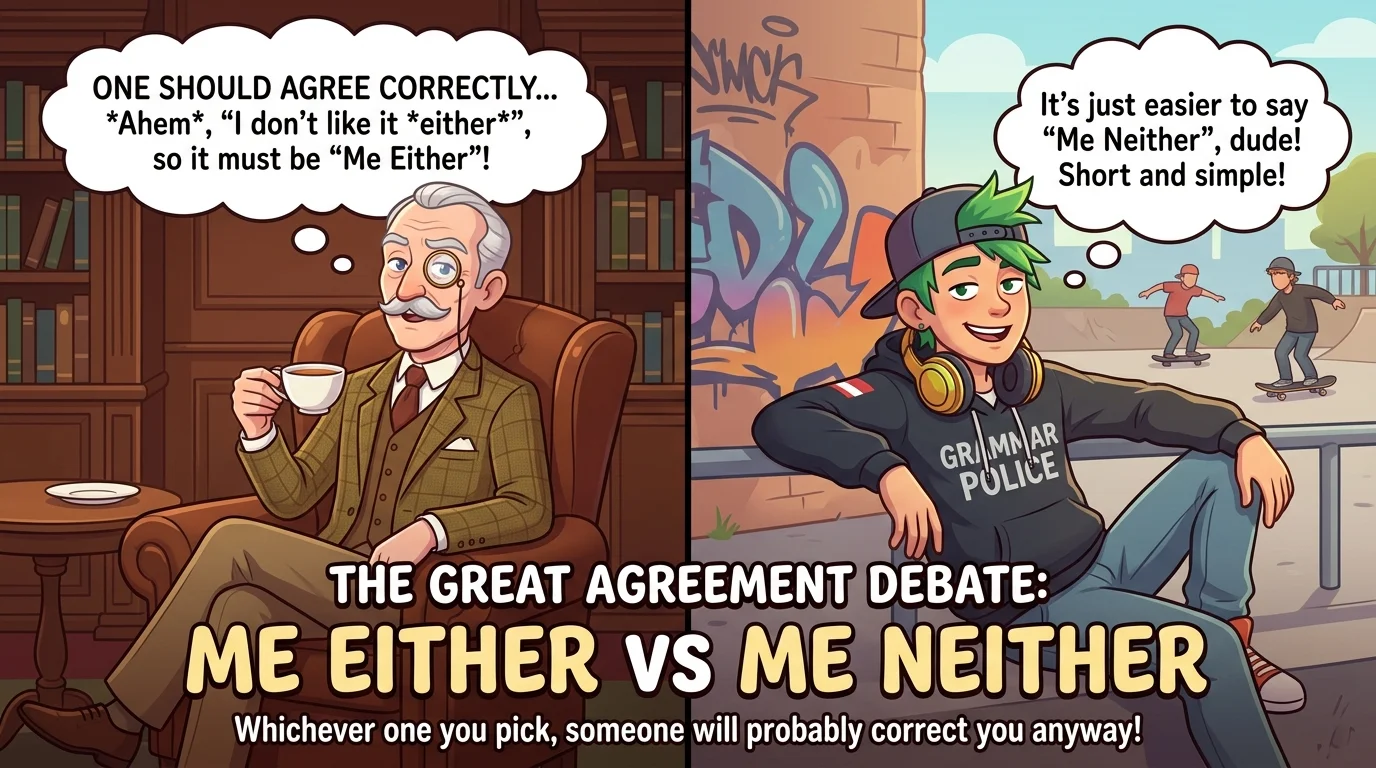
Traditionally, English grammar preferred me neither because it is an abbreviated form of structures like:
- Neither do I.
- Neither can I.
- Neither have I.
However, modern spoken English—particularly in the United States—has popularized me either. Linguists generally consider it a natural feature of conversational language rather than a grammatical error.
Today:
- Me neither remains the preferred form in formal and edited writing.
- Me either is extremely common in everyday speech and informal communication.
Understanding the difference allows you to choose the expression that best fits your audience and context.