
Quick Answer: Minuscule vs Miniscule
Minuscule is the correct spelling. It means extremely small, tiny, or insignificant in size.
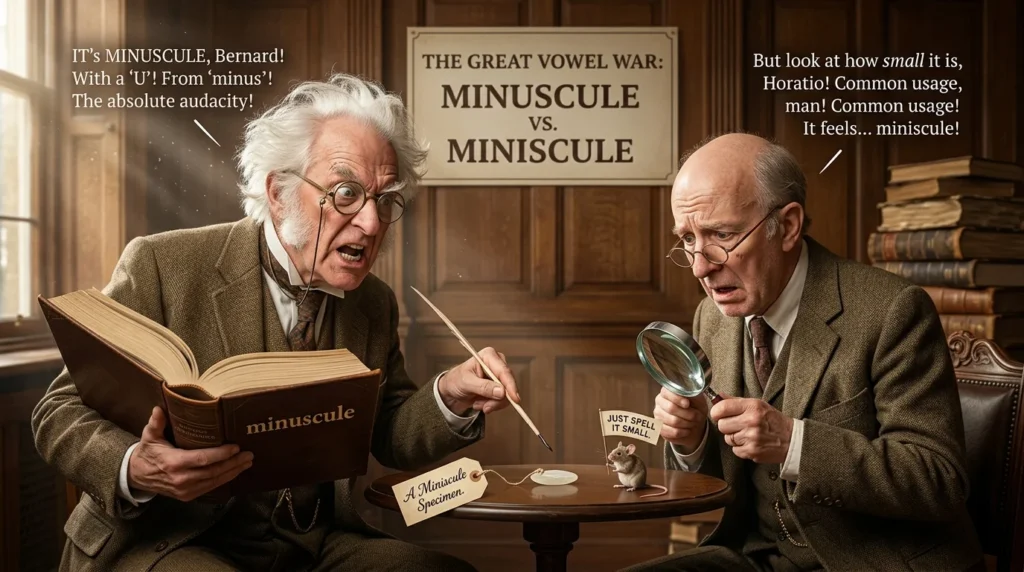
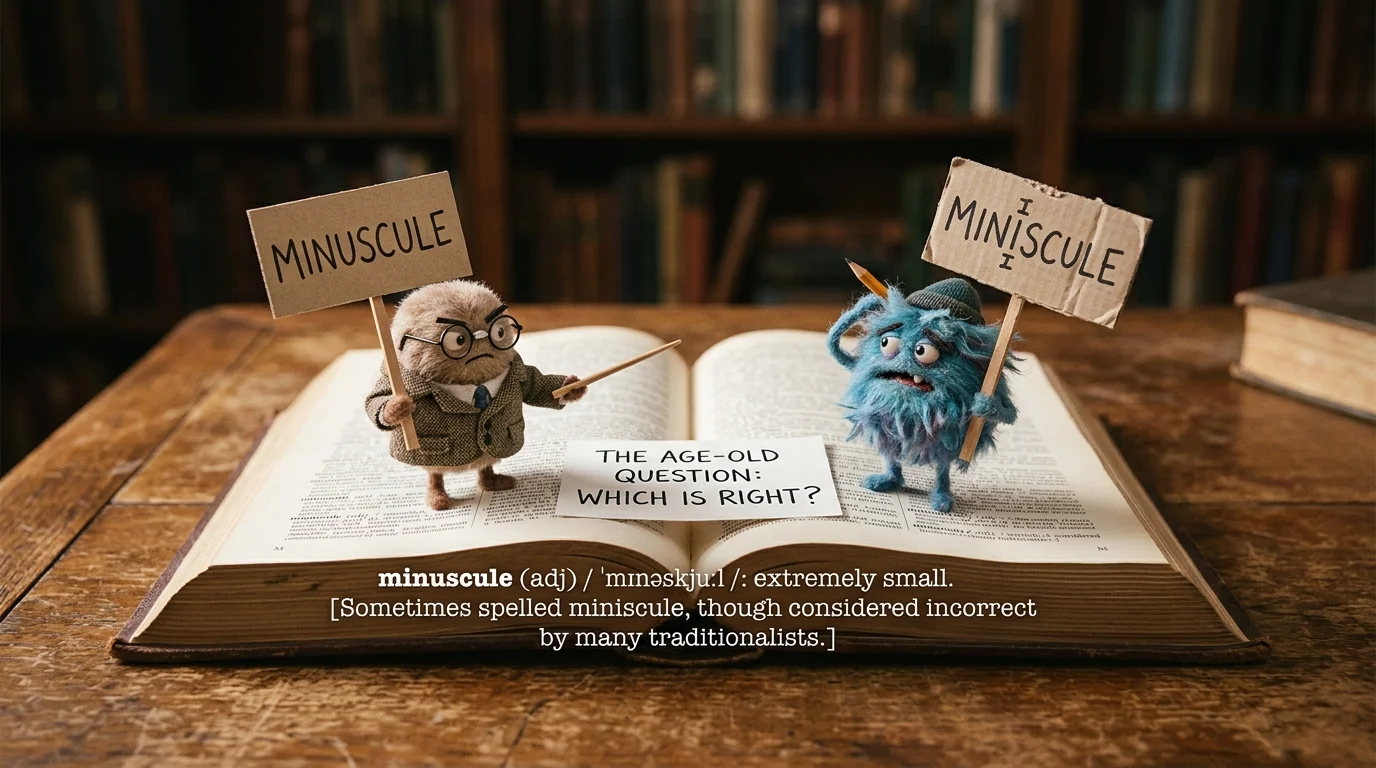
Miniscule is generally considered a misspelling of minuscule, although some dictionaries acknowledge it as a common variant because of widespread misuse.
Example
✔ The difference was minuscule.
✘ The difference was miniscule.
📌 In formal, academic, and professional writing, always use minuscule.
What Does Minuscule Mean?
Definition
Minuscule is an adjective that means:
- Extremely small
- Tiny in size
- Very insignificant
- Barely noticeable
Usage
The word commonly appears in:
- Academic writing
- Business reports
- Science articles
- Everyday conversation
- Journalism
Examples
- The error was minuscule and easy to overlook.
- Scientists observed a minuscule particle.
- The company’s profit increase was minuscule.
- There was only a minuscule chance of success.
Key Insight
Minuscule is the standard and correct spelling recognized by dictionaries and style guides.
What Does Miniscule Mean?
Definition
Miniscule is generally considered a misspelling of minuscule.
Because many people mistakenly pronounce the word with an “i” sound, the incorrect spelling has become relatively common.
Usage
You may encounter miniscule in:
- Typing mistakes
- Social media posts
- Informal online writing
- User-generated content
Examples
Incorrect:
- The change was miniscule.
- We found a miniscule amount of evidence.
Correct:
- The change was minuscule.
- We found a minuscule amount of evidence.
Key Insight
For professional and accurate writing, use minuscule, not miniscule.
Minuscule vs Miniscule: Key Differences
Quick Comparison
- ✔️ Minuscule = Correct spelling
- ❌ Miniscule = Common misspelling
- ✔️ Minuscule = Standard English
- ❌ Miniscule = Nonstandard variant
- ✔️ Minuscule = Preferred in formal writing
- ❌ Miniscule = Best avoided
Comparison Table
| Feature | Minuscule | Miniscule |
|---|---|---|
| Valid Standard Spelling | ✔️ Yes | ❌ No |
| Dictionary Preference | ✔️ Preferred | ❌ Usually listed as a variant |
| Formal Writing | ✔️ Correct | ❌ Avoid |
| Academic Writing | ✔️ Correct | ❌ Incorrect |
| Meaning | Extremely small | Same intended meaning |
| Example | Minuscule detail | Miniscule detail |
Why Is It “Minuscule” and Not “Miniscule”?
The word minuscule comes from the Latin word minusculus, meaning “somewhat smaller.”
Because of its Latin origin, the correct spelling contains “u” rather than “i” after the “n.”
Many people mistakenly write miniscule because they pronounce the word as:
“mini-skule”
This pronunciation leads to the common spelling error.
📌 The historical and dictionary-approved spelling is minuscule.
Real-World Usage Scenarios
Scenario 1: Business Report
Incorrect:
“The revenue increase was miniscule.”
Correct:
“The revenue increase was minuscule.”
🎯 Lesson: Business and professional writing should use minuscule.
Scenario 2: Scientific Research
“Scientists detected a minuscule particle.”
🎯 Lesson: Scientific publications use the standard spelling.
Scenario 3: Academic Essay
“The differences between the two studies were minuscule.”
🎯 Lesson: Academic writing favors the correct dictionary form.
Scenario 4: Everyday Conversation
“There is only a minuscule chance of rain.”
🎯 Lesson: The word often describes very small probabilities.
Scenario 5: Product Review
“The design changes are minuscule.”
🎯 Lesson: Use minuscule when describing tiny differences.
Common Mistakes
Mistake #1: Writing Miniscule Because It Sounds Correct
Many people spell the word exactly how they hear it.
✔ Correction: Remember the correct spelling is minuscule.
Mistake 2: Assuming Both Spellings Are Equally Acceptable
Some writers believe both forms are interchangeable.
✔ Correction: Most style guides strongly prefer minuscule.
Mistake 3: Using Miniscule in Professional Documents
Using the incorrect form may appear careless.
✔ Correction: Always use minuscule in formal writing.
Why This Happens
The pronunciation often tricks writers into replacing the u with an i.

Easy Memory Tricks
Trick 1: Think “Minus”
Minuscule comes from a root related to minus (smaller).
Both contain the letter u.
Trick 2: Remember the U
MinUscule = Correct
MinIscule = Incorrect
Trick 3: Connect It to Tiny Size
Think:
“A minuscule thing is so small that even the U stays hidden.”
Expert Insight: The Linguistic Origin
The word minuscule entered English through Latin and medieval writing traditions. It was originally used to describe small lowercase letters in manuscripts. Over time, the meaning expanded to describe anything extremely small or insignificant.
Although miniscule became a common misspelling because of pronunciation patterns, major dictionaries, editors, publishers, and educational institutions continue to recognize minuscule as the preferred spelling.
This makes minuscule the safest and most professional choice in all forms of writing.