
Quick Answer (Featured Snippet Target)
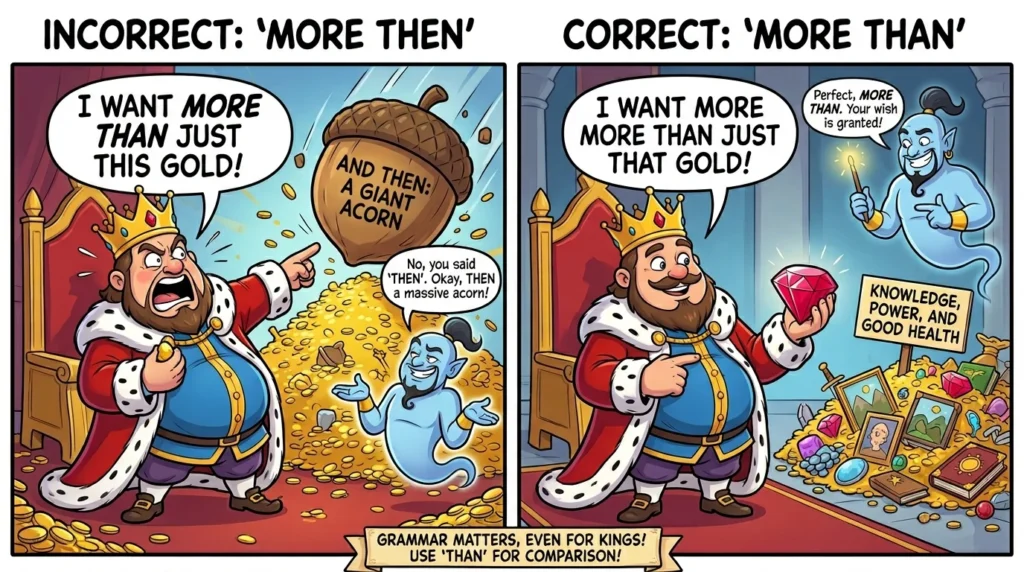
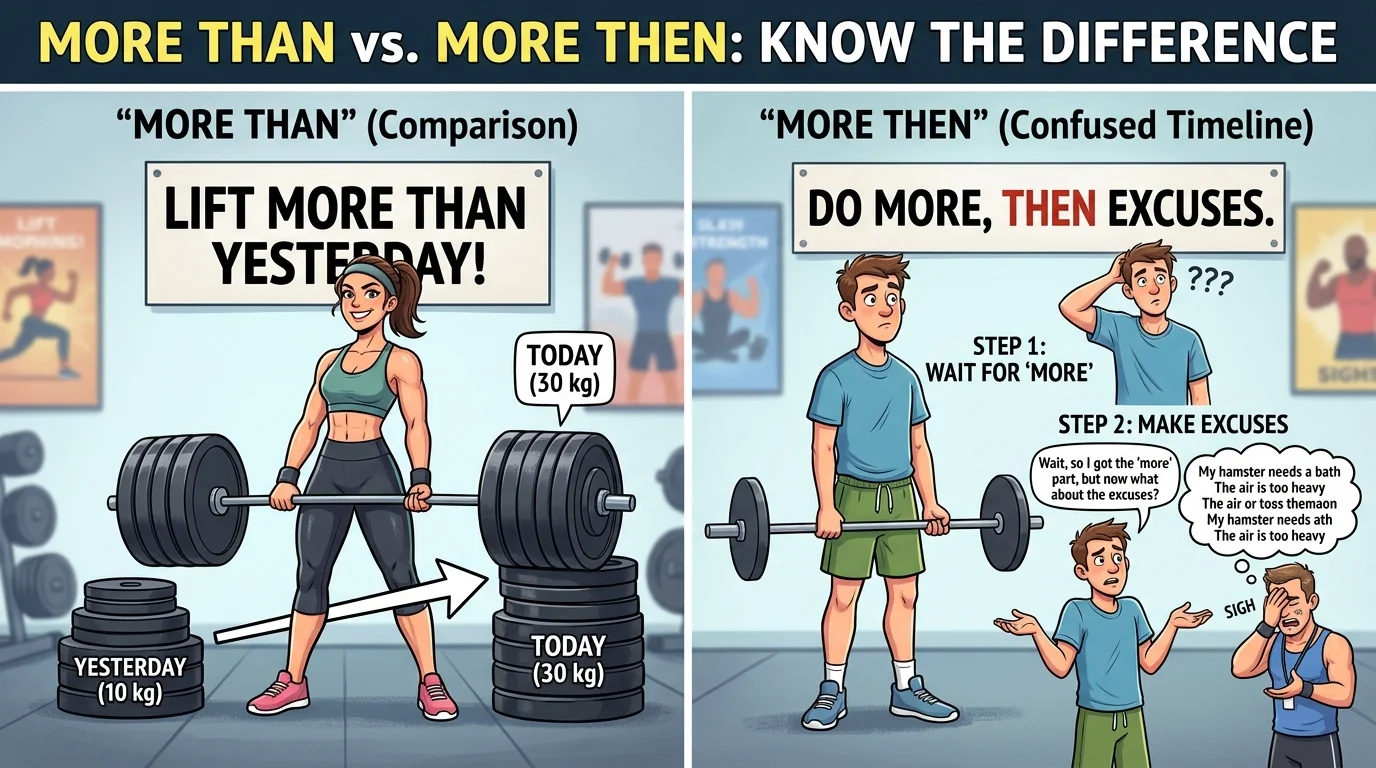
More than is the correct phrase when comparing quantities, amounts, numbers, or degrees.
More then is usually a grammatical mistake because then relates to time, sequence, or what happens next—not comparison.
✅ Correct: She has more than 100 books.
❌ Incorrect: She has more then 100 books.
What Does “More Than” Mean?
More than is a comparison phrase used to indicate a greater amount, quantity, number, degree, or level of something.
It is one of the most common comparison structures in English.
Usage Rules
Use more than when comparing:
- Numbers
- Quantities
- Amounts
- Sizes
- Degrees
- Levels
Examples
- I have more than twenty emails to answer.
- The project took more than three months to complete.
- She earns more than her colleague.
- This phone costs more than $500.
Key Insight
Whenever you’re expressing the idea of greater than, the correct phrase is almost always more than.
What Does “More Then” Mean?
The phrase more then is usually considered incorrect because then is not used for comparisons.
The word then refers to:
- Time
- Sequence
- Order of events
- What happens next
Examples of “Then”
- Finish your homework, then watch TV.
- Back then, things were different.
- We ate dinner and then went home.
Why “More Then” Is Usually Wrong
When people write:
❌ I have more then 50 dollars.
They are mistakenly using then instead of than.
The correct sentence is:
✅ I have more than 50 dollars.
Rare Exceptions
In very unusual sentence structures, more and then may appear next to each other by coincidence:
- We needed more, then decided to buy extra supplies.
Here, more and then are functioning separately, not as a fixed phrase.
More Then vs More Than: Key Differences
Difference at a Glance
- More than = comparison
- More then = usually a spelling error
- Than compares things
- Then refers to time or sequence
Comparison Table
| Feature | More Than | More Then |
|---|---|---|
| Meaning | Greater amount or quantity | Usually an error |
| Function | Comparison | Time or sequence word |
| Grammar Status | Correct | Usually incorrect |
| Common Usage | Very common | Rarely correct |
| Example | More than 10 people attended | Incorrect in comparisons |
Real-World Usage Scenarios
Scenario 1
❌ Incorrect:
“I’ve worked here for more then five years.”
✅ Correct:
“I’ve worked here for more than five years.”
🎯 Lesson: Use than when comparing time periods or quantities.
Scenario 2
❌ Incorrect:
“The car costs more then $20,000.”
✅ Correct:
“The car costs more than $20,000.”
🎯 Lesson: Prices require more than, not more then.
Scenario 3
❌ Incorrect:
“There were more then 500 visitors.”
✅ Correct:
“There were more than 500 visitors.”
🎯 Lesson: Numbers and quantities always use more than.
Scenario 4
Correct Use of Then:
“We finished the meeting and then went to lunch.”
🎯 Lesson: Then indicates what happened next.
Scenario 5
Correct Use of Than:
“This laptop is more powerful than the old one.”
🎯 Lesson: Comparisons require than.
Common Mistakes People Make
Mistake 1: Using Then for Comparisons
❌ More then 100 people attended.
✅ More than 100 people attended.
Why It Happens
The words sound similar when spoken quickly, causing spelling confusion.
Mistake 2: Mixing Time and Comparison Meanings
❌ She is taller then her sister.
✅ She is taller than her sister.
Why It Happens
Writers often remember the pronunciation but forget the grammatical role.
Mistake 3: Autocorrect Errors
Some typing tools fail to catch contextual mistakes because both words are correctly spelled.
Example:
❌ More then enough
✅ More than enough
Easy Memory Tricks
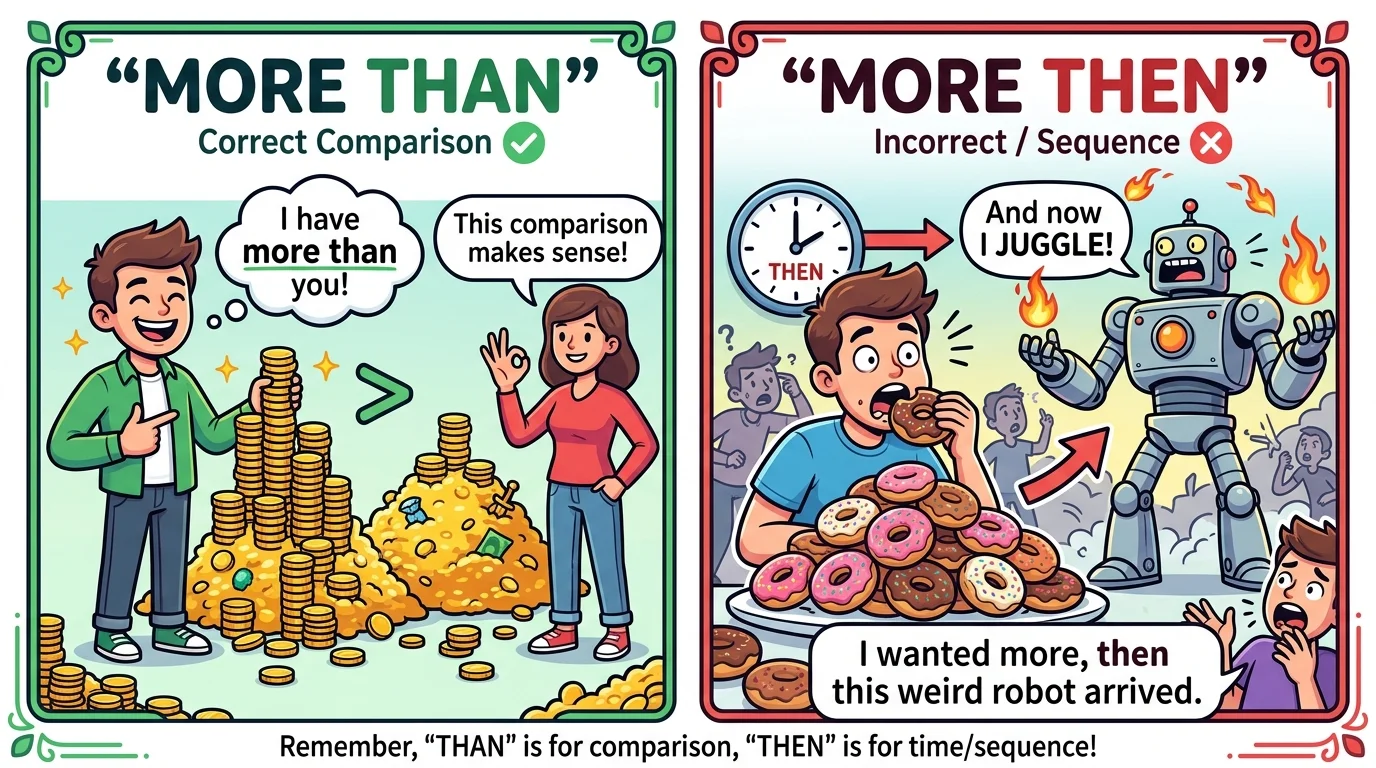
Trick 1: Than = Comparison
Think of the letter A in than.
A = Comparison of Amounts
Examples:
- More than
- Less than
- Greater than
- Better than
If you’re comparing, choose than.
Trick 2: Then = Time
Think of the letter E in then.
E = Events
Examples:
- First this, then that.
- Eat dinner, then relax.
- Back then.
If you’re talking about time or sequence, choose then.
Trick 3: Mathematical Connection
In mathematics:
- Greater than (>)
- Less than (<)
Notice that English comparisons also use than.
This makes more than easy to remember.
Expert Insight: Why English Uses “Than” for Comparisons
The word than has historically functioned as a comparison marker in English grammar. It evolved specifically to connect two things being evaluated against each other.
Examples:
- Bigger than
- Faster than
- More than
- Better than
Meanwhile, then developed as a time-related adverb referring to sequence and chronology.
Because their pronunciations are similar, they became one of the most commonly confused word pairs in modern English.
Understanding their grammatical roles eliminates nearly all confusion.