

Quick Answer (Featured Snippet Target)
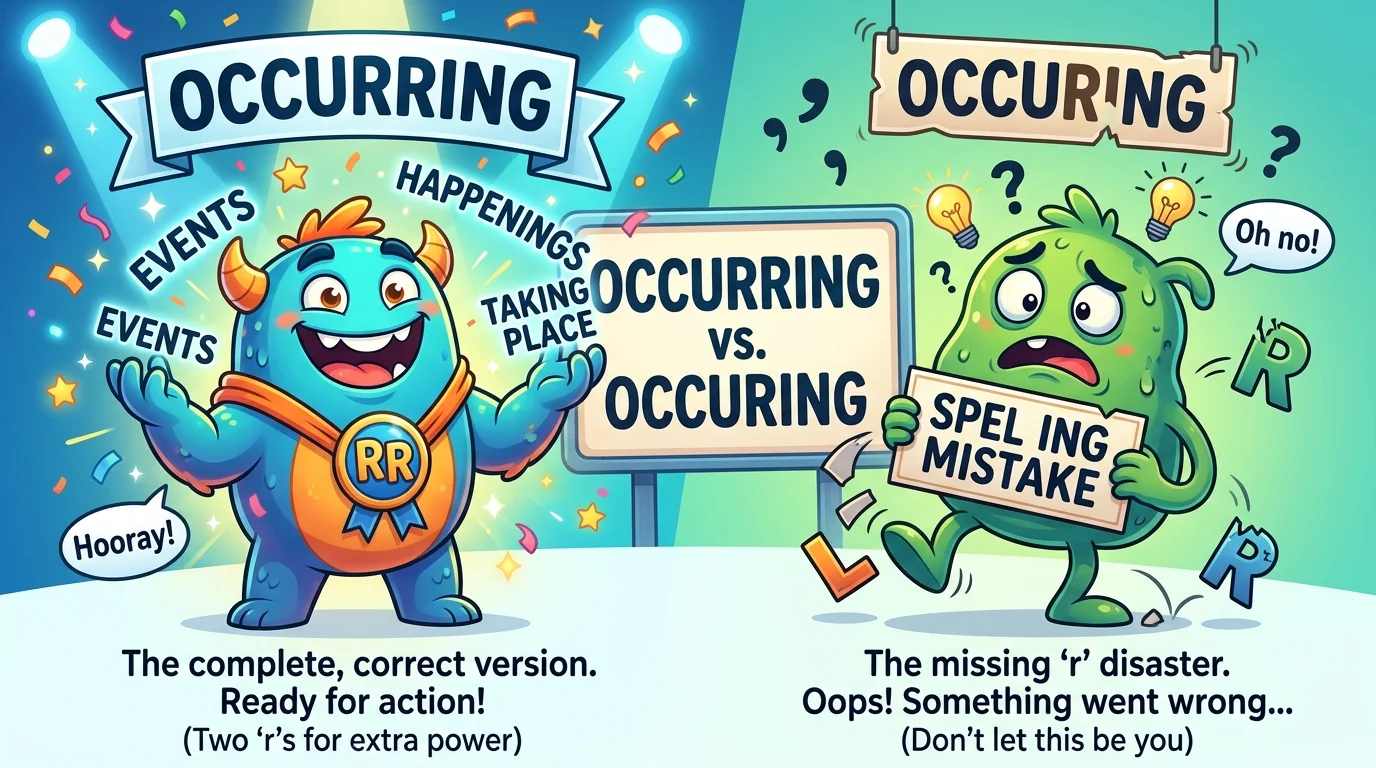
Occurring is the correct spelling.
Occuring is a misspelling and is not accepted in standard English.
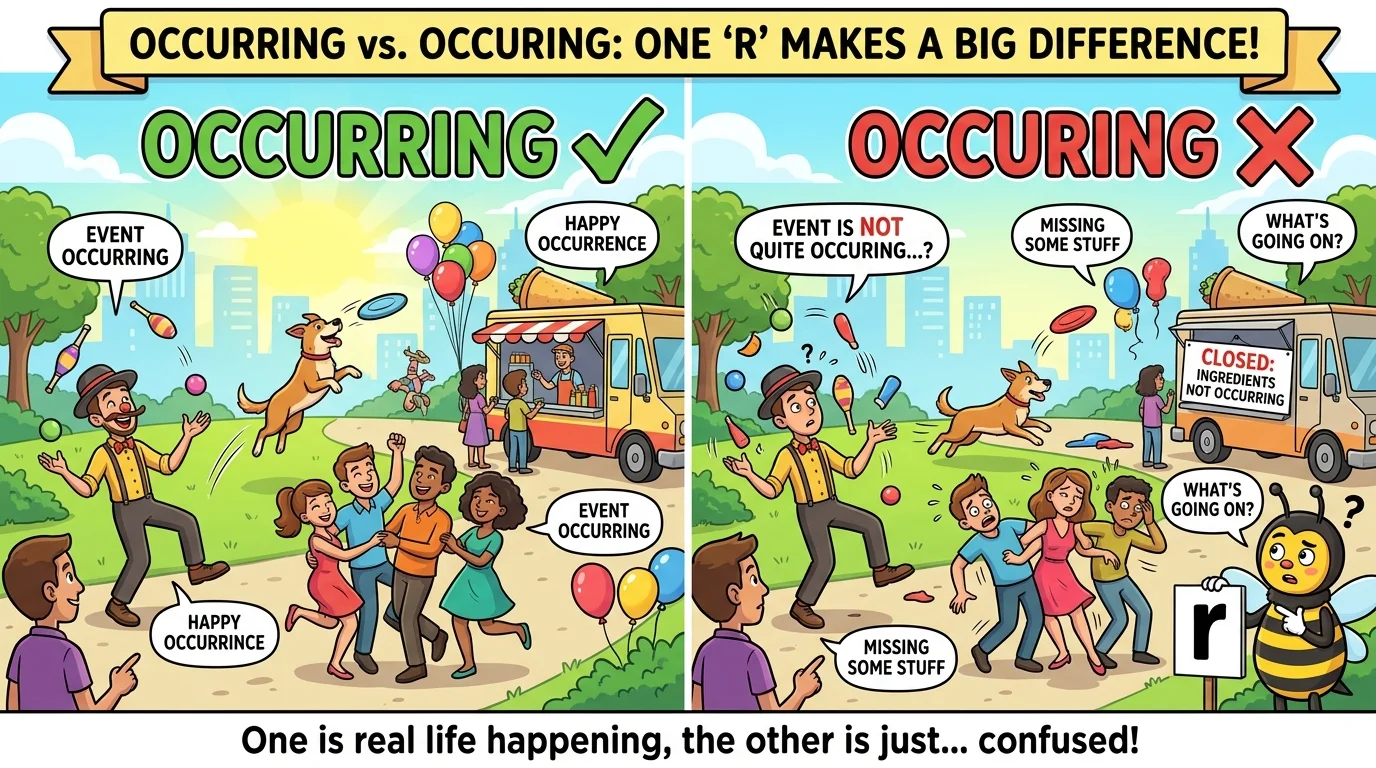
✅ Correct: A meeting is occurring right now.
❌ Incorrect: A meeting is occuring right now.
The word occurring contains two r’s because of a standard English spelling rule applied when adding -ing.
What Does “Occurring” Mean?
Occurring is the present participle and gerund form of the verb occur.
It means:
- Happening
- Taking place
- Existing
- Appearing
Usage Rules
Use occurring when describing something that is currently happening or taking place.
Examples
- Several events are occurring this weekend.
- The problem is occurring more frequently.
- A conference is occurring at the convention center.
- The changes are occurring gradually over time.
Key Insight
Whenever you need the -ing form of occur, the correct spelling is always occurring.
What Does “Occuring” Mean?
Occuring is an incorrect spelling of occurring.
It appears when writers forget to double the final r before adding -ing.
Why “Occuring” Is Wrong
The base word is:
Occur
When forming the -ing version, English spelling rules require the final consonant to be doubled:
Occur → Occurring
Not:
❌ Occur → Occuring
Key Insight
The missing second r is what makes occuring incorrect.
Why Does Occur Become Occurring?
English has a common spelling rule:
When a word:
- Ends with one vowel followed by one consonant
- Has stress on the final syllable
The final consonant is doubled before adding -ing.
Examples
| Base Word | Correct -ing Form |
|---|---|
| Occur | Occurring |
| Begin | Beginning |
| Prefer | Preferring |
| Admit | Admitting |
| Refer | Referring |
Because occur ends in a stressed -cur sound, the final r must be doubled.
Occurring vs Occuring: Key Differences
Difference at a Glance
- Occurring = correct spelling
- Occuring = misspelling
- Occurring follows English spelling rules
- Occuring omits a required letter
Comparison Table
| Feature | Occurring | Occuring |
|---|---|---|
| Meaning | Happening or taking place | Misspelling |
| Grammar Status | Correct | Incorrect |
| Dictionary Recognition | Yes | No |
| Professional Writing | Accepted | Not accepted |
| Example | The event is occurring today. | Incorrect usage |
Real-World Usage Scenarios
Scenario 1
❌ Incorrect:
“The issue is occuring repeatedly.”
✅ Correct:
“The issue is occurring repeatedly.”
🎯 Lesson: Always double the r before adding -ing.
Scenario 2
❌ Incorrect:
“Several changes are occuring in the market.”
✅ Correct:
“Several changes are occurring in the market.”
🎯 Lesson: Business and professional writing require occurring.
Scenario 3
❌ Incorrect:
“The error keeps occuring.”
✅ Correct:
“The error keeps occurring.”
🎯 Lesson: Grammar checkers often flag this mistake.
Scenario 4
Correct Usage:
“The festival is occurring annually.”
🎯 Lesson: Use occurring when describing recurring events.
Scenario 5
Correct Usage:
“A natural phenomenon is occurring offshore.”
🎯 Lesson: Scientific and formal writing use occurring.
Common Mistakes People Make
Mistake 1: Forgetting to Double the R
❌ Occuring
✅ Occurring
Why It Happens
Writers often assume adding -ing only requires attaching the suffix.
Mistake 2: Ignoring Stress Rules
❌ Occuring
✅ Occurring
Why It Happens
Many people are unaware that stressed final syllables often require consonant doubling.
Mistake 3: Typing Too Quickly
Because the double r isn’t strongly emphasized in pronunciation, it’s easy to leave one out.
Correct:
✅ Occurring
Incorrect:
❌ Occuring
Easy Memory Tricks
Trick 1: Occur Has a Double Future
Think:
Occur needs an extra R before it starts occurring.
Occur → Occurring
Trick 2: Remember Other Double-R Words
Compare:
- Refer → Referring
- Prefer → Preferring
- Occur → Occurring
The same pattern applies.
Trick 3: Count the R’s
The base word already ends in r.
Before adding -ing, add another r:
Occur + r + ing = Occurring
Expert Insight: The Linguistic Rule Behind Occurring
The spelling occurring follows a well-established English orthographic rule known as consonant doubling before suffixes.
When a verb ends with:
- A single vowel
- Followed by a single consonant
- With stress on the final syllable
The final consonant is doubled before adding endings such as:
- -ing
- -ed
- -er
This is why English uses:
- Occurring
- Occurred
- Referring
- Preferred
rather than forms with a single final consonant.
Understanding this rule helps writers correctly spell hundreds of similar words.